The Real Picture: How Much AI Has Already Changed Work in Brazil
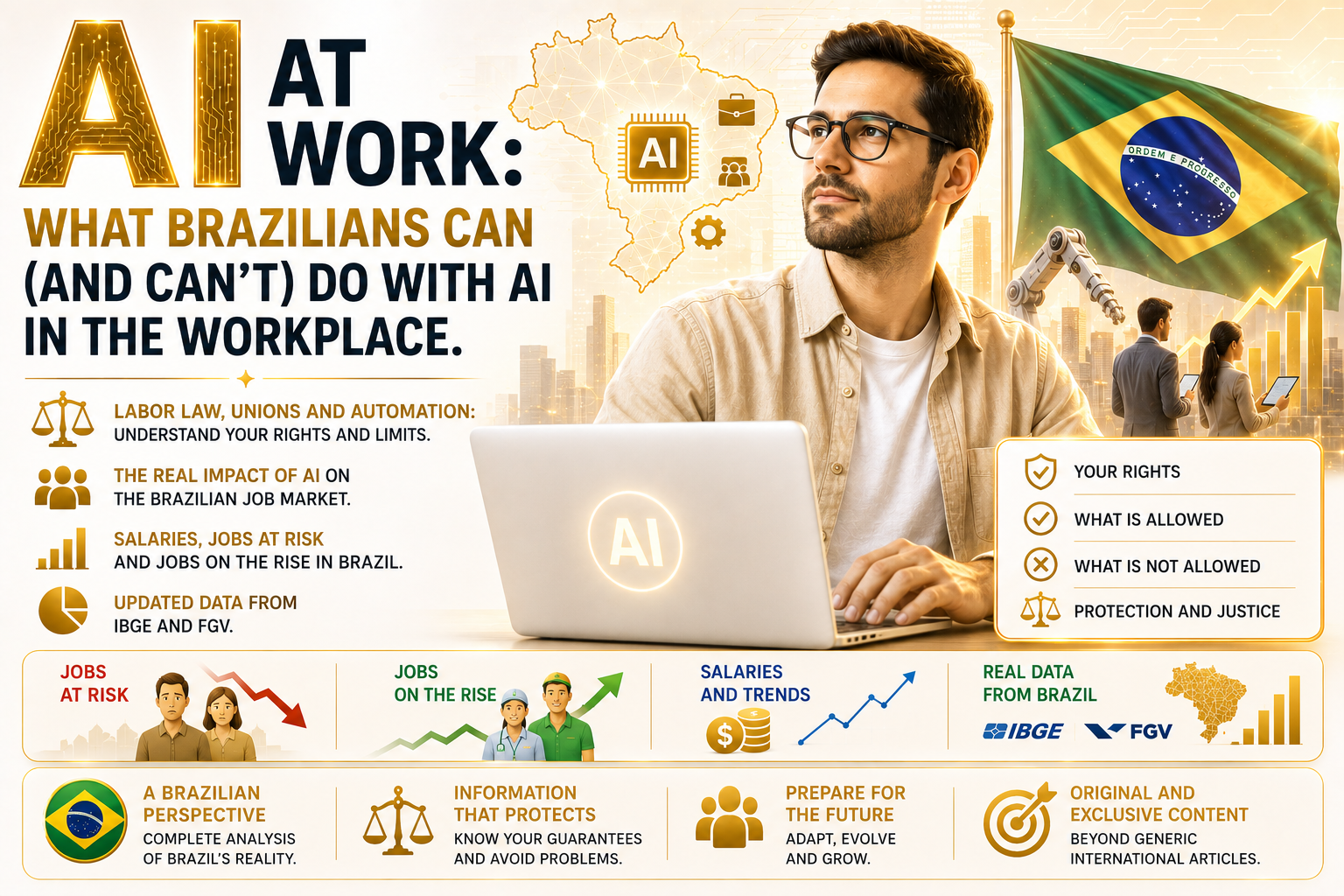
Before getting into rights and rules, it's worth understanding the scale of what's happening. According to IBGE's PNAD Contínua household survey, Brazil had roughly 103 million employed people in 2026, with unemployment between 5.1% and 5.6% — the lowest in years — and informality hovering around 38%. It's a hot labor market, but one being reshaped, at the same time, by one of the fastest technological transformations in recent history.
The other side of the picture comes from IBRE/FGV (the Getulio Vargas Foundation's economics institute), which applied the International Labour Organization's (ILO) methodology in Brazil to measure occupational exposure to generative AI. The result: roughly 31 million Brazilians are currently in roles with high exposure to automation, and about 30% of the country's occupations have some meaningful degree of exposure — close to the ILO's global average estimate of 25%. The services sector is the most affected, with over 80% of occupations exposed at some level, concentrated in administrative, accounting, legal, and customer-service activities.
It's easy to read "30% of occupations exposed" as "30% of jobs are disappearing." That's not what it means. The ILO study underlying FGV's Brazilian analysis estimates that only 5% to 6% of jobs worldwide are at risk of near-total replacement by generative AI. Most exposed occupations go through a transformation of tasks — some activities get automated, others get expanded — rather than the job itself vanishing outright.
A lesser-discussed side effect is the pressure on pay for mid-level technical roles. Activities like drafting standardized documents, basic administrative support, and simple data analysis — work that used to justify a technical-level salary — are now handled in seconds by software, which weakens the bargaining power of anyone still in those roles. It's this quieter shift, more than any single wave of layoffs, that's redrawing who earns more and who loses ground in Brazil's job market in 2026.
What Brazilian Labor Law Says (and Doesn't Say) About AI at Work
Brazil's Consolidação das Leis do Trabalho (CLT) — the country's core labor code — dates back to 1943. It doesn't contain a single line about algorithms, machine learning, or automated decision-making, and it couldn't have. That doesn't mean Brazilian workers are unprotected against AI at work, though. It means existing protections need to be interpreted in light of the new reality, combining the CLT with the Federal Constitution and, above all, with the LGPD (Brazil's data protection law).
The baseline: dismissal without cause, but not without cost
Here's a point that trips a lot of people up: in Brazil, with some exceptions (pregnant employees, safety-committee members, workers on injury-related job security, union representatives, among others), an employer doesn't need to justify a no-cause dismissal — they pay notice, a 40% severance fine on the employee's FGTS fund, and release the fund for withdrawal. That means, technically, a company can already use an AI system to decide who to lay off in a restructuring without that, by itself, being illegal. The real issue is how that decision gets made, and whether it violates other protections — like the ban on discrimination.
Harassment and constructive dismissal (CLT Article 483)
This is one of the most immediate — and least obvious — applications of Brazilian labor law to AI in the workplace: algorithm-generated targets that are systematically impossible to hit, continuous and invasive productivity monitoring, or automated pressure through off-hours notifications can constitute psychological harassment. When that happens, a worker has the right to request constructive dismissal under CLT Article 483 — effectively "dismissal caused by the employer's fault," which entitles the worker to the same payouts as a standard no-cause dismissal.
LGPD Article 20: the provision protecting workers most today
In the absence of a labor-specific AI law, the single most relevant legal provision for anyone evaluated or monitored by an algorithm at work is Article 20 of the LGPD, which guarantees the right to request review of decisions made solely through automated processing of personal data that affect the data subject's interests — including professional, personal, credit, and behavioral profiling decisions. An AI-generated performance review, automated résumé screening, and a productivity scoring system all fall under this umbrella. We cover the full scope of the LGPD in our guide to AI and Digital Privacy.
If you were let go as part of a round of layoffs "suggested" by an AI system and suspect the criteria used were biased or wrong, you can formally request that the company review the decision and explain the criteria used, based on LGPD Article 20. If the company refuses to provide that explanation, you can take the complaint to the ANPD (Brazil's data protection authority) and, depending on the case, to labor court.
Confirmed vs. Not Yet Confirmed: Where Workplace AI Regulation Is Headed
As with any area of digital law still under construction, it's essential to separate what already applies today from what's still a proposal, a debate, or a political promise. Mixing the two is the most common mistake we see among both workers and HR professionals.
Confirmed
- The LGPD already applies: the right to review automated decisions (Article 20) is already law and can already be invoked today, including in the employment context.
- The CLT and the Constitution already apply: harassment, discrimination, and constructive dismissal remain valid claims regardless of whether the decision was made by a human or an AI.
- PL 2338/2023 already classifies "employment and worker management" as a high-risk area. As we detail in our guide to Brazil's AI Law — still moving through Congress — AI systems used to hire, evaluate, or dismiss will require documentation, auditing, and mandatory human oversight once the bill passes.
- Brazil's Ministry of Labor and Employment has already put forward a public proposal called the "Digital Protection Network," championed by Minister Luiz Marinho, built on two pillars: a formal "right to explanation" whenever an algorithm is used to hire, dismiss, or evaluate performance, and a debate over an additional social-security contribution for companies that replace human jobs with AI at scale, meant to fund worker retraining.
Not yet confirmed
- Whether — and when — the "automation tax" becomes law. As of August 2026, it's a proposal under discussion at the Ministry of Labor, with no formal bill in Congress.
- The exact design of any such contribution — nothing has been settled on rates, criteria for "replacement at scale," or which sectors would be affected.
- Whether unions will get veto power or only consultation rights over the rollout of algorithmic management systems in collective bargaining — this point is politically contested.
- The final approval date for PL 2338 — as we cover in our guide to Brazil's AI Law, there's no statutory deadline for the floor vote in the Chamber of Deputies.
Headlines claiming "new law will ban AI firings" or "workers will get automatic compensation" that circulate on social media generally conflate proposals under debate with rules already in force. As of this article's publication, there's no Brazilian law that specifically bans the use of AI in hiring or dismissal decisions — what does exist is the requirement that those decisions comply with the LGPD, the CLT, and the Constitution.
What You CAN Do Today: Your Guaranteed Rights
Putting the points above into practical action, here's what's already your right today, regardless of any future law:
- Request an explanation: if a decision about your hiring, evaluation, or dismissal was made (fully or partially) by an automated system, you can formally request an explanation of the criteria used.
- Request human review: automated decisions that affect your interests can be challenged and reviewed by a person, not just re-confirmed by the same system.
- Report algorithmic discrimination: if you suspect a résumé-screening or performance-evaluation system reproduces bias based on race, gender, age, or origin, you can file a complaint with the ANPD (via the gov.br website) and seek support from your union.
- Request constructive dismissal in cases of algorithmic harassment: system-generated impossible targets, abusive monitoring, or disproportionate AI-driven pressure can justify constructive dismissal under CLT Article 483.
- Involve your union before accepting unilateral changes: rolling out a new AI-based management system that changes targets, hours, or how you're evaluated can — and in many sectors should — go through collective bargaining.
What Your Employer CANNOT Do With AI at Your Job
On the flip side, there are practices some Brazilian companies already use or are testing with AI that run into clear legal limits — even without a labor-specific AI law.
Monitoring without proportionality
Tracking productivity during work hours is legal and common. Monitoring personal communications, tracking location outside working hours, or using emotion recognition to gauge "engagement" in meetings, however, runs into labor-court case law on proportionality — and into PL 2338 itself, which classifies emotion recognition without legitimate justification as a prohibited use of AI.
Fully automated decisions with no human oversight in high-impact cases
Firing someone, denying a promotion, or applying disciplinary penalties based exclusively on an AI score, with no possibility of human review, conflicts with both the spirit of LGPD Article 20 and the mandatory human-oversight logic that PL 2338 sets out for high-risk systems in "employment and worker management."
Discrimination dressed up as "optimization"
A résumé-screening system trained on a company's historical hiring data can reproduce — and amplify — gender, race, or age bias that already existed in past hiring decisions, even without any explicit instruction to do so. That's not an isolated technical glitch: it's algorithmic discrimination, prohibited under the Constitution, the Consumer Defense Code (where applicable), and the LGPD.
Can your employer require you to use AI at work? Generally yes, as long as the tool fits your role and doesn't violate your privacy or dignity — refusing to use a legitimate work tool can amount to insubordination. Can AI decide who gets promoted on its own? It can influence the decision, but high-impact calls made with zero human oversight sit in a legal gray zone that's likely to tighten once PL 2338 passes. Can a union ban AI use in a given sector outright? Not in absolute terms, but it can negotiate specific clauses in collective agreements limiting how AI is used — and that's already happening in some sectors in Brazil.
Unions and AI: How Brazilian Labor Is Responding
Contrary to what many assume, Brazil's union movement isn't just reacting to AI — in some sectors, it's already negotiating. Labor federations like the CSB (Central dos Sindicatos Brasileiros) have been publicly discussing the issue, including a curious side effect: the operating cost of heavy AI use — particularly autonomous agents that execute tasks without constant human supervision — has pushed some companies to limit their own AI usage, which shifts the dynamics of negotiations.
The most concrete tool unions have today is the collective bargaining agreement. Sectors with a tradition of negotiating tech-related clauses — like bank workers, who have had specific automation clauses since branches were computerized in the 1990s — are adapting that history for the generative-AI era: advance-notice clauses before rolling out algorithmic management systems, employer-funded retraining guarantees, and explicit limits on using AI for individual performance evaluation.
For workers, the practical takeaway is simple: before passively accepting a process change "because the company decided to roll out a new AI system," it's worth asking your union whether the current collective agreement already has a specific clause on the topic — it often does, and it's often under-publicized.
Professions at Risk in Brazil: Where Automation Is Already Cutting Jobs
Surveys from the World Economic Forum, cross-referenced with Brazilian sector data, show a consistent pattern: the most vulnerable roles combine high standardization, low variability, and repetitive interaction with the public or with data.
| Role / Function | Sector | What's Already Changing |
|---|---|---|
| Call center / customer service agent | Customer service | Bots and smart IVR systems already handle a large share of end-to-end service interactions |
| Bank and grocery-store cashier | Retail and finance | Self-checkout, app-based payments, and increasingly digital-only banking shrink headcount |
| Data-entry clerk | Administrative | Robotic process automation (RPA) performs the task faster and with fewer errors |
| Administrative assistant (routine work) | Administrative | Scheduling, inbox triage, and standardized reports are already AI-automated |
| Accounting assistant (routine tax work) | Accounting | Automated reconciliation and e-invoicing cut down on manual filing |
If you want to dig deeper into which careers are expected to emerge and disappear in the coming years, our guide to AI and the Future of Work covers the full breakdown, profession by profession.
One important point: in almost every case above, what's disappearing is the mechanical task — not necessarily the entire career. Accountants with a consultative bent, capable of working on tax planning and compliance, remain in high demand; it's the purely operational profile that's losing ground. That migration — from mechanical execution to strategic analysis — is the most consistent trend among people tracking Brazil's job market in 2026.
Booming Professions and Salaries: Who's Winning From AI
On the other side of the same transformation, a narrow set of professions is experiencing the strongest salary growth Brazil's tech job market has seen in recent memory.
| Role | Salary Range (2026) | Why It's Booming |
|---|---|---|
| AI Engineer | R$8,000–12,000 (junior) up to R$30,000+ (senior) | The biggest salary jump in Brazil's job market in 2026, per LinkedIn and Robert Half surveys |
| Prompt Engineer | R$6,000–20,000+ | A new profession, requiring no specific degree, with growing demand outside tech roles |
| Data Scientist / Data Engineer | R$7,000–18,000 | Remains among the most sought-after roles for turning data into strategic decisions |
| Cybersecurity Specialist | R$8,000–22,000 | Growing need to monitor automated systems and prevent data leaks |
| Applied-AI Consultant (law, HR, marketing) | R$5,000–15,000 | Professionals from traditional fields who master applied AI earn up to 47% more than average, per Robert Half |
The standout phenomenon of 2026 might just be the prompt engineer: a role that requires no specific college degree, yet already pays starting salaries under Brazil's formal employment regime (CLT) between R$6,000 and R$12,000, climbing past R$20,000 at the senior level — and even higher for freelancers working on international projects billed in dollars. It's one of the rare cases where the barrier to entry dropped at the same time the salary ceiling rose.
Brazil vs. Other Countries: How Workplace AI Regulation Compares
Brazil isn't navigating this alone. Looking at what other countries have already done — or are about to do — helps put the Brazilian proposals in perspective: bold, timid, or simply in step with the rest of the world?
| Country / Bloc | Current Status | What It Covers |
|---|---|---|
| Brazil | LGPD in force; PL 2338 moving through Congress; Ministry of Labor proposals still under debate | Right to explanation (LGPD, already in force); "employment" as a high-risk category under PL 2338 (not yet passed) |
| European Union | The AI Act already classifies worker management as high-risk; the Platform Work Directive (2024/2831) must be transposed into national law by December 2, 2026 | Transparency around automated monitoring, mandatory human review of significant decisions, restrictions on biometric and emotional data use |
| Italy | One of Europe's pioneers on specific rules for remote monitoring ("controllo a distanza") and algorithmic management of platform workers | Transparency obligations and limits on remote performance control that predate the EU directive itself |
| United States | No federal law specific to the issue; regulation fragmented by state and city | Targeted laws, like Illinois' AI Video Interview Act and New York City's Local Law 144 on bias audits for AI hiring tools |
The pattern that emerges is clear: no country has "solved" this. The EU has the most advanced framework on paper, but member states are still in the process of transposing the directive into national law, racing a tight December 2026 deadline. Brazil, with PL 2338 and the Ministry of Labor's proposals, is heading in the same direction — just further back on the legislative timeline.
Common Mistakes (From Workers and Employers Alike)
In practice, the most frequent mistakes we see — from both the evaluated and the evaluators using AI — keep repeating:
- Assuming "it's just an algorithm" removes the employer's responsibility: it doesn't. The employer is accountable for an AI-assisted decision the same way it would be for an equivalent human decision.
- Not keeping records: if you suspect improper treatment by an automated system, screenshotting, saving emails, and noting dates is what makes a later labor claim viable.
- Employers rolling out AI systems with no advance notice or training: beyond the legal risk, this tends to generate more resistance and productivity loss than gain.
- Confusing task automation with whole-job automation: both employers and workers tend to overestimate how much of a given role can realistically be replaced in the short term.
- Ignoring the sector's collective agreement: before accepting (or rolling out) an AI-related change, it's worth checking whether a specific clause already exists.
Beyond What's Possible: Where This Could Go
Stepping outside the realm of established rules and concrete proposals, it's worth exploring — with both feet on the ground about what's plausible — where this transformation could head over the coming years.
Shorter workweeks funded by productivity gains: technically plausible, and already debated in some European countries; in Brazil, it would depend on sector-by-sector collective bargaining and is far from a national trend as of 2026.
Automation-linked basic income: a recurring theme in academic debates and isolated proposals from individual lawmakers in various countries, but with no mature Brazilian bill moving in that direction so far — this is long-term speculation, not a policy in progress.
AI replacing middle-management roles: technically further off than it might seem today. Software already helps organize teams and predict bottlenecks, but people-management decisions involve contextual judgment that, at least for now, remains largely human — even at heavily automated companies.
Everything in this section is speculation about possible futures, not a forecast or an established fact. None of these points are law, an advanced bill, or expert consensus — they're plausible medium-to-long-term scenarios meant to help frame the direction of the debate, not conclusions.
What to Do Right Now
Regardless of when (or whether) the Ministry of Labor's proposals become law and when PL 2338 gets a vote, there are actions that make sense today for anyone employed in Brazil.
If you're an employee
Find out whether your sector's current collective agreement already has a specific AI clause. Document any monitoring situation that feels disproportionate. And, above all, invest in skills that combine your existing field with applied AI — the Robert Half finding of up to 47% higher pay for people who master these tools isn't an isolated exception; it's a consolidated trend across virtually every sector, from law to marketing.
If you're a manager or business owner
Start documenting now the criteria used by any AI system involved in hiring, evaluation, or dismissal — it will save you time and legal risk once PL 2338 passes. Set up a real human-review channel for high-impact decisions, not just a pro-forma form. And take collective bargaining seriously: clauses negotiated today cost far less than labor liabilities tomorrow.
Conclusion: The CLT Wasn't Written for This — But It Still Protects You
Brazil's labor code is over 80 years old and never imagined an algorithm deciding who gets promoted or let go. Even so, combined with the Constitution and, above all, the LGPD, it already offers a real foundation of protection — the right to an explanation, to human review, to non-discrimination, and to constructive dismissal in cases of harassment didn't vanish just because part of the decision-making is now handled by a machine.
What's coming — PL 2338, the Ministry of Labor's proposals, new union clauses — will strengthen that protection, not create it from scratch. For Brazilian workers, the practical takeaway is twofold: you already have more rights than you might think when it comes to AI at work, and the time to build skills for the professions this same technology is rewarding is now, not after the dust settles.
Frequently Asked Questions (FAQ)
Technically, yes — in Brazil, a no-cause dismissal doesn't require formal justification, except in job-security cases. What the law already requires is that, if you ask, the company explain the criteria used and allow human review of the decision, under LGPD Article 20.
Not yet, not a dedicated "AI at work" law. What already applies is the combination of the CLT, the Federal Constitution, and the LGPD. PL 2338/2023, which classifies employment as a high-risk area, and the Ministry of Labor's proposals are still moving through Congress and under debate, respectively.
It's a public proposal from Minister Luiz Marinho, built around two main pillars: a formal "right to explanation" for algorithm-driven hiring, evaluation, and dismissal decisions, and a debate over an additional social-security contribution for companies that replace workers with AI at scale. As of August 2026, it's a proposal under discussion, not an approved law.
Yes, and it already happens in some sectors — like banking, which has had automation-related clauses since the 1990s. It's worth checking your sector's current collective agreement to see whether a specific AI-in-people-management clause already exists.
The most exposed roles combine standardized, repetitive tasks: call center agents, bank and grocery-store cashiers, data-entry clerks, routine administrative assistants, and accounting assistants doing mechanical tax work. The more consultative side of those same fields generally remains in demand.
It depends on your starting point. Fully pivoting into AI engineering usually takes 2 to 4 years of study and practice. Incorporating applied AI into your current field — law, marketing, HR, accounting — usually takes 6 to 12 months and already brings real salary gains, according to industry surveys.
Get the news before everyone else
AI, digital security, and technology — every week, straight to your inbox. No spam.