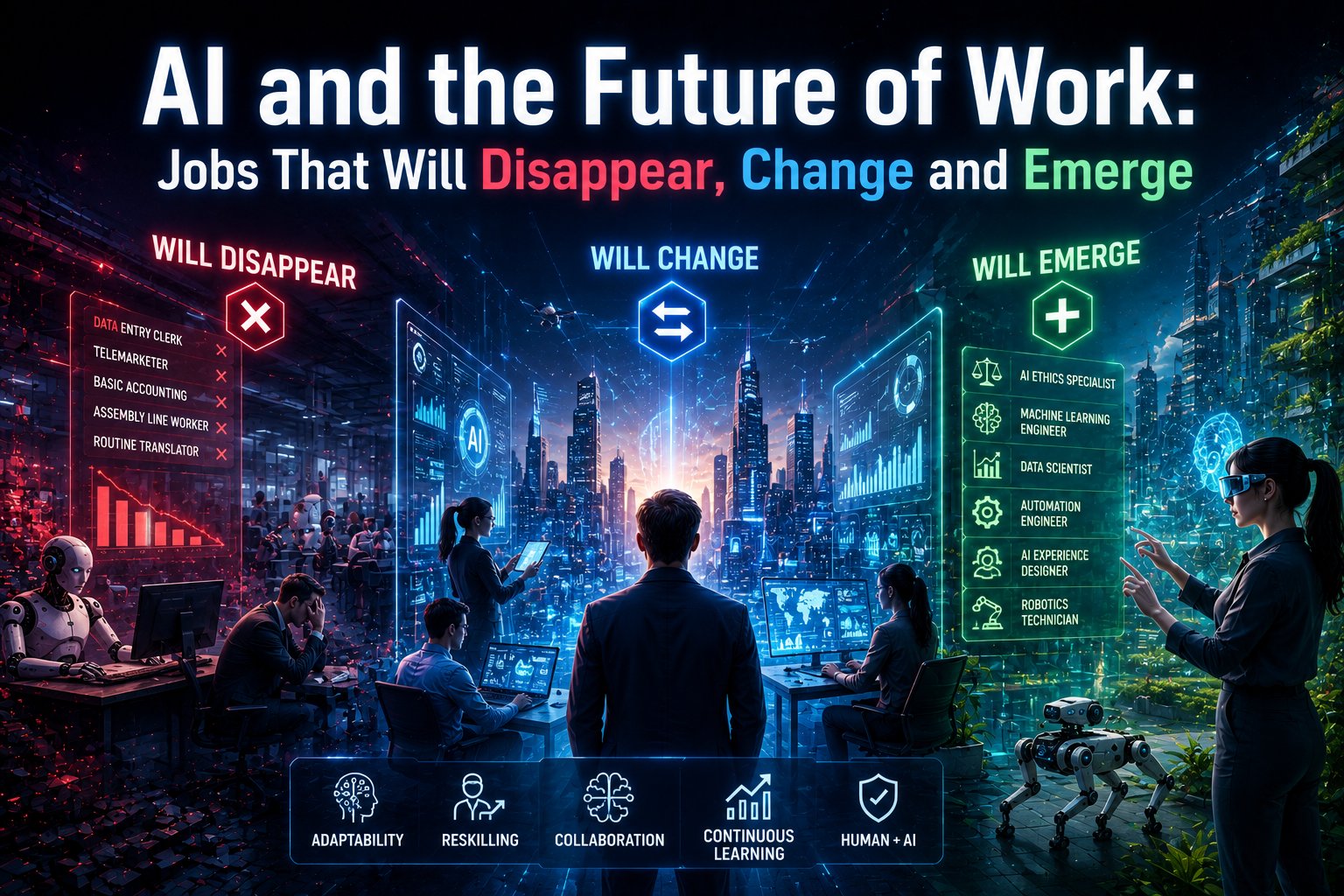
1. A Transformation Without Parallel — and Why This Time Is Different
Every major technological revolution was preceded by a wave of fear — and followed by a job expansion that no one predicted. The steam engine eliminated hand weavers and created railway engineers. Electricity destroyed the candle business and generated electricians, technicians, and factory operators. The internet wiped out physical encyclopedias, travel agencies, and video rental stores, but created web developers, e-commerce managers, and an entire digital economy that employs hundreds of millions of people globally.
Generative AI is different from those revolutions in one crucial way: it attacks cognitive work, not just physical work. Previous revolutions replaced muscles. This one is replacing parts of the reasoning process — writing, analysis, synthesis, translation, code, design. And that means no sector is immune. The lawyer, the doctor, the journalist, and the programmer feel the impact as much as the cashier or the data entry clerk.
The mistake of comparing to the past
Economists frequently argue that "it has always been this way" — that revolutions create more jobs than they destroy. And historically, that is true. But there is one detail this reassuring narrative omits: the time interval. The Industrial Revolution took decades to create the jobs it destroyed. The transition from agriculture to industry took generations. Generative AI matures exponentially — what took ten years of technological development now takes two. This leaves a much smaller adjustment window for workers, educational institutions, and governments.
The World Economic Forum estimates that 44% of professional skills will be disrupted in the next five years. But "disrupted skills" does not mean "unemployed workers" — it means workers who will need to learn new skills while still employed. The difference between who succeeds and who falls behind will depend, to a large degree, on the capacity for continuous learning.
2. What Is Happening Now: AI in the Real World
Before speculating about the future, it is useful to look at what is already happening in 2026 — because the transformation is not a distant threat. It is already underway, in concrete sectors, with tools that anyone can use today.
Customer service
AI chatbots based on GPT-4, Claude, and similar models already handle the majority of first-level contacts at companies like Bank of America, Amazon, Salesforce, and hundreds of others. These are not the frustrating DTMF menu bots of the past — they are systems that understand natural language, query real-time databases, resolve issues, and escalate to humans only when necessary. Companies that previously needed 500 agents now operate with 150, at equal or higher satisfaction scores.
Content creation
ChatGPT, Claude, Gemini, and Llama are already integrated into content creation workflows at agencies, newsrooms, and marketing companies. They are not replacing writers — they are changing what writers do. A content creator who previously produced 3 articles per week now uses AI to produce 10, reserving time for editorial curation, source reporting, and the creative angle that models still do not master.
Software development
GitHub Copilot, Cursor AI, and similar tools already write between 30% and 50% of some developers' code. Security firm Snyk published data showing that AI-assisted teams deliver features 55% faster. But — and this is the critical point — the developer is still the one who defines architecture, chooses technologies, reviews generated code, ensures security, and makes strategic decisions. AI writes the code; the human decides what the code needs to do and why.
Design and visual content
Midjourney, DALL-E 3, and Adobe Firefly have generated a visual design revolution. A company that previously hired three junior designers to create banner variations now uses an AI tool for that and employs one senior designer for oversight and creative direction. The volume of images produced has increased; the number of humans needed to produce them has decreased.

3. Jobs Most Threatened by AI
There is a simple rule for identifying which roles are most vulnerable: the more repetitive, predictable, and structured a task, the easier it is to automate. AI is extraordinarily good at patterns — and very poor at handling the unexpected, the emotional, and the contextually complex.
The following list does not describe professions that will disappear tomorrow, but roles where the number of professionals needed will decrease significantly over the next 5 to 10 years. Many will continue to exist — but will require fewer people to perform the same volume of work.
Why "threatened" does not mean "extinct"
A common mistake is to treat automation as a switch: either the profession exists, or it has been eliminated. The reality is far more gradual. Telemarketing will not disappear overnight — it will contract over years. Companies will reduce headcount at contract renewals, in expansion processes that previously increased staffing and now no longer do. It is a slow erosion, not a sudden extinction.
Workers in these roles therefore have time — but not unlimited time. The strategy of waiting to see is risky. The strategy of starting the transition now is significantly safer.
4. Jobs That Will Be Profoundly Transformed
This is, arguably, the most important and most misunderstood category. The popular narrative tends to polarize the debate: either AI replaces the profession, or it does not affect it. The reality is that most skilled professions will fall into a third category — profoundly transformed, but not eliminated.
Software developers and engineers
AI generates code. That is a fact. What it does not do, and will take much longer to do, is understand the business behind the code. A senior developer spends less than 30% of their time writing code — the rest is requirements meetings, architecture decisions, code review, security analysis, technical planning, and communicating with non-technical stakeholders. AI can drastically accelerate that 30% — and it already is. But the other 70% remains profoundly human.
The practical outcome: junior developers will face difficulty — because many entry-level tasks that served as a learning stage are now done by AI. Senior developers with architectural vision and strategic thinking have excellent prospects.
Physicians and healthcare professionals
AI already outperforms human radiologists in detecting certain types of cancer in imaging studies. This does not mean radiologists are unemployed — it means the best radiologists are those who use AI as a second opinion and can interpret the cases that AI flags as inconclusive. The physician who refuses AI does not compete with it — they compete at a disadvantage against the physician who uses it.
Lawyers and legal professionals
Legal research, contract analysis, and precedent review are tasks that AI does in minutes and that previously demanded hours from an associate or paralegal. Firms that adopt AI free up that time for strategic analysis, client relationships, and building sophisticated legal arguments. The parallel with developers is direct: the junior lawyer without a differentiator will struggle; the lawyer with strategic vision and strong relationships will see growing demand.
Teachers and educators
AI personalizes learning in ways that a teacher with 40 students in a classroom has never been able to achieve. Systems like Khan Academy with AI already adapt pace, language, and examples to each student individually. This does not eliminate the teacher — it frees the teacher from mechanical tasks (grading repetitive exercises, preparing standardized material) to focus on what only humans do well: motivation, mentoring, perceiving each student's emotional difficulties, building connection, and teaching critical thinking.
Journalists and communications professionals
AI already produces financial reports, sports game summaries, and weather bulletins at industrial scale. What it does not do is investigative journalism — source reporting, in-depth interviewing, the nose for a story that is not yet public, building trust with confidential sources, and interpreting the political and social context that turns raw data into a report that shifts public debate.
5. Jobs AI Will Struggle to Replace
There are categories of work where AI, even advanced, encounters fundamental barriers — not technical, but ontological. These are roles whose essence depends on human presence, genuine empathy, contextual judgment, or interpersonal trust accumulated over time.
| Role | Why AI cannot replace it | What changes |
|---|---|---|
| Psychologists and therapists | Therapeutic bond, embodied empathy, presence in human suffering | AI for records, research, and initial triage |
| Nurses and caregivers | Direct physical care, human comfort, situational clinical judgment | AI as diagnostic support and alert system |
| Business leaders | Strategic vision, organizational culture, political and relational navigation | AI as data analysis and scenario-planning tool |
| Entrepreneurs | Risk tolerance, creation of non-existent markets, investor relationships | AI accelerates validation and reduces cost of experimentation |
| Consultative sales professionals | Personal trust, reading non-verbal cues, complex negotiation | AI optimizes prospecting and prepares meeting context |
| Artists with distinct voices | Singular creative identity, lived perspective, artistic intention | AI as a production tool, not a creation tool |
| Social workers | Community context, crisis intervention, navigating bureaucratic systems with humanity | AI for case management and documentation |
The pattern in these professions is not coincidental: all involve what economists call "relational work" — activities whose value is intrinsically in the interaction between human beings. A person in crisis does not want to be supported by a chatbot. A client closing a ten-million-dollar deal wants to look in the eyes of the person who will deliver the result. An artist making intentional aesthetic choices does not want an algorithm deciding for them.
6. New Careers That AI Is Creating
The most underestimated part of the debate is this: AI is not only destroying and transforming jobs — it is creating entirely new professional categories. Some already exist and come with very high salaries. Others are emerging now. All tend to grow in the coming years.
7. The Most Valuable Skills in the AI Era
The question every professional should be asking is not "will my job end?" but "what skills make me more valuable in a world where AI handles parts of my work?" The answer is consistent across all research: the skills AI does not replicate well are precisely the ones that will become most scarce and therefore most valuable.
In the future, the competitive advantage will not be competing against AI — it will be knowing how to work alongside it. The professional who masters AI as a tool and combines that with genuinely human skills will be far more productive and valuable than either alone.
| Skill | Why AI cannot replicate it | How to develop it |
|---|---|---|
| Critical thinking | AI synthesizes; it does not question premises | Philosophy, debate, argumentation analysis |
| Original creativity | AI recombines; it does not innovate with purpose | Diverse experiences, artistic practice |
| Emotional intelligence | AI simulates emotion; it does not feel it | Therapy, mentorship, team leadership |
| Persuasive communication | AI speaks to everyone; humans speak to one person | Public speaking, writing, negotiation |
| Leadership and vision | AI optimizes; it does not inspire or define purpose | Project management, entrepreneurship |
| Continuous learning | AI has no motivation to learn what it was not trained on | Learning habits, active curiosity |
| Novel problem-solving | AI is strong on patterns; weak on the completely new | Complex problems without obvious solutions |
8. Sectors Poised for the Most Growth Through 2030
While some sectors contract, others expand. Identifying where growth will be concentrated is essential for anyone planning a career transition or investing in education and training.
- Artificial Intelligence and Machine Learning: still in early stages, with demand far outpacing supply of qualified professionals
- Cybersecurity: every new AI system creates new attack vectors; security demand grows proportionally
- Healthcare and biotechnology: population aging and AI-powered personalized medicine create enormous demand
- Renewable energy: the global energy transition creates millions of jobs in installation, maintenance, and smart grid management
- Digital education and professional training: mass reskilling requires teachers, platforms, and content at scale
- Robotics and industrial automation: technicians who program, maintain, and supervise industrial robots
- Cloud computing: all AI infrastructure runs in the cloud; cloud architects are in growing demand
- Specialized software development: focused on integrating AI into existing products and enterprise systems
9. Beyond What Is Possible: Still Fiction — But Maybe Not for Long
This section explores speculative scenarios grounded in real trends, but not yet reality in 2026. Some are probable. Others are distant. None is guaranteed.
AI as CEO
Firms like Gartner already project that by 2030 some organizations will experiment with "AI executives" — autonomous systems making strategic decisions based on real-time data. The startup NetDragon Websoft formally appointed an AI as CEO in 2022, on an experimental basis. Results were inconclusive. The real question: can an AI make decisions involving moral values, organizational culture, and long-term vision that contradict short-term data? Probably not, and this limitation will keep humans at the top of organizational hierarchies for a long time.
Work fully mediated by AI
Researchers at MIT and Stanford are working on models where AI agents conduct most of a project — research, coding, design, review — and humans only validate the final output. For simple software projects, this is already close to reality with tools like Devin. For complex and creative projects, the human is still needed at every step of the way.
Universal Basic Income as a response to technological unemployment
Sam Altman, CEO of OpenAI, has stated that Universal Basic Income (UBI) may become necessary if AI displaces jobs at a scale sufficient to destabilize the labor market. Several Nordic countries are running UBI experiments. If AI automation truly eliminates jobs in mass — which is still debated among economists — pressure for some income distribution mechanism will become unavoidable.
10. The Key Risks of This Transformation
No honest analysis of the AI-driven future of work can ignore the very real risks that accompany this transformation. They are serious, documented, and deserve equal attention to the opportunities.
- Concentrated technological unemployment: the impact will not be distributed equally. Low-income workers without access to reskilling will be most vulnerable — amplifying already existing inequalities
- Country-level inequality: nations with industrial economies dependent on cheap labor may suffer more than economies already advanced in high-value services
- Technological dependence: critical systems controlled by AI create vulnerabilities — an attack or failure can paralyze entire sectors
- Misinformation at industrial scale: deepfakes, AI-generated fake news, and financial market manipulation via AI are real and growing threats
- Workplace surveillance erosion of privacy: AI systems in work environments can monitor productivity, communications, and employee behavior at a level never previously possible
- Power concentration: very few companies control the most powerful AI models, creating an unprecedented economic and political imbalance
- Cultural homogenization: if all content creation passes through AI models trained on the same data, there is a risk of impoverishment of creative diversity
Conclusion: AI Will Not End Jobs — It Will End Inertia
Artificial Intelligence will not trigger a mass extinction of jobs overnight. What it will trigger — and is already triggering — is the elimination of professional inertia as a life strategy. The idea that a single degree serves an entire 40-year career became obsolete decades ago; with AI, it is simply no longer an option.
The professions that disappear are the most predictable and repetitive. Those that survive and thrive combine genuinely human skills with mastery of AI tools. And the new careers emerging are, for the most part, tied to the very development, auditing, application, and supervision of AI.
The question every professional should answer today is not "will AI replace me?" but "what do I do that AI cannot — and what could I do far better if I used AI as a tool?" Those who answer that question well, and act on it, will have more opportunities in the job market than at any other point in history.
Frequently Asked Questions (FAQ)
The most vulnerable are highly repetitive and predictable roles: basic-level telemarketing, data entry clerks, simple standardized translators, cashiers, and tier-1 support agents. But "disappear" rarely means sudden extinction — it means a gradual reduction in the number of professionals needed to perform the same volume of work, over 5 to 15 years. Workers in these roles have time — but not unlimited time.
Not entirely. AI already writes code and is reducing demand for junior developers in mechanical tasks. But system architecture, security, strategic technology decisions, and communication with non-technical stakeholders remain profoundly human. Senior developers with systemic vision have excellent prospects. Junior developers without a differentiator will face growing difficulty — because AI is now doing much of what they used to do to learn the craft.
The main ones are: Prompt Engineer, AI Trainer, AI Auditor, AI Ethics Specialist, Automation Manager, AI Consultant, AI-Generated Content Curator, and AI Agent Developer. The last one tends to have the most accelerated growth in coming years, as autonomous agents become standard corporate tools.
Four practical actions: 1) Learn to use AI as a tool in your current field — don't wait for your employer to teach you; 2) Invest in hard-to-automate skills: critical thinking, communication, leadership, and creativity; 3) If your role is highly repetitive, begin a gradual transition now toward areas with a greater human component; 4) Consider education in growth areas: cybersecurity, data science, healthcare, renewable energy.
Historically, technological revolutions have created more jobs than they destroyed. The World Economic Forum projects that AI will displace 85 million roles by 2025, but create 97 million new ones. The real problem is not the net balance — it is the transition interval. Jobs destroyed happen faster than new ones are created and learned. Workers currently in the 40–55 age range may not have sufficient reskilling time without public policy support.
Not replaced — transformed. AI already outperforms humans in imaging diagnosis for certain specific exam types, and already does legal research in minutes that previously took hours. But contextual clinical judgment, the physician-patient relationship, legal strategy, and courtroom representation remain profoundly human. The physician who uses AI will treat more patients with greater accuracy. The lawyer who uses AI will prepare more robust cases in less time.
Get the news before everyone else
AI, future of work, technology, and careers — every week, straight to your inbox. No spam.