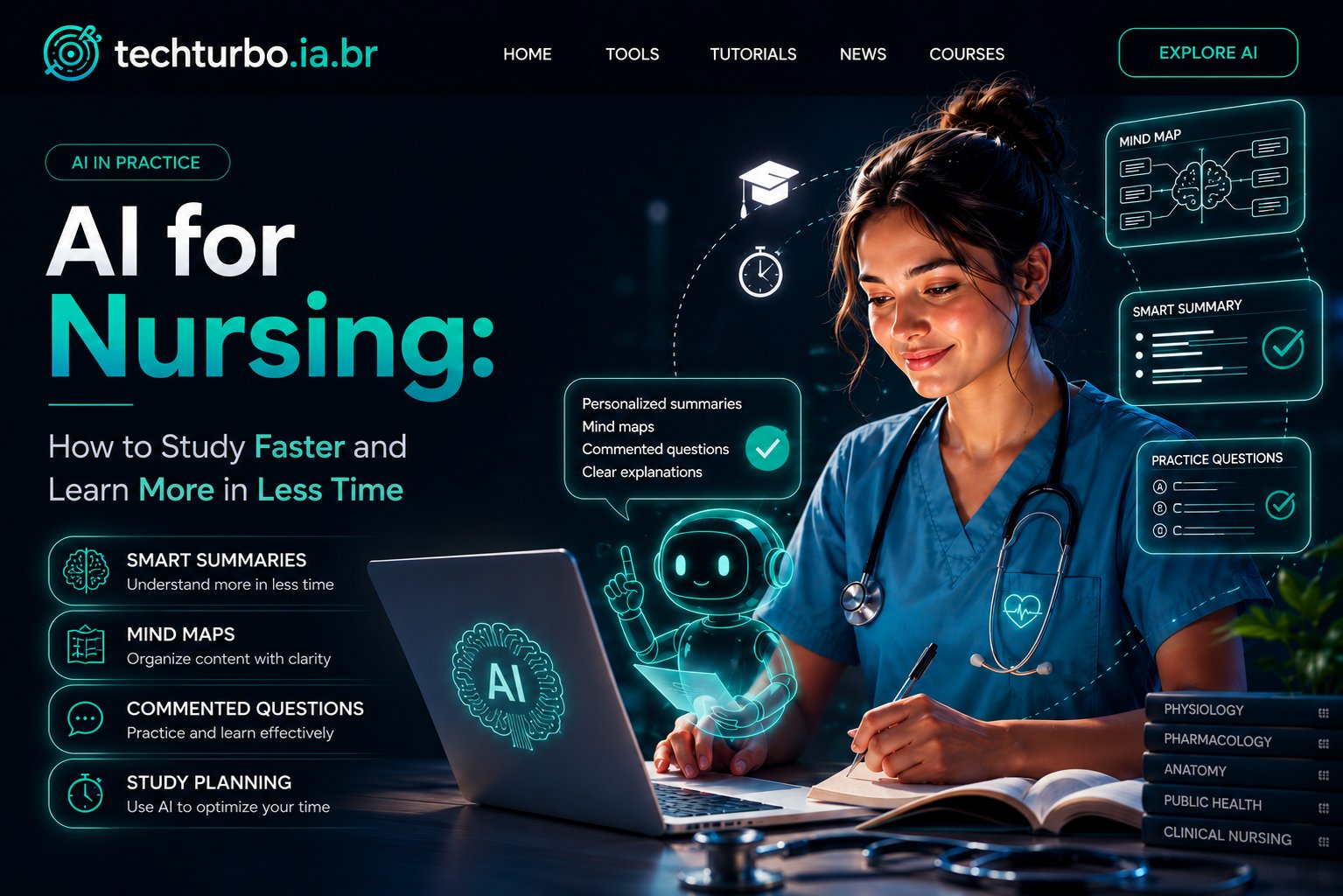
Nursing curricula are, without exaggeration, among the most demanding in higher education. Anatomy, physiology, pharmacology, nursing care plans, semiology, infectious diseases, emergency medicine, professional legislation — and all of this competes with clinical placement hours that routinely consume the time that should be spent studying. The predictable result: overwhelmed students, professionals struggling to stay current, and a persistent sense that the content is always larger than the time available.
Artificial intelligence has changed that equation. Not magically — and this guide will be very clear about that — but concretely and measurably. When used with method, AI can compress hours of passive reading into far more efficient active study sessions. This guide shows you exactly how to do that: which tools to use, for which purposes, with which prompts, and — equally important — what limits you cannot afford to ignore.
Why AI is different from the study resources that already existed
Before discussing specific tools, it's useful to understand what makes AI genuinely different from a well-used Google search or a digital textbook. The fundamental difference isn't the quantity of information — textbooks have more. The difference is adaptive interactivity.
A textbook explains hypovolemic shock the same way to everyone. An AI can explain hypovolemic shock to a second-semester student using a garden hose analogy, and to a nurse with five years in the ICU using haemodynamic parameters and pulse pressure variation. The level of real-time adaptation to your existing knowledge is what differentiates AI from any static resource.
Research published in the Journal of Nursing Education (2025) showed that students who used conversational AI as a complement to traditional study retained 34% more content in summative assessments compared with groups using only conventional materials. The critical finding: the group that benefited most combined active reading with AI-based questioning — not those who used AI as their primary source.
The tools available and what they actually do in practice
There is a proliferation of AI tools on the market. For nursing students, what matters isn't having access to all of them, but knowing which to use for each purpose.

How to use AI to study each area of nursing
Anatomy and Physiology
This is probably the area where AI shines most for beginners. The difficulty with anatomy is frequently not a lack of information — it's a lack of a clear mental image and connections between structure and function. AI can build those connections through analogy.
A prompt that works: "Explain kidney physiology as if I were a nursing student who has never seen this content before. Use a real-life analogy for each function, then ask me 5 questions to check I've understood."
The crucial element of this prompt is the ending: asking the AI to test your understanding transforms passive reading into active study. Answering the questions — even mentally — activates memory retrieval, which is the most robust mechanism of learning consolidation that cognitive science knows.
Pharmacology
Pharmacology is the subject that frightens nursing students most — and for good reason. The volume of medications, interactions, risk categories and dose calculations creates a combination that no simple memorisation technique resolves on its own.
AI is particularly useful here for grouping medications by mechanism of action, which is far more efficient than trying to memorise drug by drug. When you understand how beta-blockers work at the adrenergic receptor, it becomes much easier to infer the side effects of any drug in that class — even one you've never encountered before.
Specific prompts for pharmacology:
- "Create a comparison table of the main antihypertensives by class: mechanism, primary adverse effects, contraindications and nursing considerations."
- "Explain the difference between an agonist and an antagonist using the example of morphine and naloxone in a way I'll never forget."
- "Simulate a case where a patient received the wrong heparin dose. What happens? What are the clinical signs? How does nursing intervene?"
- "What are the 10 most common medication errors in the ICU? Explain how each can be prevented by the nursing team."
⚠️ Critical limit: Never use AI responses to calculate doses for real patients. AI can make errors, round inappropriately or ignore patient-specific clinical variables. Always use validated calculators, institutional protocols and the responsible nurse's supervision. AI for study ≠ AI for clinical practice.
Nursing Care Plans (NCP)
Care planning is where many students get stuck. The problem isn't lack of theoretical knowledge — it's difficulty integrating NANDA diagnoses, NOC outcomes and NIC interventions into coherent logic for a specific clinical case.
AI can function as an "on-call tutor" for care planning — available at 2am when you're stuck on a nursing diagnosis. The key is using structured hypothetical cases:
"You are an experienced nurse. I'm going to present you with a clinical case and I want you to help me identify the main NANDA nursing diagnoses. Don't give me the answer directly — ask me questions so I arrive at the diagnoses myself, correcting my reasoning when needed. The case is: a 67-year-old woman with decompensated heart failure, bilateral lower limb oedema ++/4, resting dyspnoea, SpO2 92% on room air, visible anxiety."
This approach — asking AI to guide the reasoning rather than give the answer — is called Socratic AI-mediated learning, and is significantly more effective for developing clinical reasoning than simply copying a completed care plan.
Emergency and Critical Care
Scenario simulation in emergency settings is one of the most valuable AI applications for nursing. It obviously doesn't replace manikin simulations or real clinical placement — but it can serve as mental preparation for protocols:
- "Simulate a cardiac arrest response. I'll play the lead nurse and you play the scenario. Tell me what's happening with the patient and I'll respond with my actions."
- "Create a 10-question quiz on sepsis protocol, with explanatory feedback on each wrong answer."
- "Explain the ABCDE trauma approach in order, with the clinical reasoning for each step and an example of a finding that would stop the assessment at each letter."
Professional Ethics and Legislation
Professional nursing legislation — Nursing Practice Acts, Codes of Ethics, regulatory board guidelines — is inherently dry. AI can transform legal texts into accessible language and create ethical scenarios for discussion:
Example: "Explain the difference between activities exclusive to registered nurses and those that can be delegated to licensed practical nurses, using examples from real hospital situations that would make it clear."
Advanced study techniques with AI that most people don't use
The Feynman technique accelerated by AI
The Feynman technique proposes that you truly learn when you can explain a concept as if teaching a child. With AI, you can do this in real time and receive immediate feedback on the points where your explanation was imprecise or incomplete.
How to apply it: Study a chapter normally. Then go to the AI and say: "I'm going to explain [heart failure] to you. Interrupt me at any point where I use an imprecise term, make a conceptual error or leave an important gap unexplained." This session will reveal exactly where the gaps in your knowledge are — something that passive reading never reveals.
Generating exam-style questions
One of the most practical applications for anyone preparing for licensing exams, graduate school entrance or competitive recruitment is using AI as a question generator:
"Create 5 NCLEX-style questions about nursing care for a patient with acute ischaemic stroke. The questions should have 4 options (A to D), with progressively increasing difficulty and a commented answer key with justification for each incorrect answer choice."
The element that differentiates this approach from simply searching for old exam questions online is the commented answer key with justification for wrong choices. Understanding why an answer choice is wrong consolidates knowledge far more deeply than just marking the right one.
Text-based mind maps and comparative frameworks
AI doesn't generate images directly (in the free ChatGPT version), but it can create mind map structures in text that you then transfer to tools like Miro, Mindmeister or even paper. Even more useful: the comparative tables that AI generates for relating diseases, medications or nursing diagnoses are frequently better than those in many textbooks.
Pre-exam revision with a compression protocol
The night before an exam, time is short and anxiety is high. A prompt that works very well:
"I have an exam tomorrow on [chronic renal failure]. Give me the 15 most important points I need to know, in order of likelihood of being on the exam, with a 2-line explanation of each."
This type of compressed revision doesn't replace prior study — but works very well as short-term memory activation the night before.
Real comparison: AI vs traditional study methods
| Method | Best use | Limitation | Time investment |
|---|---|---|---|
| Textbook reading | Building solid conceptual foundation | Passive — low retention without technique | High |
| Personal notes | Active consolidation | Labour-intensive, can reinforce errors | Very high |
| Video lectures | Visualising procedures | Difficult to pause and question | Medium-high |
| Conversational AI | Active adaptive questioning | Can hallucinate (invent) information | Low-medium |
| Anki + AI | Long-term memorisation | Requires initial setup | Medium (but efficient) |
| Study group + AI | Joint discussion and revision | Requires group discipline | Medium |
| Clinical simulation + AI | Applied clinical reasoning | Doesn't replace in-person simulation | Medium |
The lesson from this table: AI isn't the fastest method for building initial conceptual foundation — the textbook still wins there. But it's unbeatable for the active questioning phase, which is where most students invest the least time and have the greatest potential for gain.
Common mistakes nursing students make when using AI
1. Using AI as a primary source
The most frequent and most dangerous error. AI is excellent for explaining and questioning, but it's not a reliable source of specific clinical data — doses, laboratory reference values, institutional protocols. For those, always go to the primary source: drug package inserts, regulatory bodies, specialist society guidelines.
2. Asking questions that are too broad
"Explain pharmacology to me" doesn't work. "Explain the mechanism of action of digoxin, its toxic effects and how nursing monitors digitalis toxicity in 3 objective points" works very well. The specificity of the prompt determines the quality of the response.
3. Not verifying responses
All AI models hallucinate — they invent information that looks true. This happens more in very specific areas (such as exact reference values for lab tests, precise dosages or names of regional protocols). All clinically relevant content must be verified in validated sources before being internalised as fact.
4. Submitting AI-generated care plans as assignments
Beyond the ethical issue and plagiarism risk, this practice eliminates exactly the cognitive process that care planning should develop — clinical reasoning. An AI-generated NCP submitted without personal processing is academically dishonest and clinically useless.
5. Only using AI to summarise, never to question
Summarisation is the least valuable AI function for learning. Questioning, simulating, explaining, comparing, generating exercises — these are the functions that produce real retention. If you only use AI to "summarise the chapter", you're using 10% of the tool's potential.
For professionals: continuing education with less time
Nurses and nursing assistants already working in the field face a different challenge from students: not a lack of foundation, but a lack of time to stay current. New guidelines, revised protocols, evidence that changes clinical approaches — the volume is enormous.
How to use AI for professional development
- Guideline summaries: Paste a new clinical guideline PDF into Claude or ChatGPT and ask: "What are the 10 main changes in this guideline compared with conventional nursing practice?"
- Research paper translation: Articles in other languages become accessible with AI — not just translated, but explained in the context of your practice.
- Specialisation preparation: Use AI to identify knowledge gaps before starting a specialisation, mapping the most commonly tested topics in entrance examinations.
- Team case discussions: Bring real cases (without identifying data) for discussion with AI — the result can be used as a basis for team meetings.
✓ Best practice: Perplexity AI is particularly useful for professional development because it cites the sources of each statement in real time. You can verify whether the information comes from a current guideline or an outdated source — something standard ChatGPT doesn't do.
Future trends: where AI and nursing are heading over the next few years
What exists today — AI as a study and research tool — is only the beginning. The trends already being developed that will directly impact nursing include:
- AI integrated into electronic health records: Systems that suggest nursing diagnoses and interventions based on real-time patient data, with the nurse validating and adjusting.
- Immersive clinical simulation with AI: Virtual patients with dynamic responses based on real physiological models — already available in some US and European institutions, arriving more broadly.
- Personalised continuing education chatbots: Systems that identify each professional's specific gaps and generate personalised development pathways.
- AI for patient safety: Alert systems that identify clinical deterioration patterns before signs become obvious — with the nurse as the critical interpreter of the alert.
The practical implication for those studying today: familiarity with AI is no longer a differentiator — it's becoming a basic competency. The nursing professional who knows how to use these tools with judgement will have a real advantage in the job market of the coming years.
A practical study plan: how to organise a week using AI
| Day | Main activity | AI tool | Estimated time |
|---|---|---|---|
| Monday | Reading new content (textbook/notes) | None — focus on primary source | 60–90 min |
| Tuesday | Active questioning of content read | ChatGPT / Claude | 30–40 min |
| Wednesday | Creating Anki flashcards | Anki + AI plugin | 20–30 min |
| Thursday | Simulated clinical case | ChatGPT (Socratic simulation) | 30–40 min |
| Friday | Quiz and exam-style questions | ChatGPT / Claude | 30 min |
| Saturday | Anki revision (spaced repetition) | Anki | 20 min |
| Sunday | General revision + gap identification | NotebookLM or Perplexity | 30 min |
The total weekly AI use in this plan is approximately 2h30min — significantly less than reading time, but landing exactly in the phases of learning where cognitive effort produces the most retention.
The Definitive Guide to Modern Nursing
Protocols, career development and artificial intelligence for nursing professionals.
View course →AI in Healthcare
How artificial intelligence is transforming clinical practice, diagnostics and the healthcare job market.
View course →// Conclusion
Artificial intelligence won't make nursing easier — and it shouldn't. The profession demands developed clinical reasoning, clear ethical responsibility and technical skills that can only be built through supervised practice. What AI does is make the learning process more efficient, freeing up more time and cognitive energy for what truly matters.
The practical recommendation is simple: start today, with one tool, for one specific topic you're studying right now. Use one of the prompts in this guide. Evaluate the result. Adjust. The learning curve for AI as a study tool is short — within two or three sessions, you'll have a clear sense of what works for your learning style.
The nursing student who learns to use AI with judgement isn't replaced by it — they become more competent, more current and harder to surpass.
FAQ — Frequently Asked Questions
Which AI tools are most useful for studying nursing?
Can AI replace textbooks and professors in nursing?
Is it safe to use AI to clarify pharmacology questions?
How can AI help me create nursing care plans?
Does AI help with nursing licensing exams like the NCLEX?
What is the risk of AI giving wrong information in healthcare?
Do I need to pay for premium AI plans to study nursing?
Can AI help me prepare for graduate nursing programmes?
Recommended Tools for Studying Nursing with AI
Tested devices that make a real difference to your study routine. All available on Amazon with fast delivery.
Lightweight, months of battery life and a glare-free screen. The best device for reading textbooks and study PDFs anywhere.
🛒 See on Amazon →11" display, 128GB, 5G connectivity. Ideal for reading protocols, annotating and running AI tools without lag.
🛒 See on Amazon →Noise cancellation for studying in any environment. Essential for audiobooks and video lectures during clinical placement.
🛒 See on Amazon →Lightweight, Google Gemini built-in and Intel processor. A reliable, affordable laptop for running all AI study tools.
🛒 See on Amazon →