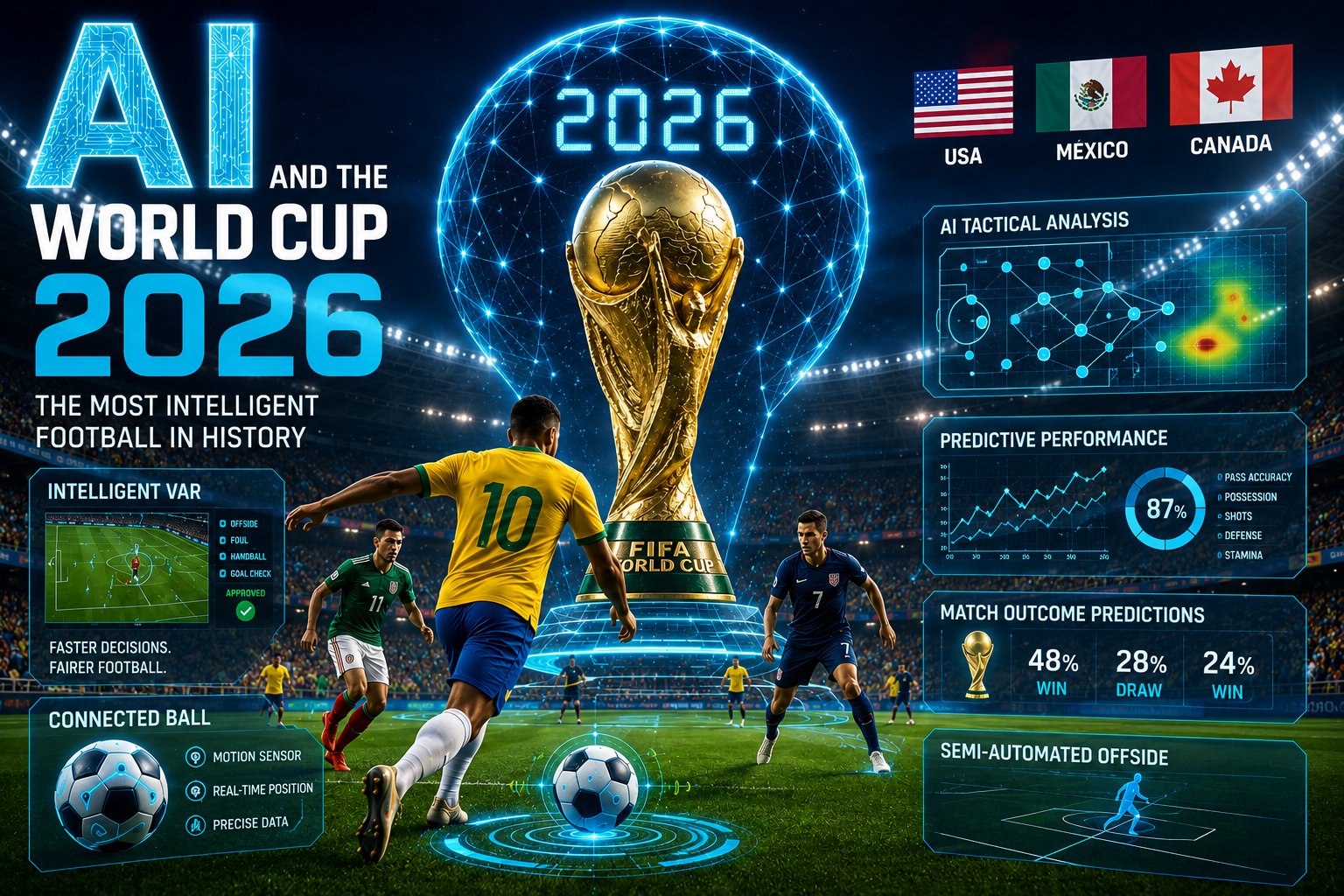
1. The 2026 World Cup: The Biggest Ever — By Design
Context matters. The 2026 edition isn't just larger — it's a different beast entirely. 48 teams, up from 32 that competed since France 1998. More than 104 matches across 16 venues in three countries with different time zones, languages, and infrastructure capacities. And a projected global audience of 6 billion people — roughly three-quarters of everyone alive.
For the United States, this is the largest sporting event in American history, dwarfing even the Super Bowl in scale. And unlike the NFL or the NBA — where AI-driven analytics have been deeply embedded for over a decade — football (soccer) is only now catching up at the international level. The 2026 World Cup is where that gap closes dramatically.
2. AI-Assisted Refereeing: VAR Grew Up
If you followed the 2022 World Cup in Qatar, you remember VAR dividing opinion sharply. The technology was capable — the implementation was slow, opaque, and often maddening. By 2026, that changes.
Semi-automated offside: from minutes to seconds
FIFA's Semi-Automated Offside Technology (SAOT), debuted in Qatar 2022, will be significantly more refined in 2026. The core innovation: the official match ball contains an embedded IMU sensor transmitting data 500 times per second. The moment a player's foot contacts the ball is captured with microsecond precision — no more disputes about which video frame to use.
Simultaneously, 12 dedicated tracking cameras per stadium use computer vision with deep learning to model the position of every player 50 times per second. The system extracts 29 body-point measurements per player — shoulders, hips, knees, ankles, feet — to determine whether any goal-scoring body part was beyond the last defender at the exact moment of the pass. Offside calls that once took 4 minutes now take under 30 seconds, with a photorealistic 3D visualization displayed instantly on stadium screens and broadcast.
The ball sensor detects the exact moment of contact. The system freezes all 22 players' positions at that microsecond. Computer vision extracts 29 body landmarks from each player in 3D space. If any permitted goal-scoring body part of an attacker is beyond the last defender — by even a centimeter — the system flags it automatically. No argument about camera angles. No ambiguity about timing.
Automated foul detection — the next frontier
Computer vision systems are being developed to automatically flag events like dangerous tackles, deliberate handballs, and simulation — alerting the on-field referee in real time without requiring a VAR review request. The AI doesn't decide; it informs. The human referee retains final authority. This distinction matters enormously for the integrity of the game.
3. AI Helping Coaches: Football Became Data
Elite coaches like Pep Guardiola and Jurgen Klopp have used advanced analytics platforms for years. But the gap between top European clubs and national teams — especially from Africa, Asia, and CONCACAF — in data capabilities has been significant. In 2026, AI is the great equalizer.
Opponent analysis at industrial scale
Platforms like StatsBomb, Wyscout, and SkillCorner process data from hundreds of thousands of matches to build predictive behavioral models for every team. For a coaching staff preparing for an opponent, AI can generate:
- Tactical heat maps showing where the opponent builds attacks, where they concede pressure, and where they're most vulnerable
- Penalty kick tendencies — preferred directions under pressure, behavioral patterns by score line, goalkeeper positioning habits
- Pass network analysis identifying the key nodes in the opponent's ball circulation
- Game scenario simulations testing different formations and pressing schemes against the opponent model
What previously required weeks of analyst work is now processed in hours. A coaching staff can receive a comprehensive opponent dossier before they've even watched the footage manually.
4. Injury Prevention: Protecting the Stars
A World Cup lasts a month. Players arrive after exhausting domestic seasons. The margin for physical management errors is near zero — one key injury can eliminate a nation's best hope. This is where AI may have its most tangible and least controversial impact.
Real-time biometric monitoring
GPS-enabled vests combined with accelerometers capture, per player per match:
- Total distance covered and distribution by intensity (walking, jogging, high-speed running, sprinting)
- High-intensity sprint count and recovery intervals between efforts
- Acceleration-deceleration load — one of the most reliable indicators of muscular stress
- Heart rate variability throughout the match
- Core body temperature — critical in warm-weather venues like Miami or Dallas
ML models trained on historical injury data identify patterns that precede muscular problems — even when the player feels nothing. An attacker whose sprint acceleration is declining in the final 20 minutes, combined with elevated temperature and his third game in eight days, may trigger an automatic risk alert before any symptom appears.
5. Scouting & Talent Discovery: No Diamond Goes Unnoticed
The World Cup has historically been the stage where unknown talents announce themselves to the world. In 2026, AI will ensure those talents were already on someone's radar long before they stepped into the spotlight.
Systems analyzing thousands of players simultaneously
Scouting platforms like InStat, Catapult, and SciSports use computer vision to automatically evaluate players across hundreds of leagues globally — including African, Asian, and North American competitions that traditionally received far less attention from traditional scouts. The algorithm evaluates positioning off the ball, pass completion rates under pressure, decision-making in tight spaces, dribble efficiency, and high-press effectiveness across dozens of metrics.
The most underappreciated effect of AI scouting is geographic democratization. A 19-year-old striker in a semi-professional league in Ivory Coast now has a realistic chance of appearing on a European club's radar — because algorithms have no geographic bias. This could directly impact the quality of African squads in 2026.
| Area | AI Technology | Primary Benefit | Current Adoption |
|---|---|---|---|
| Refereeing | Computer vision + IMU sensor | Offside calls in under 30 seconds | High (FIFA) |
| Tactical Analysis | Predictive ML models | Full opponent report in hours | High (top nations) |
| Injury Prevention | Biometrics + risk ML | Early muscular risk alerts | Medium-High |
| Scouting | Multi-league computer vision | Global coverage without travel | Medium |
| Fan Experience | NLP + recommendation systems | Personalized real-time content | Growing |
6. Fan Experience: The Most Personalized World Cup Ever
For the three billion people who won't be in a stadium, the 2026 World Cup may be the richest and most personalized viewing experience in sporting history — not because of the football itself, but because of the technology layer wrapping every broadcast and digital interaction.
Real-time multilingual translation
With 48 nations from every continent and three host countries speaking different languages, the communication barrier is substantial. AI translation systems like Google's Neural Machine Translation and DeepL already deliver near-human quality for dozens of language pairs. In 2026, live broadcasts are expected to feature automatic subtitles in real time with under 2-second latency — including for less-represented languages like Swahili, Bengali, and Tagalog.
AI-generated highlights and real-time statistics
Streaming platforms already use AI to generate goal clips, saves, and controversial moments seconds after they occur. In 2026, this process will be more sophisticated: the algorithm not only detects the event, but selects the optimal camera angle, applies slow-motion at the right moments, and adds statistical overlays — all automatically, without human editing. For cord-cutters on Apple TV+, Amazon Prime Video, or Peacock, AI will personalize which highlights and notifications you receive based on your viewing history.
AI chatbots and World Cup assistants
FIFA and technology partners plan conversational AI assistants responding in real time: "When does the USMNT play next?", "What's the head-to-head record between England and Germany at World Cups?", "How many goals has Kylian Mbappé scored in 2025?" Integrated with live data feeds, these assistants eliminate the need to navigate multiple websites for basic tournament information.
7. AI-Generated Content: The Automated Press Box
There's a quiet revolution happening in sports media: news agencies are using generative AI to produce match reports automatically. The result is controversial but inevitable at this scale.
Automatic match summaries at scale
Systems like Automated Insights — which has automatically generated NFL performance reports for years — will produce match summaries in minutes after the final whistle, in dozens of languages simultaneously. For a tournament with 104 matches, producing quality coverage in every major language is logistically impossible with human journalists alone. AI fills that gap while human journalists focus on analysis, context, and storytelling.
Advanced real-time statistics in broadcast
The next frontier is live statistical overlays during matches — not just possession and shots, but metrics like real-time Expected Goals (xG in motion), "distance to open goal" for each player, and maximum sprint speed displayed immediately after each run. Broadcasters including ESPN, Fox Sports, and CBS Sports are actively testing these features. The 2026 World Cup in the United States may be the catalyst for mainstream adoption.
8. Predicting Results: Can AI Tell Who Wins?
Every World Cup triggers a wave of predictive models. Goldman Sachs, Microsoft, and now DeepMind-type systems compete to forecast who lifts the trophy. The honest answer: no model consistently gets it right — but some are far better than random chance.
What the models actually analyze
State-of-the-art prediction models process variables including: FIFA rankings, head-to-head historical records, recent form (trailing 12 months), average goals scored and conceded by opponent tier, group stage vs. knockout performance differentials, home continent advantage effects, climate conditions at the match venue, and even betting market odds (which aggregate the "wisdom of crowds" from millions of bettors globally).
No AI model can reliably predict World Cup results because football has the highest intrinsic randomness among major team sports. Models calculate probabilities, not certainties. In 2022, Goldman Sachs gave Argentina just a 6% title probability before the tournament. They won. Use AI predictions as sophisticated probabilistic references — never as oracles.
9. Challenges and Controversies: When Technology Complicates
Over-dependence and algorithmic failures
In Qatar 2022, a play in the Brazil vs. Switzerland match nearly triggered an incorrect automated flag — the tracking camera struggled with body overlap at a specific moment. The system was ultimately correct, but the episode revealed a dangerous dependency: when the algorithm fails, there is no robust human fallback to correct it quickly. The dependency creates a blind spot.
Athlete data privacy
GPS vests, biometric sensors, and tracking cameras collect extraordinarily detailed information about each player's body — heart rate patterns, movement signatures, fatigue indices. Who controls this data? Can it be sold to third parties? Used against a player in contract negotiations? The FIFPro players' union has warned that regulation of athlete biometric data is lagging far behind available technology.
The soul-of-the-game debate
This is the most genuinely philosophical tension. Football is loved precisely for its human unpredictability — the referee's error that becomes legend, the improbable goal that no algorithm foresaw, the manager who changed the game on pure instinct. When technology reduces human error, it also reduces the chaos that makes the sport captivating. There's no easy answer. It's a values choice.
10. Beyond the Possible: What's Still Science Fiction — But May Be the 2034 World Cup
This section describes concepts in early research, credible technical rumors, and declared visions of engineers and scientists. None have confirmed implementation timelines. But all have real foundations.
The fully autonomous referee — no human in VAR
Researchers at DeepMind and MIT are working on systems capable of officiating entire matches autonomously, without human intervention. The system would not merely detect infractions but make the decision — with a natural language explanation displayed in real time for the stadium and broadcast audience. The primary obstacle isn't technical: it's political and cultural. FIFA will likely take decades to accept this. But the technical system may exist well before then.
Personalized broadcast — your own camera, powered by AI
Imagine watching the World Cup with a camera that follows exclusively the player you choose for the entire match — with automatic zoom, instant replay on every play they touched, and real-time statistics overlaid. This is technically feasible today with AI tracking. The obstacle is bandwidth and broadcast rights. By 2030, with 6G infrastructure globally, this is entirely plausible for streaming platforms.
Full digital twin simulation of matches
Before a World Cup knockout match, coaching staffs could run 10 million simulations of the game against that specific opponent, with real-time variables for formation, weather, and current player fitness. The model identifies the strategy with the highest win probability given the current context. Monte Carlo simulation algorithms already do this in rudimentary form — refined with LLMs and agent-based models, they could become extraordinarily precise.
Fully immersive AR stadium experience
Fans inside the stadium would see — through AR glasses — each player's real-time statistics floating above their heads: current speed, distance covered, probability of next pass destination. It would be like watching the match with video game data overlaid onto reality. Technologies like Apple Vision Pro and cheaper competitors may make this accessible for future World Cups — perhaps as early as 2030.
11. The Future After 2026
The World Cup has historically functioned as a showcase that accelerates global adoption. VAR was normalized across top European leagues after being tested at the 2018 World Cup. Semi-automated offside reached the Premier League in 2023 after its World Cup debut in 2022. Whatever succeeds technically in 2026 will become standard in domestic leagues by 2028-2030.
Referees will increasingly become decision managers rather than decision-makers. Coaches will be more data curators than solitary strategists. Fan experience will become progressively personalized. And football — which survived professionalization, television, sovereign wealth fund money, and super-agents — will survive AI too. Probably better for it.
Conclusion: AI Won't Play — But It Will Be on the Pitch
The 2026 World Cup will not be won by an algorithm. The goal will still be scored by a human, with all the emotional weight, the error, the glory, and the imperfection that make football the most beloved sport on Earth. But AI will be everywhere around that goal: validating it with millimeter precision, analyzing the movement that created it, broadcasting it in dozens of languages simultaneously, and generating a personalized clip for every type of fan within seconds.
Understanding this isn't rooting for technology over football. It's recognizing that both can coexist — and that the 2026 World Cup will be, simultaneously, the most human and the most technological edition in history.
Frequently Asked Questions (FAQ)
Yes, and in a significantly more advanced form. The Semi-Automated Offside Technology (SAOT) from Qatar 2022 will be expanded and refined. Key improvements include faster decision-making, clearer visual explanations for fans in stadiums and on TV, and more reliable body-point tracking. The ball sensor and 29-point player body tracking enable decisions in seconds with near-zero error rates.
Primarily through: automatic real-time subtitles in dozens of languages, personalized AI-generated highlights seconds after key moments, advanced statistics overlaid during broadcast (like real-time Expected Goals), and conversational AI assistants answering tournament questions instantly. Streaming platforms like Apple TV+, Amazon Prime Video, and Peacock are actively testing several of these features ahead of 2026.
It can calculate probabilities, not certainties. AI models can identify favorites with reasonable accuracy — Brazil, France, England, and Argentina typically appear at the top — but football has too much intrinsic randomness for reliable predictions. In 2022, Goldman Sachs gave Argentina just a 6% chance before the tournament. They won. Use AI predictions as sophisticated probabilistic reference points, never as oracles.
This is one of the most active debates in professional football. Data collected by GPS vests and sensors legally belongs to the clubs and federations — not the players. The FIFPro players' union is pushing for stricter regulation, arguing that heart rate patterns, fatigue indices, and movement signatures are highly sensitive and could be weaponized in contract negotiations. Specific regulations will likely emerge before 2026, but the debate is far from resolved.
England, Germany, and Spain lead in advanced data analytics adoption at club level. At national team level, Germany (SAP partnership), England (StatsBomb and Wyscout usage), and the Netherlands are most sophisticated. The United States has been rapidly catching up across MLS and the USMNT, particularly in preparation for hosting the 2026 World Cup. The tournament itself may be the catalyst that levels these differences globally.
Get the news before everyone else
AI, World Cup 2026, gadgets and world-changing technology — every week, straight to your inbox. No spam.
* Amazon affiliate links. Purchasing through them supports TechTurbo at no extra cost to you.