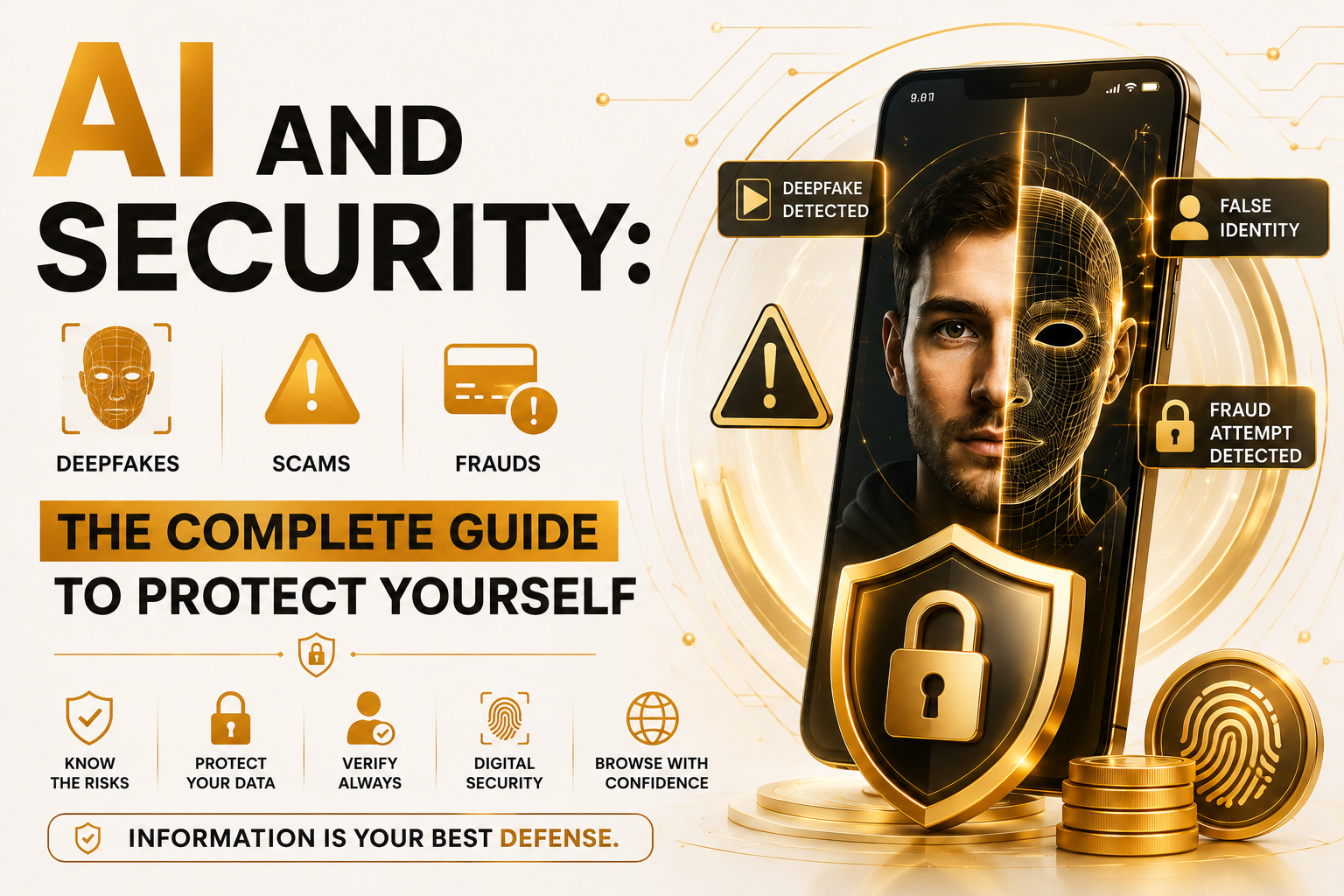
1. Why AI Changed the Rules of Cybersecurity
Until a few years ago, a social engineering scam took time: the attacker had to research the target, write a convincing message, sometimes even rehearse an accent. Today a language model writes a grammatically flawless phishing email, tailored to the victim's role and their company's tone, in seconds. A voice model clones someone's timbre from 20 seconds of public audio — plenty from an Instagram story or a LinkedIn video. And an image or video generator produces a photorealistic fake scene without requiring any technical skill from whoever's operating it.
The practical result is a shift in scale, not in kind: the same old scams — the fake kidnapping, the fake executive, the fake invoice — now run at industrial scale, with quality good enough to fool even people who are paying attention. That changes what the right response looks like: identity verification can no longer rely on "I recognize the voice" or "that's clearly them" — it needs an independent second channel of confirmation.
2. Deepfakes: When Seeing (or Hearing) Stopped Meaning Believing
Deepfake is the umbrella term for synthetic content — video, audio, or image — generated or manipulated by AI to show a real person saying or doing something that never actually happened. The underlying technology (generative adversarial networks, diffusion models, and, more recently, multimodal models trained specifically for lip-sync and voice cloning) has advanced to the point where the classic visual tells — odd blinking, blurred edges, robotic-sounding audio — have essentially disappeared in the newest generation of tools.
Documented cases of corporate fraud using cloned executive voices have already resulted in multimillion-dollar wire transfers, according to police investigations and cyber-insurance reports. Major tech companies (Google, Meta, OpenAI, Microsoft) have already announced watermarking/labeling tools for AI-generated content (such as C2PA, the content provenance standard). Several countries and regions, including the EU with its AI Act, are moving toward legally requiring synthetic content to be labeled.
There's no deepfake detector today with guaranteed accuracy against the newest generative models — the race between generation and detection is ongoing, and no commercial tool promises 100% accuracy. There's also no global standardization of mandatory watermarking yet, and how effective legal labeling requirements will be in practice still depends on enforcement that barely exists so far.
Comparison: detection tools and approaches
| Approach | How it works | Main limitation |
|---|---|---|
| Automated forensic detection | Analyzes compression artifacts, noise, and pixel patterns invisible to the human eye | Loses effectiveness as generative models improve |
| Watermarking / C2PA | Embeds a cryptographic signature at the point of content creation | Only works if the generating tool cooperates; easy to strip by re-exporting the file |
| Second-channel verification | Confirming through a different medium (calling back a known number, a family safe word) | Depends on human process — but it's the most reliable option today |
| Behavioral biometrics | Analyzes typing patterns, mouse movement, and live micro-expressions | Expensive and mostly used by banks, not widely accessible to individual users |
Real-world cases that have already happened
- Cloned-voice CEO fraud: finance staff have received calls with cloned executive voices requesting urgent transfers outside the normal approval process.
- Fake video call with an "entire leadership team": in a widely reported case in Hong Kong, an employee joined a video call where every other participant was a deepfake, and authorized a multimillion-dollar transfer.
- Relative-in-distress scam: short cloned audio clips, built from public social media videos, are used to fake distress calls asking for money.
3. AI Scams and Social Engineering: Phishing Got Personal
Social engineering has always exploited trust, urgency, and authority. What's different now is personalization at scale: a language model reads a target's public LinkedIn profile, their company's website, and recent posts, and generates an email that references the manager's name, an actual ongoing project, and the typical tone of that company's internal communications — all automatically, without a grammar mistake, without the classic tells that security training used to teach people to spot.
That doesn't mean the scam is undetectable — it means the signals shifted. Bad grammar stopped being a reliable indicator; artificial urgency, requests to skip the normal process, and pressure not to double-check with anyone else remain the most reliable red flags, because they target psychology, not spelling.
Common mistakes people make
- Trusting they can "recognize" a voice or face without confirming through a second channel.
- Responding through the same channel where the suspicious contact arrived (calling a number found inside a suspicious email instead of the one on the back of the card or in the official app).
- Assuming "this only happens to people who don't understand technology" — IT and finance professionals are among the most targeted precisely because they have access to critical systems.
- Skipping ongoing training: a once-a-year awareness talk can't keep pace with how fast these scams evolve.
Practices that actually reduce risk
- Set up a family or team "safe word" to confirm urgent requests for money or system access.
- Any request to transfer funds, change banking details, or grant system access outside the formal process should be confirmed through a different channel from the one that raised it.
- Adopt a "it's fine to double-check" culture: no company should ever penalize an employee for confirming twice before a transfer goes out.
How many seconds of audio does it take to clone a voice? Current tools produce convincing results from as little as 10 to 20 seconds of clean audio. Is a real-time deepfake on a live video call possible? Yes — real-time face-swap tools already exist and have been used in corporate scams. Is SMS two-factor authentication safe? Better than nothing, but vulnerable to SIM swapping; an authenticator app or passkey is safer.
4. Passwords in the AI Era: Why the Traditional Password Is on Its Way Out
AI models have dramatically sped up brute-force attacks and pattern reverse-engineering, and made credential phishing far more convincing. At the same time, database leaks (credential stuffing) remain the most common way in — not because any single password is "weak," but because it gets reused across multiple services.
| Method | Protection level | Note |
|---|---|---|
| Simple, reused password | Low | Vulnerable to credential stuffing and social engineering |
| Strong password + password manager | Medium-high | Eliminates reuse, but still relies on a secret that can be accidentally shared |
| App-based multi-factor authentication (MFA) | High | Blocks most automated attacks; vulnerable to "MFA fatigue" scams |
| Passkeys (device/biometric-based key) | Very high | Removes the password as a target entirely; can't be phished the same way |
In practice: if you can only make one change today, switch your primary email and banking app to app-based multi-factor authentication (not SMS, which is vulnerable to SIM swapping) and turn on passkeys wherever they're available.
5. Facial Recognition and Biometrics: Real Security or Just the Feeling of It?
Biometrics — fingerprints, facial recognition, iris scans — feel inherently secure because "it's literally you." The problem is that, unlike a password, you can't change your face after a leak. Leaked biometric databases (this has already happened at national scale in more than one country) are permanent: once exposed, that specific biometric data point can never again be fully trusted as a single authentication factor.
On top of that, the same generative AI behind deepfakes is also used to try to trick facial verification systems during account opening or loan applications (so-called "liveness bypass"), feeding synthetic video in place of a live capture. That's why serious systems pair biometrics with liveness detection — checking depth, light reflection, and micro-movements that a pre-recorded video doesn't faithfully reproduce.
6. AI-Powered Banking Fraud
The financial sector is the most targeted for an obvious reason: it's where the money is. The most common fraud patterns today combine three AI ingredients: synthetic identity generation (AI-forged documents used to open mule accounts), cloned voice or video used to authorize transactions over the phone, and scam chatbots that impersonate bank support to capture passwords and one-time codes in real time, immediately relaying them to the actual attacker to complete the login.
On the defense side, banks themselves use AI for behavioral anomaly detection (typing patterns, unusual access time or location, how fast a form gets filled out) — meaning, ironically, the same technology sits on both sides of this arms race.
7. Enterprise AI: Securing It at Scale Inside Organizations
For companies rolling out generative AI internally, the risk isn't just falling victim to an external scam — it's also sensitive data leaking through prompts (employees pasting confidential information into public AI tools) and prompt-injection attacks against internal assistants connected to company systems. Enterprise AI usage policy needs to, at minimum, define which data can go into external tools, require vendor contracts that exclude training on company data, and review the permissions of any AI agent with access to internal systems the same way you'd review a new employee's credentials — because from a risk standpoint, that's exactly what it is.
8. The Other Side of the Coin: When AI Finds the Flaws Before Criminals Do
Not every AI-and-security headline is about attack. In April 2026, Anthropic announced Claude Mythos, a model capable of autonomously discovering — and even building working exploits for — zero-day vulnerabilities, at a scale and cost no human security research team could match. In the company's own internal testing, the model found a vulnerability that had existed in OpenBSD for 27 years — an operating system historically regarded as one of the most hardened against attack — using fewer than a thousand autonomous runs and a total cost under $20,000.
The scope went well beyond a single system: under Anthropic's own program, called Project Glasswing, Claude Mythos and roughly 50 partner organizations together surfaced more than 10,000 high- or critical-severity vulnerabilities across software used by much of the world — operating systems, browsers, and critical open-source libraries. Findings reported by trade press include a browser exploit that could let an attacker read data from another domain (say, a bank's site open in another tab) and weaknesses in cryptography libraries that could allow decrypting communications or forging digital certificates.
The same reasoning and coding capability that makes an AI model dangerous in a scammer's hands — writing a flawless phishing email, cloning a voice, assembling a fake video — is the capability that, on the defense side, finds and fixes a flaw that survived 27 years of human review before a criminal gets there first. It's the same argument that runs through this entire guide: AI isn't inherently good or bad, it multiplies the speed of whoever is using it — including, fortunately, defenders.
There's also a governance angle worth following: access to Claude Mythos is, for now, restricted to a select group of trusted partners inside Project Glasswing, and the sheer pace of this mass discovery has already sparked public debate over who should have access to this kind of capability and how quickly it should expand — including reports that the U.S. government stepped into decisions about expanding that access to additional organizations. In other words, the same question this guide raises about AI-powered scams — who controls the technology, and how fast it spreads — repeats itself, at a different scale, on the defense side.
9. Beyond the Possible: Speculation and the Future — How Far Could This Go?
This section separates plausible extrapolation from what still belongs to pure speculation. Nothing here is guaranteed.
Plausible in the short-to-medium term
Broader adoption of legally mandated watermarking across regional blocs (the EU is already moving this way with the AI Act) and liveness detection built into smartphones by default.
Still distant or uncertain
A single, globally mandatory content-authentication standard that works across every platform today runs into diverging commercial interests among the major tech companies. Deepfake detection with near-100% accuracy against future, still-unknown models is, by definition, something no one can guarantee today.
Speculation / science-fiction territory
AI capable of generating a complete synthetic biometric identity (face + voice + typing pattern + behavior) indistinguishable in real time from a real person to any verification system — discussed in academic papers as a future risk scenario, but with no evidence of practical implementation today.
10. Practical Checklist: What to Do Today
- Turn on app-based multi-factor authentication (not SMS) for your primary email and banking app.
- Agree on a family or team safe word for urgent requests involving money.
- Never confirm a transfer request or sensitive data through the same channel the suspicious contact came from.
- Turn on passkeys wherever they're available (Google, Apple, and Microsoft all support them broadly now).
- Reconsider what synced audio/video content you post publicly — the less high-quality voice and face material out there, the less raw material available for cloning.
- At the company level: formalize an AI usage policy with clear rules about what data can go into external tools.
Bottom Line: the Most Effective Defense Is Still Process, Not Technology
No single piece of software will eliminate the risk of AI-powered scams, because the actual target is still a human decision about whether to trust something. The best defense available today combines technology (MFA, passkeys, liveness detection) with process (a second verification channel, a safe word, a no-rush policy).
Start with the simplest item on the checklist above right now — most successful scams exploit exactly the delay in adopting habits like these.
Frequently Asked Questions (FAQ)
It's audio, image, or video content generated or altered by artificial intelligence to show a real person saying or doing something that never actually happened.
Don't rely solely on recognizing the voice. Hang up and call back a number you already know and have saved — never a number given to you during the suspicious call.
Yes. Passkeys remove the password as a phishing target entirely, since the key stays tied to the device and local biometrics rather than traveling across the network the way a password does.
Yes, most major banks use behavioral anomaly-detection models to flag transactions that fall outside a customer's normal pattern in real time.
Not completely, but reducing public exposure of high-quality audio/video and locking down the privacy of older posts shrinks the raw material available for cloning.
* Amazon affiliate links. Buying through them supports TechTurbo at no extra cost to you.
Get the news before everyone else
AI, digital security, and technology — every week, straight to your inbox. No spam.