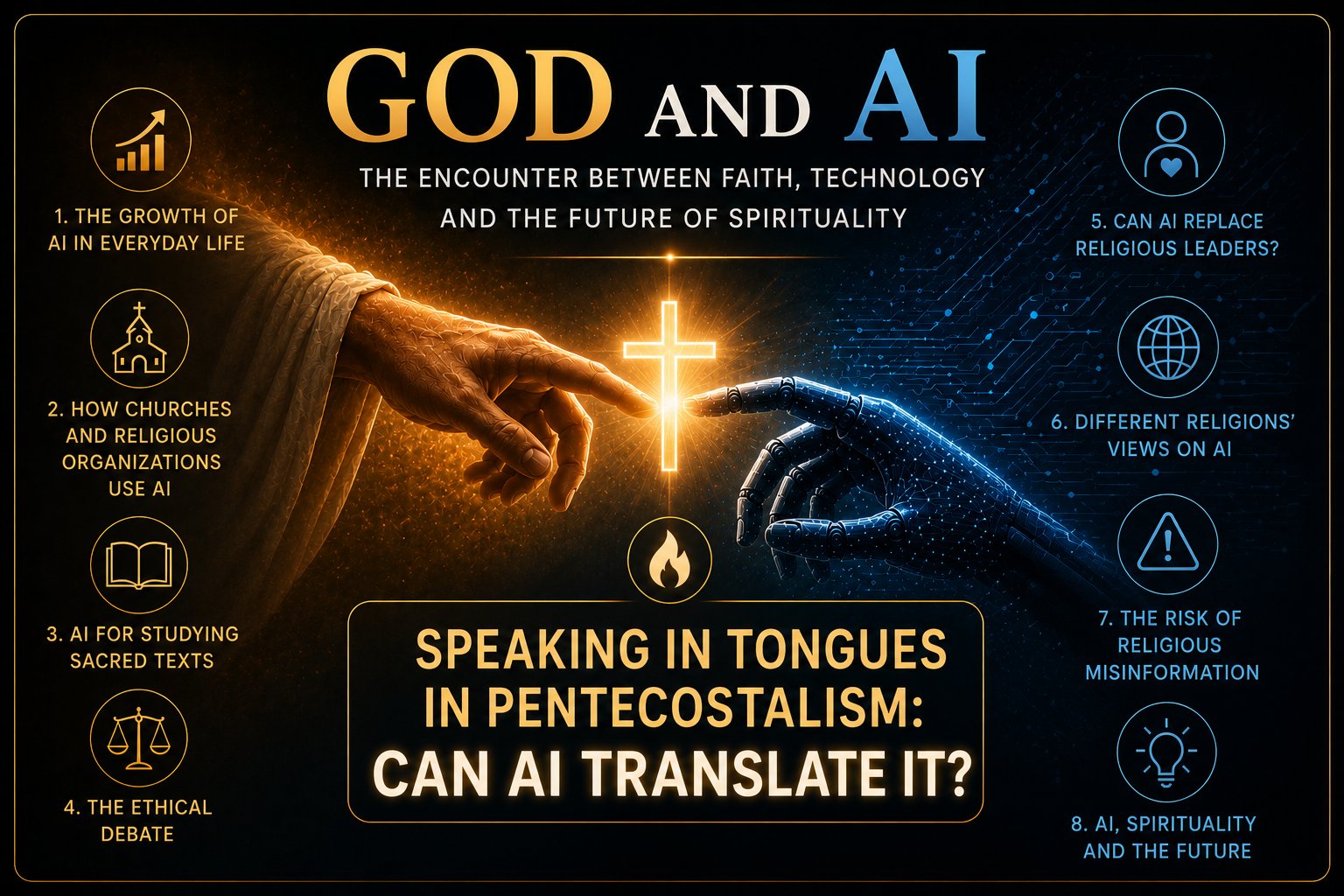
1. The Growth of AI in Daily Life and Its Convergence with Religion
More than 100 million people used ChatGPT in its first month after launch. By 2026, AI tools are embedded in smartphones, productivity apps, customer service — and increasingly, in religious contexts. This is no accident. It is the natural consequence of technology's exponential growth across every dimension of human life.
The convergence between AI and religion follows a simple principle: wherever people spend meaningful time, technology follows. And people spend enormous time in spiritual practice — studying sacred texts, participating in worship, seeking religious guidance, managing faith communities. When AI enters that space, questions arise that transcend the technical: what remains authentic in a spiritual practice mediated by algorithms?
Why this debate is urgent now
Timing matters. We are at the exact moment when generative AI has matured enough to produce convincing sermons, interpret biblical passages with apparent erudition, and answer theological questions in natural language — but we have not yet developed the ethical and theological frameworks to evaluate these practices. That gap between technological capability and ethical reflection is precisely where the greatest risks reside.
2. How Religious Organizations Already Use AI
What seemed like science fiction five years ago is now documented reality in congregations across multiple continents. Adoption is not uniform — it ranges from cautious experiments to ambitious implementations — but it is no longer possible to ignore.
Sermon writing and Bible study preparation
Pastors and religious leaders across the United States and globally already use ChatGPT, Claude, and similar tools to draft sermon structures, identify relevant scripture passages for specific themes, and generate illustrations and analogies. Most describe using AI as a starting point, not a final product — but that line is frequently blurry.
In 2023, a Baptist congregation in Kansas City sparked controversy when it revealed that an AI-generated sermon had been delivered to the congregation without disclosure. The reaction divided opinion sharply: some defended the practicality, others questioned the spiritual authenticity of a message generated by a machine. The ensuing debate proved richer than any single sermon.
Translation of sacred texts
This is arguably the most valuable and least controversial use of AI in religious contexts. Translating sacred texts — whether the Bible, Quran, Torah, Vedas, or Buddhist sutras — requires knowledge of ancient languages, historical context, and cultural sensitivity. AI does not replace linguists and archaeologists, but accelerates their work extraordinarily.
The organization Ethnos360, which works with isolated linguistic groups, already uses AI tools to accelerate biblical translation into languages without prior documentation. What once required decades of missionary scholarship now has portions of the process compressed into months. For communities that previously had no access to sacred texts in their own language, AI represents a genuine democratization of spirituality.
Chatbots for congregant support
Several denominations are experimenting with chatbots that answer questions about liturgy, service times, event dates, and basic scriptural content. The Archdiocese of Washington implemented a digital assistant for general information. The boundary between information and spiritual guidance, however, is deliberately maintained: the chatbot redirects deep personal questions to a priest or human counselor.
Administrative management and content creation
Churches, temples, and mosques are organizations with real administrative challenges: volunteer management, member communication, event organization, financial oversight. AI already contributes across all these areas — and here the ethical debate is minimal. Using Notion AI or ChatGPT to draft a community newsletter or organize a volunteer roster raises no deep theological questions.
The tension emerges in content creation directed at doctrine and faith — social media posts interpreting passages, AI-scripted devotional videos, Bible study podcasts with automatically generated outlines.
3. Benefits of AI for Religious Education and Study
Regardless of ethical debates, there are applications of AI in religious contexts that deliver clear, measurable benefits to practitioners.
Democratized access to sacred knowledge
A theology student in a remote area now has access, via AI, to comparative analyses of Dead Sea Scroll manuscripts that previously required years of academic study and access to specialized libraries. Tools like Logos Bible Software, which has integrated AI capabilities, enable sophisticated semantic searches in original Hebrew, Greek, and Aramaic texts, with instant contextual explanations — available to anyone with a smartphone.
- Advanced contextual search: find every passage addressing a specific theme across the entire Bible, with historical context analysis, in seconds
- Translation comparison: view simultaneously how different versions (NIV, ESV, NLT, KJV, NASB) translate the same passage and understand each translator's choices
- Historical context analysis: understand what a passage meant to its original audience, not merely its literal meaning to modern readers
- Summaries and conceptual maps: synthesize extensive books while preserving central theological points
- Question answering: receive clear explanations of complex theological concepts in accessible language
Personalized spiritual learning
Recommendation algorithms already personalize religious content: apps like YouVersion (Bible.com), with over 600 million downloads, use reading data to recommend personalized reading plans. AI identifies patterns — themes the user reads most, times of day of engagement, bookmarked verses — and tailors suggestions. It is personalization at industrial scale, applied to spiritual formation.
4. The Ethical Debate: Questions Technology Cannot Answer
This is where the article must be honest: there are questions generated by AI in religious contexts that have no technological answer. They are philosophical, theological, and human questions — and pretending technology resolves them would be dishonest.
Can a machine interpret sacred texts?
This is the central question. Sacred texts are not merely documents — they are objects of faith, subject to living interpretations that have evolved across centuries of communal practice. Biblical hermeneutics is an entire discipline dedicated to interpretation theory. When an AI "interprets" a biblical passage, it essentially compiles and synthesizes human interpretations existing in its training corpus — it does not generate new theology.
The problem: the end user typically does not know this. The response appears with confidence and fluency, without indicating that it represents a probabilistic average of human interpretations, not an authorized revelation. The appearance of authority without the substance of authority is a genuine risk.
In tests conducted by University of Notre Dame researchers in 2023, ChatGPT produced interpretations of New Testament passages that blended Catholic, mainline Protestant, and evangelical perspectives without indicating doctrinal differences — presenting as consensus what is, in reality, centuries-old debate. To a layperson, the response appeared definitive. To a theologian, it was a problematic oversimplification with potential to mislead.
How far can a machine guide someone spiritually?
There is a fundamental difference between informing and providing spiritual counsel. Informing — "what is the historical significance of Pentecost?" — is something AI handles reasonably well. Providing spiritual counsel — "I am in a faith crisis, I lost my child, how do I find meaning?" — is something entirely different, requiring human presence, embodied empathy, and spiritual authority built through years of lived ministry.
The danger is that AI, trained to be helpful and responsive, frequently attempts to answer the second question with the confidence level of the first. And the person in crisis may not notice the difference.
| AI Use | Benefit | Ethical Risk | Concern Level |
|---|---|---|---|
| Sacred text search | Speed and breadth | Decontextualization | Medium |
| Biblical translation | Democratized access | Lost nuance | Medium |
| Sermon generation | Leader productivity | Spiritual authenticity | High |
| Spiritual counseling | 24/7 availability | Absence of real empathy | Very High |
| Administrative management | Organizational efficiency | Minimal | Low |
| Religious misinformation | None | Distortion of beliefs | Critical |
5. Can AI Replace Religious Leaders?
The direct answer is: technically, partially. Spiritually, no. And the difference between those two answers is what defines the entire debate.
What AI does well
There are functions that religious leaders perform which AI already executes with growing competence: answering questions about doctrine, citing relevant passages for specific contexts, organizing thematic studies, providing comparative interpretation history. For these informational functions, AI is efficient and scalable.
What AI can never replicate
But the heart of religious ministry — and here all traditions converge — is not information. It is presence. It is the pastor who shows up at the hospital at 2 AM. The rabbi who knows three generations of a family's history. The imam who accompanies a convert through years of spiritual growth. The nun who feels the weight of the suffering of the person kneeling before her.
- Embodied empathy: AI simulates emotional understanding but does not experience it — and people in crisis frequently perceive this distinction
- Built spiritual authority: not about titles or positions, but about credibility constructed over years of life lived in coherence with one's faith
- Longitudinal accompaniment: a spiritual leader knows their congregation over time, with the full complexity of individual histories and relationships
- Physical presence: rituals like communion, baptism, marriage, and last rites require bodily presence — something AI by definition cannot provide
- Community connection: the social dimension of religion — belonging to a community — is fundamentally human
Pope Francis, in a 2023 document, warned that AI "cannot replace the human experience of encounter with the other." The World Council of Churches published guidelines recommending that pastoral decisions always be made by humans. The global trend among religious leaders is active caution, not rejection — deliberate partnership, not unreflective delegation.
6. How Different Religions View AI
There is no single religious position on AI — what exists is a rich spectrum of perspectives reflecting the diversity of the traditions themselves.
Christianity
Within Christianity, the position varies significantly by denomination. Tech-forward evangelical churches like Church of the Highlands in Alabama use AI extensively in communication and management. Orthodox churches tend to reject any technological mediation of sacraments. The Vatican published the Rome Call for AI Ethics in 2020, signed by Microsoft, IBM, and religious leaders, advocating AI that respects human dignity — with principles of care, explainability, and non-discrimination.
Islam
Islamic scholars debate whether AI can issue a fatwa (legal-religious pronouncement). The dominant answer is no — fatwas require a mujtahid (qualified specialist) performing ijtihad (independent legal reasoning). But using AI for Islamic research, Quranic access, and mosque management is widely accepted. AI-assisted tools for navigating hadith collections are growing in use across the Muslim world.
Judaism
Jewish tradition places enormous emphasis on text study and interpretation — halachah (Jewish law) is essentially a sophisticated textual reasoning system. This has created genuine interest in AI as a study tool. Platforms like Sefaria have integrated AI features for navigating Talmudic texts. The dominant position among rabbis: AI as a study tool, never as a legal or spiritual authority.
Buddhism
Some Buddhist traditions have been more open to experimentation. The Kodaiji temple in Japan installed an AI-based android that recites sutras and delivers sermons. Practitioner responses were divided — some saw democratization of teaching, others saw profanation of the sacred. The Dalai Lama addressed the topic, stating that compassion — the core of Buddhism — is a quality that artificial consciousness cannot genuinely develop.
7. God and AI: The Question No Algorithm Can Answer
This section deserves special treatment — it is arguably the deepest question in the entire faith-and-technology debate. Can God speak through artificial intelligence? Can AI be a divine instrument? And if someone's life was transformed by an algorithmically generated response — what actually happened? There is no unanimous answer. There is theology, philosophy, lived experience, and intellectual honesty.
Does God speak? The foundation of the debate
Before asking whether God can speak through AI, we must ask: Does God speak at all? For classical theism — present in Christianity, Islam, and Judaism — God is a personal being who actively reveals himself in history, through sacred texts, in creation, and directly to the human heart. In this view, the question "Can God use AI?" is essentially the same as "Can God use a book, a dream, a stranger, a moment of silence?" — and the historical answer of theism is invariably yes. For deism, the question would be irrelevant; for atheism, it does not arise. But for the billions who believe in a personal, active God, it is absolutely central.
The doctrine of providence: God acts through secondary causes
One of the most robust doctrines of classical theism is divine providence — the belief that God sustains and governs all of creation through intermediate agents without annulling their own causality. In philosophical language: God is the primary cause, and everything else — human beings, nature, history, technology — are secondary causes through which providence operates.
This has direct implications for the AI question. If God can use a doctor to heal, a book to instruct, a friend to comfort — then the question of whether God could use an algorithm to place the right person before the right verse at the right moment is, within this logic, entirely plausible. This does not make AI sacred in itself — it simply does not exclude it from the reach of divine providence.
"For my thoughts are not your thoughts, neither are your ways my ways, declares the Lord." (Isaiah 55:8). For many theologians, this suggests that the means through which God acts frequently surprise human expectations — including expectations about what constitutes an "appropriate means" for divine revelation.
Three questions the debate conflates — which must be separated
Is AI itself sacred or divine?
Near-unanimous answer: no. It is a language processing system. It has no consciousness, spiritual intentionality, or relationship with the sacred.
Can God use AI as an instrument?
For classical theism: yes, in principle. Just as God uses any secondary cause. This does not make AI special — it simply does not exclude it from providence.
Does AI replace special revelation?
Near-unanimous answer: no. Sacred texts, prophecy, and divine incarnation belong to a category no algorithm can replicate.
When AI text moves someone deeply — what happened?
This already happens and is documented. People report deep spiritual impact through AI-generated content — a devotional in an app, a passage suggested by a chatbot during a crisis, a reflection that "arrived at exactly the right time." From a theological standpoint, there are at least four possible interpretations:
- Radical providentialist: God orchestrated that specific person, in that specific moment of openness, to make that search and receive that response — using the algorithm as an instrument of providence, just as God would use any secondary cause. The interior experience is genuinely of God; the medium is contingent.
- Moderate providentialist: AI was not "used by God" in a direct way, but God can use whatever happens — including coincidences — to work in the human heart. The person's interior openness is what matters; AI was simply the available channel.
- Psychological-spiritual: the experience is real and significant but requires no supernatural explanation. The human mind in a state of openness finds resonance with meaningful content — a legitimate form of spiritual growth.
- Critical discernment: the subjective experience of "being moved" does not automatically validate the content. Throughout religious history, people have been moved by things that were theologically incorrect. Experience precedes and does not substitute rational and communal discernment.
Can AI be a prophet? Can it bring a word from God?
Here, historic religious traditions are nearly unanimous: no, in the proper sense of the word. The concept of prophecy in the Abrahamic traditions involves far more than transmitting information. A prophet is someone who stands before God — with a personal relationship with the sacred, moral responsibility for the message, and who frequently pays an existential price for proclaiming it. Jeremiah was thrown into a cistern. Isaiah was, according to Jewish tradition, sawn in two. The prophet is not merely a transmitter — he is a witness who risks everything for the truth he proclaims.
An AI can reproduce Jeremiah's words with extraordinary precision. It can contextualize, compare translations, identify historical context. But it cannot be Jeremiah. It cannot stand before God. It cannot risk anything. And it is precisely this existential dimension — embodied witness — that religious traditions consider irreplaceable in genuine prophetic proclamation.
The greatest theological risk is not that someone uses AI to find a biblical passage. It is that, over time, the ease of AI causes people to stop distinguishing between the Word of God (the sacred text itself) and content about the Word of God generated by algorithms. This confusion of categories — revelation versus information about revelation — is what religious leaders across all traditions urge their communities to avoid through conscious discernment.
The silence of God and the noise of AI: a subtle spiritual danger
All great contemplative traditions — Christian mysticism, Jewish Kabbalah, Islamic Sufism, Buddhist meditation, Quaker silence — deeply value silence and waiting as essential spiritual practices. The idea that the sacred speaks in silence — "a still small voice" (1 Kings 19:12) — is transversal across many traditions.
AI is, by nature, the opposite of silence. It is a machine of infinite, instantaneous content production. The spiritual risk — and spiritual directors and contemplative teachers are already sounding the alarm — is that the habit of seeking immediate AI answers substitutes the practice of sitting with the question, tolerating spiritual uncertainty, and waiting in interior listening that many traditions call prayer or meditation. The speed of AI can paradoxically become an obstacle to certain kinds of spiritual growth that require profound slowness.
God as the one being sought: AI as the first door to the sacred
There is a less controversial and more hopeful angle: AI as the first door to spirituality. Millions of people who would never enter a church, synagogue, or mosque — from shame, skepticism, religious trauma, or lack of access — have engaged with spiritual content via AI. They asked questions they would not dare ask a religious leader. They explored sacred texts with honest curiosity. They received, in a moment of deep despair, a passage of comfort that someone wrote centuries ago and which AI simply retrieved and presented.
For these people, AI was the first contact with something greater than themselves. Not the destination — the door. And from the perspective of any tradition that believes God is actively seeking human beings, the idea that even an algorithm can be the first opening in a journey that leads to the sacred carries genuine theological beauty. The impulse that leads a desperate person to ask ChatGPT "why does God allow suffering?" at 3 AM is perhaps the same impulse that runs through all of human history — and which may, this time, find a digital door to a much older journey.
Pentecostal Tongues: Can AI Translate Glossolalia?
This is one of the most specific — and most fascinating — questions AI raises for a particular religious tradition: Pentecostalism and the practice of speaking in tongues (glossolalia). With more than 600 million Pentecostals and charismatics worldwide — including massive communities across the United States, Latin America, and Africa — the question is both theological and linguistic: can an AI system, trained on every known human language, translate what occurs when a believer "speaks in tongues"?
What Pentecostal theology says about tongues
To engage the question honestly, we must understand what Pentecostalism actually claims. There are at least two distinct types of "tongues" in charismatic theology, with very different natures:
- Xenolalia: speaking in a real, known human language the speaker has never learned — as occurred at Pentecost in Acts 2, where those present heard the disciples speaking in their own native languages. If this occurs, it is by definition translatable by any native speaker — and therefore also by an AI trained on that language.
- Glossolalia: speaking in a language that corresponds to no known human tongue — a "heavenly language" or expression of the Holy Spirit that transcends human idiom. Paul addresses this in 1 Corinthians 14, distinguishing tongues that require interpretation from those that can be understood. In this case, by theological definition, there is no language to translate — and the "interpretation" is itself a spiritual gift, not a linguistic act.
"For one who speaks in a tongue speaks not to men but to God; for no one understands him, but he utters mysteries in the Spirit." (1 Corinthians 14:2). For Pentecostal theologians, this verse confirms that glossolalia is not, in its essence, a decodable human communication — it is a direct communication from the believer's spirit to God, transcending human language. If that is true, no AI could translate it — because there is no human language to translate.
What linguistics and AI say about glossolalia
Linguistic science has studied glossolalia extensively. Linguist William Samarin conducted the most comprehensive study in 1972 and concluded that glossolalia has phonological structures consistent with the speaker's native language — that is, a Portuguese speaker tends to use Portuguese sounds and patterns, an English speaker uses English patterns — but does not constitute a human language in the technical sense: it has no consistent vocabulary, morphology, or recognizable semantic structure.
Researchers who have used AI tools to analyze glossolalia recordings reached similar conclusions: algorithms trained on thousands of human languages find no correspondence with any known tongue. The system recognizes human sound patterns but finds no decodable linguistic structure. From the standpoint of computational analysis, glossolalia is genuinely irreducible to any existing linguistic corpus.
Non-religious researchers interpret this data differently than believers: for them, the fact that glossolalia corresponds to no known language and has no recognizable linguistic structure suggests it is a psycholinguistic phenomenon — a form of fluid vocalization influenced by emotional state and religious context, not a language in the technical sense. For the Pentecostal believer, this data is beside the point: the "heavenly language" is by definition not a human tongue, so it would not be expected to correspond to any human corpus.
The gift of "interpretation of tongues" — could AI do this?
In Pentecostal assemblies, when someone speaks in tongues, another person often receives the "gift of interpretation of tongues" — also listed as a spiritual gift in 1 Corinthians 12. This interpretation is not a linguistic translation in the conventional sense: two different interpreters may give distinct "translations" of the same tongues utterance without this being considered inconsistent, because the interpretation is understood as an independent spiritual revelation, not a code-deciphering operation.
This is precisely the opposite of what AI does. A translation AI operates by finding systematic equivalences between linguistic structures — a deterministic task based on patterns. The interpretation of tongues, in Pentecostal theology, is an act of divine grace that obeys no linguistic determinism. These are fundamentally different categories — and conflating them would be both a scientific error and a theological inadequacy.
So what can AI actually do in Pentecostal contexts?
The honest answer: a great deal at the periphery, nothing at the core. AI can:
- Translate sermons and worship music from any language into others — this is conventional translation and AI performs it at high quality
- Phonologically analyze recordings of glossolalia and identify present sound patterns — useful for linguistic research, not for spiritual practice
- Access and compare biblical texts used in Pentecostal theology, including the passages in Acts 2 and 1 Corinthians 12-14
- Identify whether what a person speaks is a real human language (xenolalia) — if someone in a trance speaks fluently in classical Aramaic, Mandarin, or any recognizable language, AI can identify and translate it
What AI cannot do: translate glossolalia understood as heavenly language, substitute the spiritual gift of interpretation of tongues, or determine whether a specific episode is xenolalia (human language) or glossolalia (transcendent spiritual expression). These questions belong to the domain of faith and communal spiritual discernment — terrain where algorithms are, by definition, incompetent.
What this debate reveals is something broader: AI is a tool of human language. Everything within the universe of human language — it can analyze, translate, compare, contextualize. Everything that, by theological claim, transcends human language — it is, by definition, incapable of reaching. This is, in fact, one of the clearest and most honest demarcations of what AI can and cannot do in the spiritual context.
8. Beyond the Possible: What Is Still Fiction — But May Not Be for Long
This section explores speculative scenarios, technological rumors, and visions declared by researchers. None are fully implemented today. But all have roots in real trends.
The artificial priest, rabbi, or imam
Human-computer interaction researchers are already developing AI avatars with convincing human appearances capable of sustaining long pastoral conversations with simulated empathy. The company Soul Machines develops "digital humans" with real-time emotional expression. Combined with LLMs trained on specific theological traditions, these avatars could function as "spiritual leaders" for people without geographic access to religious communities. The debate: would this be democratization or dangerous simulacrum?
AI-induced mystical experiences
In neuroscience laboratories, researchers have already mapped the neural correlates of mystical experiences — what happens in the brain during deep meditation, contemplative prayer, or "unity" experiences described across all traditions. Technically, nothing prevents neural stimulation systems (like those Neuralink is developing) from artificially inducing similar states. This raises one of the deepest questions in the philosophy of religion: is an artificially induced spiritual experience authentic?
AI that writes new scriptures
This is already happening rudimentarily — online communities have published "AI-generated gospels," "artificial sutras," and even an "AI religion" called Way of the Future, founded by former Google engineer Anthony Levandowski, which proposed worshipping a future superintelligence as a deity. The organization was dissolved in 2021, but the cultural phenomenon persists: people seeking spiritual meaning in AI systems. This is concerning not for technological reasons, but anthropological ones.
Virtual reality and immersive worship environments
The Vatican already has a virtual representation in the metaverse. American evangelical churches held services on VRChat during the pandemic. The futuristic question: is it possible to have an authentic religious experience in a fully artificial environment, mediated by AI and virtual reality? Philosophers of religion are genuinely divided. Some argue that what matters is the practitioner's intention, not the environment. Others contend that embodiment — the physical body present — is essential to genuine spirituality.
9. The Risk of Religious Misinformation by AI
This is arguably the most underestimated and most imminent risk. Generative AI systems hallucinate — they produce incorrect information with the same confidence as correct information. In religious contexts, this is especially dangerous.
How AI-generated religious misinformation manifests
- Invented citations: AI can cite biblical verses that do not exist, with precise but incorrect chapter and verse references
- False attributions: attributing statements to Saint Augustine, Martin Luther, or C.S. Lewis that they never made
- Doctrinal blending: presenting as consensus what is debate — for example, stating "the Bible says X" when interpretation varies radically between denominations
- False religious content with apparent authority: articles, studies, and analyses that appear academic but are not
The practical recommendation is clear: always verify religious information provided by AI against primary sources (the sacred texts themselves, in recognized versions) and with qualified religious leaders of your specific tradition. AI is a starting point, never a final source of spiritual authority.
10. The Future of Faith in the Age of Artificial Intelligence
The central question of the future will not be "what can AI do in religion?" — but "how will faith communities choose to use AI in ways consistent with their values?"
- Personalized spiritual assistants: apps that know your spiritual history, your favorite texts, and your recurring doubts — like an intelligent spiritual journal
- Instant sacred text translation: real-time access to any religious text in any language, with historical context built in
- AI-assisted sermons: where AI researches and structures, but the human leader provides voice, personal context, and spiritual authority
- Personalized religious formation: catechism, bar mitzvah, or madrasa curricula adapted to each individual's learning pace and style
- Religious misinformation detection: tools that identify false or manipulated content about specific beliefs
Conclusion: AI as Tool, Faith as Core
The encounter between artificial intelligence and religion does not need to be a collision. It can be — and in many cases already is — a productive partnership, provided it is conducted with discernment.
AI can democratize access to sacred knowledge, accelerate translations that would take decades, free religious leaders for what only humans can do, and make the management of faith communities more efficient. All of that is real and valuable. But AI cannot pray. It cannot feel compassion. It cannot accompany someone through the grief of losing a child or the joy of blessing a grandchild's marriage. It cannot be a witness to a life lived with integrity.
The challenge for faith communities is not to reject AI — it is to use it with wisdom, applying it where it amplifies what is human and refusing it where it would substitute what is irreplaceable.
Frequently Asked Questions (FAQ)
Most Christian denominations do not consider it sinful to use digital tools, including AI, for Bible study — just as using a Bible dictionary or concordance is not sinful. What matters is intention and discernment: using AI as an access and research tool is different from replacing personal reading, prayer, and pastoral guidance. Consult the spiritual leader of your denomination for specific guidance on your tradition's position.
Yes and no. ChatGPT can provide information about theology, religious history, and text interpretations — but with important limitations: it can make factual errors, blend different doctrinal perspectives, and present opinion as fact. For important questions of faith and religious practice, always confirm with qualified leaders of your specific tradition. Treat AI as a research starting point, never as theological authority.
As of 2026, no major religion formally bans the general use of AI. Some denominations have specific guidelines — for example, that AI cannot substitute sacraments or pastoral counseling — but outright prohibition as a tool is rare. The Amish, known for technology restrictions, evaluate technologies case by case, with no broad pronouncement on AI yet issued. The landscape evolves rapidly, and it is recommended to follow the specific guidance of your denomination.
Technically, experiments along these lines already exist — like the Mindar android at Kodaiji Temple in Japan. From a spiritual and liturgical perspective, the great majority of religious traditions consider human presence essential in sacramental ceremonies. In Christianity, sacraments require an ordained minister. In Judaism, several rituals require a human quorum (minyan). In Islam, prayer leadership (imamate) is a human prerogative. The question remains more open for guided meditation sessions, where AI is already widely accepted.
Three practical steps: 1) Verify the passage or citation in the original sacred text — never trust an AI reference without confirming it directly. 2) Consult recognized academic sources of your tradition — biblical commentaries, systematic theology works, official denominational documents. 3) Speak with a qualified religious leader for important doctrinal questions. AI as a research tool is useful; as a source of authority, it is inadequate.
Get the news before everyone else
AI, technology, spirituality and the future — every week, straight to your inbox. No spam.
* Amazon affiliate links. Purchasing through them supports TechTurbo at no extra cost to you.