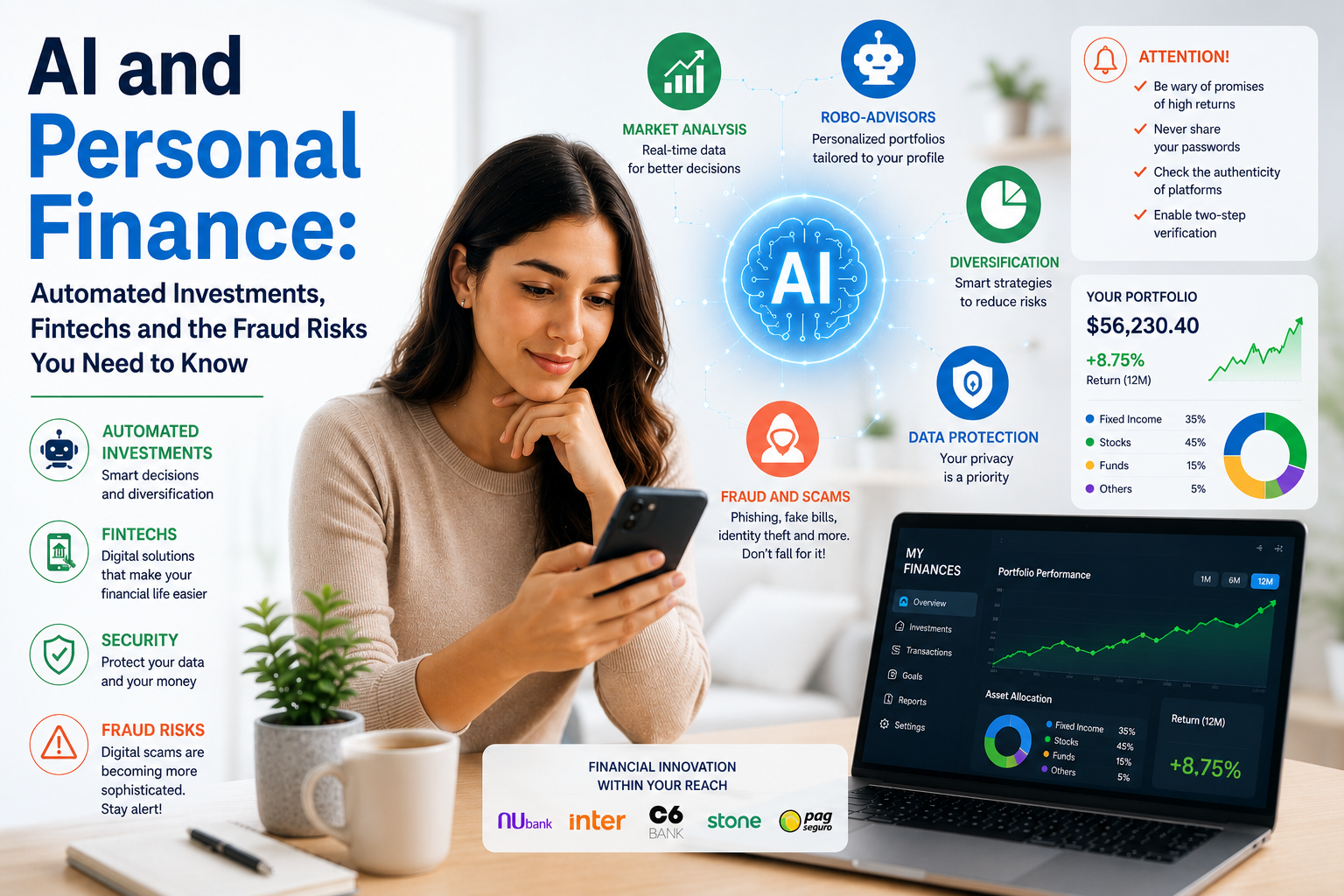
What Is AI Applied to Finance?
When people hear "AI in finance," most picture robots buying stocks on their own — but the reality is far broader and far more present in everyday life than that. Financial AI is, fundamentally, a set of techniques that do six core things: analyze massive volumes of data no human could process manually, identify behavioral patterns, forecast trends based on historical data, automate repetitive decisions, detect fraud in real time, and offer personalized recommendations for each user profile.
What makes this field especially interesting is the scale of adoption: it's not a niche technology restricted to billion-dollar hedge funds. It's present in traditional banks, brokerages, insurers, fintechs, and the personal finance apps anyone can download for free. If you've ever gotten an alert from your bank about a "suspicious purchase" or an investment suggestion inside your brokerage app, you've already interacted with financial AI — probably without noticing.
How Banks and Fintechs Use AI in Practice
Behind the simple experience of opening a banking app sits an artificial intelligence infrastructure working continuously. These are the functions where AI already operates decisively across the financial system:
- Credit analysis: models that evaluate hundreds of variables — far beyond the traditional credit score — to decide approval and interest rates in seconds
- Chatbot customer service: resolving simple questions, reissuing statements, blocking cards, and checking balances without waiting on hold
- Biometric authentication: facial and voice recognition for login and transaction confirmation, replacing easily compromised passwords
- Suspicious transaction detection: algorithms comparing each purchase against the user's historical pattern and preemptively blocking out-of-profile operations
- Personalized offers: financial products suggested based on spending behavior and life stage
- Automated loan approval: personal loan and financing decisions processed without manual review in most cases
- Automatic expense categorization: classifying every purchase into categories (food, transport, entertainment) with zero effort from the user
When you swipe your card at a store, an entire chain of AI decisions happens in under a second: spending pattern verification, location check, fraud risk analysis, and transaction approval (or block) — all while the payment terminal is still processing.
AI Financial Assistants: Your Money's Copilot
Unlike the institutional functions banks run, personal financial AI assistants are tools aimed directly at the end user — usually inside personal finance apps or built into the bank's own app. Their most useful functions include:
- Organizing income and expenses: connecting bank accounts and cards to consolidate your entire financial life into a single dashboard
- Automatic budget creation: suggesting spending limits per category based on your real historical behavior, not generic spreadsheet templates
- Bill due-date alerts: avoiding late fees and interest from forgotten payments
- Identifying recurring charges: surfacing forgotten subscriptions and services you're paying for but no longer use
- Suggesting savings goals: calculating a realistic monthly savings amount based on your income and spending pattern
- Projecting cash flow: showing whether you'll end the month positive or negative before it happens
- Answering financial literacy questions: explaining concepts like APY, compound interest, or diversification on demand
The most accurate analogy for these assistants is an airplane copilot: they monitor, alert, and suggest — but the final decision about spending, investing, or not investing remains yours. An AI assistant can tell you that you're spending 40% of your income on delivery food; only you can decide whether that's a problem or a conscious choice.
Automated Investing: How Robo-Advisors Work
Robo-advisors are platforms that automate investment management using algorithms — without a human advisor manually building your portfolio. The process, across most platforms, follows a well-defined logic:
How a Robo-Advisor Builds Your Portfolio
- Investor profile assessment: a questionnaire evaluates risk tolerance, investment horizon, and financial goals
- Diversified portfolio construction: the algorithm distributes capital across asset classes (bonds, stocks, REITs, international) according to the identified profile
- Automatic rebalancing: when one asset grows faster than others and throws off the planned proportion, the system sells part of the winner and buys the laggard — automatically
- Long-term goal tracking: the system adjusts strategy as you approach a target (retirement, home purchase, etc.)
- Reducing impulsive decisions: since management is automated, it removes the temptation to panic-sell everything during a market downturn
Process automation is completely different from guaranteed results. A robo-advisor can build the most technically sound portfolio in the world and still lose money in a crash year — because it manages risk, it doesn't eliminate risk. No AI, however sophisticated, can guarantee positive returns on equity investments.
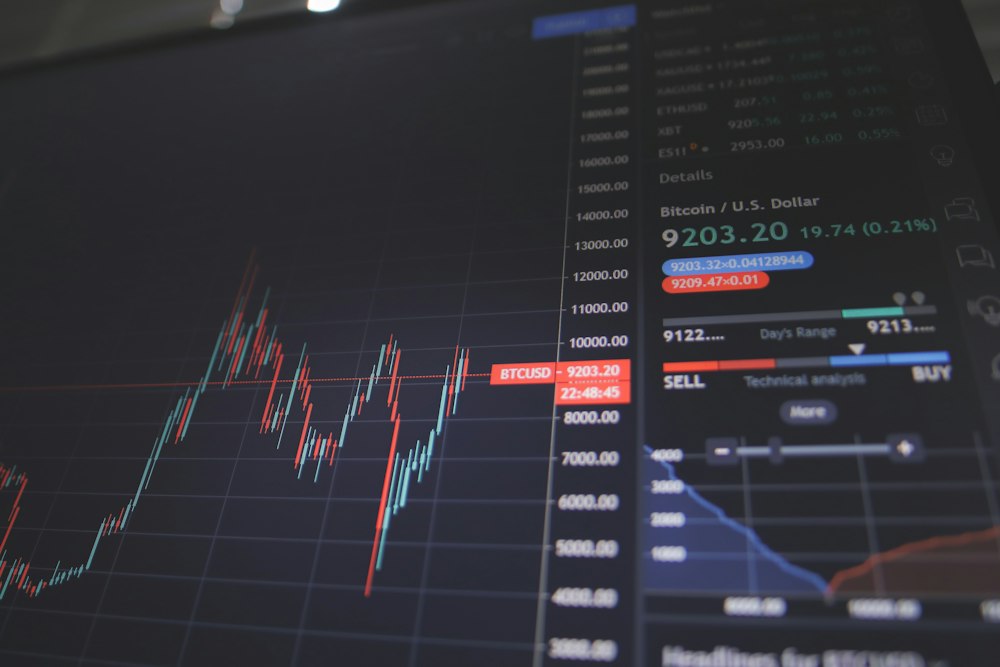
AI in Financial Markets: Institutional vs. Individual Investor
It's important to separate two worlds that often get conflated in popular imagination: institutional use of AI (funds, investment banks) and the tools available to everyday individual investors.
Institutional-Level Applications
- Algorithmic trading: systems executing thousands of trades per second based on complex mathematical models — today responsible for the majority of volume traded on global exchanges
- Real-time news analysis: AI reading thousands of news stories, reports, and filings simultaneously to identify potential impact on assets before humans can process the information
- Social media sentiment analysis: monitoring mentions of companies and assets to capture shifts in market perception
- Volatility forecasting: models estimating the probability of large price swings, used to size portfolio risk
- Large-scale risk management: continuous monitoring of billion-dollar funds' exposure to different market scenarios
What Reaches the Everyday Investor
Individual retail investors don't have access to the high-frequency algorithmic trading infrastructure of large funds — and it's important to be clear about that to manage expectations. What's actually available: robo-advisors for portfolio management, price alerts and opportunity notifications, automated fundamental analysis reports, and assistants that explain economic indicators in plain language. It's a real and useful level of sophistication, but categorically different from what runs on the trading floors of major banks.
Financial Education with AI: Learning at Your Own Pace
One of financial AI's most underrated applications is its educational potential. Language assistants can:
- Explain complex financial concepts in plain language, adapting depth to your familiarity with the topic
- Create personalized study plans on investing, progressing from basics to advanced concepts
- Simulate investment scenarios showing hypothetical projections of different strategies over time
- Compare financial products side by side — fees, liquidity, risk, and historical returns
- Help define realistic financial goals, breaking large targets into achievable monthly steps
AI assistants are excellent teachers of general concepts, but poor at full personal context. They don't know you have a hidden family debt, that your job is unstable, or that you have low emotional tolerance for losses. Use AI to learn the concepts; use your own judgment (or a human professional) to apply them to your specific reality.
A Day With an AI Financial Assistant
To make this concrete, follow the routine of Sarah, 29, who has used an AI financial assistant built into her banking app for six months:
7:15 AM — Morning notification. Still in bed, she gets a summary: "You spent $85 more than planned on food delivery this month. At this rate, your December trip goal will be delayed by 2 months." No judgment, just data.
12:30 PM — Budget adjustment. Over lunch, she opens the app and moves $50 from "entertainment" to "travel" — a conscious decision based on the morning's alert, not a suggestion she blindly accepted.
6 PM — Investment review. Her robo-advisor shows the portfolio drifted 4% from the target allocation because international stocks appreciated. It suggests automatic rebalancing. She approves — but first reads the explanation of why the algorithm recommends selling part of the winning position (locking in gains and maintaining the planned diversification).
9 PM — The limit of AI. A friend calls offering "an incredible opportunity" to invest in a company promising to triple capital in 3 months. No AI assistant will warn her about this — because she never asked the app, and no AI has access to her personal phone calls. She recognizes the scam signals on her own, because she learned from her own assistant, over the months, what an unrealistic return promise looks like.
Real Benefits of AI in Personal Finance
Bringing together everything covered so far, the concrete gains financial AI delivers day-to-day are substantial and measurable:
- Speed: decisions that would take days of manual analysis happen in seconds
- 24/7 availability: your money is monitored while you sleep, without depending on business hours
- Personalization: recommendations calibrated to your specific profile, not generic blog advice
- Reduced operational errors: fewer human mistakes in repetitive calculations, categorizations, and processing
- Continuous monitoring: unusual patterns detected before they become big problems
- Greater financial organization: a consolidated, automatic view of your entire financial life
- Decision support: data and projections that inform better choices, without replacing final judgment
The Risks: What Can Go Wrong
No honest article about financial AI can limit itself to the benefits. The risks are real, growing, and in some cases have already cost unsuspecting victims fortunes. This is, deliberately, one of the most complete sections of this guide.
AI-Powered Fraud: Scams Got Dramatically More Sophisticated
The same technology protecting your money is also being used by criminals to steal it — and methods have evolved dramatically in recent years:
- Voice cloning: with just a few seconds of audio (sometimes pulled from public social media videos), criminals generate a synthetic voice indistinguishable from the real one to call relatives requesting urgent transfers
- Deepfake videos: fake recordings of executives, celebrities, or even family members "confirming" money requests or promoting fraudulent investment schemes
- Hyper-personalized phishing: AI-generated emails and messages that perfectly mimic your real bank's tone, style, and context — without the spelling errors that used to give away old scams
- Mass AI-generated messages: scammers produce thousands of variations of the same fraudulent message, making automatic spam-filter detection harder
- Fake financial advisors: complete profiles (photo, bio, post history) generated by AI to appear as a trustworthy financial expert, promoting nonexistent investments
In 2024, a multinational in Hong Kong transferred the equivalent of $25 million after an employee joined a video call where they "recognized" their CFO and other colleagues — all AI-generated deepfakes. None of the people on the call were real, except the victim.
Incorrect Information: When AI Errs With Confidence
Financial AI assistants share a dangerous limitation with all large language models: they can err with the same fluency and naturalness with which they get things right.
- Misinterpreting data: AI can confuse contexts or apply a generic financial rule to a situation that requires an exception
- Outdated information: interest rates, tax brackets, and investment rules change frequently — a model trained up to a certain date may not reflect current law
- Overconfident answers: AI rarely says "I'm not sure" when it should, presenting estimates as if they were definitive facts
Excessive Dependence: the Silent Risk
More dangerous than a one-off error is the behavioral pattern that sets in when trust in AI becomes blind dependence:
- Blindly trusting recommendations without understanding the logic behind them — which prevents you from spotting when something is clearly wrong
- Ceasing to study investments because "the AI already thinks for me," losing the ability to critically evaluate new opportunities
- Taking on risk incompatible with your actual profile because a generic algorithm suggested an allocation that doesn't account for real emotional factors (like your actual reaction to a 20% loss)
Privacy: Your Financial Data Demands Extra Protection
Financial AI tools collect an extraordinary volume of sensitive information: income, detailed spending habits, purchase locations, total net worth, and complete banking history. This dataset is particularly dangerous because, unlike a leaked password (which can be changed), a person's complete financial profile is practically permanent and reveals extremely intimate life patterns — from how much you earn to where you'll likely be on a given day of the week, based on your recurring purchases.
| Data collected | Why it's sensitive |
|---|---|
| Income and net worth | Reveals purchasing power, making the person a potential target for scams and targeted crime |
| Spending habits | Allows inference of routine, likely location, and even emotional state (impulse spending) |
| Complete banking history | Combined with other leaks, allows reconstruction of a person's entire financial life |
| Transaction location | Precisely maps physical movements, creating personal safety risk |
How to Spot an AI-Generated Financial Scam
The good news is that, despite the technical sophistication, AI scams still follow recognizable behavioral patterns. Watch for these warning signs:
- Exaggerated urgency: "you need to decide now," "this offer expires in 1 hour" — time pressure is the oldest (and still most effective) financial manipulation tool
- Unrealistic return promises: any investment guaranteeing fixed returns far above traditional fixed-income yields, with no corresponding risk, is an absolute red flag
- Synthetic voice or video profiles: calls or videos from family/executives asking for money deserve verification through a second channel (call back on a known number, never the number that called you)
- Requests to transfer to unknown accounts: especially if the "familiar" person never asked this before or suddenly changes accounts
- Suspicious links in messages: even if the text looks perfect (without the typos of old scams), always verify the actual URL before clicking
If someone asks for money or financial data via voice, video, or message — hang up and call back using a number you already had saved, never the contact that just called you. This single practice defeats the vast majority of voice cloning and deepfake scams, because the criminal has no access to your independent verification channel.
Can AI Predict the Stock Market?
This is, without question, one of the most-searched questions on the topic — and the honest answer disappoints anyone hoping for a magic formula. AI can, in fact, identify historical patterns, process volumes of information impossible for humans, and generate sophisticated probabilistic scenarios. What it cannot do is predict the market with certainty.
The reason is structural, not a technical limitation that "more data" or "better models" will fix: financial markets are systems influenced by truly unpredictable events — sudden political decisions, natural disasters, regulatory changes, geopolitical crises, and even irrational mass human behavior (bubbles and panics). A model trained on historical data has no way to "predict" an event that has never occurred in that exact form before.
There's an even deeper conceptual problem: if an AI really could reliably predict the market, everyone with access to it would act on that prediction — and that collective action itself would move prices before the prediction materialized, canceling it out. It's a logical limitation, not merely a technical one.
Will AI Replace Financial Advisors?
As with other professions analyzed on this site, the honest answer is nuanced: part of the work will be automated, but the essence of financial advisory has components technology doesn't reach.
| What AI does well | What still requires a human professional |
|---|---|
| Complex calculations and numerical simulations | Estate planning: strategies involving multiple generations and complex family goals |
| Analyzing large volumes of market data | Wealth succession: emotional and family issues in inheritance and asset division |
| Automating portfolio rebalancing | Advanced tax strategy: legal structuring requiring judgment on specific cases |
| Continuous investment monitoring | Alignment with family goals: conversations about values, priorities, and conflicts among family members |
| Generating reports and projections | Financial behavior: understanding why someone sabotages their own financial goals and helping change that pattern |
The most likely trend isn't replacement, but complementarity: financial advisors who master AI tools can serve more clients with more depth, delegating raw data analysis to the algorithm and focusing their human time exactly where it makes a real difference — in the hard conversations about money, family, and life goals.
Regulation: Who's Watching Financial AI?
The growing use of AI in the financial sector has raised a set of regulatory questions that authorities worldwide, including the SEC and the Federal Reserve in the US, are increasingly focused on:
- Financial data protection: privacy regulations increasingly set specific rules for handling financial data, considered sensitive for the wealth of information it reveals
- Accountability for automated decisions: when an algorithm denies credit or recommends an unsuitable investment, the financial institution remains legally responsible — AI is not a liability shield
- Algorithm transparency: regulators increasingly require institutions to explain, at least in general terms, how their credit and investment algorithms make decisions
- Anti-money laundering: the same AI that analyzes spending patterns to detect fraud is also used to identify suspicious money laundering activity
- Ethical use of AI in financial services: growing debate over algorithmic bias in credit approval, which can reproduce historical discrimination even without intent
What Changes With Open Banking and AI
Open Banking — the system allowing authorized sharing of financial data between institutions, with explicit user consent — dramatically enhances what financial AI can offer. By accessing data from multiple banks, cards, and investment accounts simultaneously (always with your explicit authorization), algorithms can build a far more complete picture of your real financial situation.
This enables genuinely more personalized recommendations: an assistant that sees your checking account, your credit card from a different bank, and your investments at a separate brokerage can suggest, for example, that you pay off an expensive debt using part of a low-yield emergency fund — something impossible to calculate when each institution only sees an isolated slice of your financial life.
More shared data means a larger risk surface. Every Open Banking authorization you grant is a new access point to your financial data — periodically review which data-sharing permissions you have active and revoke the ones you no longer use. Consent is reversible, but only if you remember to manage it.
10 Mistakes AI Can't Prevent for You
No technology, however advanced, replaces fundamental human decisions. These are the financial mistakes that remain entirely your responsibility — AI can flag them, but it can't decide for you:
- Spending more than you earn — the assistant can show the alert in real time; ignoring it is a human choice
- Investing without an emergency fund — no algorithm stops you from putting all your money into risky assets without a safety cushion
- Following guaranteed-profit promises — greed overrides the skepticism any rational person should have toward unrealistic returns
- Ignoring diversification — even with a robo-advisor suggesting a diversified portfolio, you can choose to concentrate everything in one asset "because you trust it"
- Making decisions based on emotion — panic-selling everything during a downturn, even if the system recommends staying the long-term course
- Not reading what you're signing — accepting financial product terms without understanding fees and conditions, even when the information is available
- Trusting unverified sources — believing a "hot tip" investment from a group chat without checking its origin
- Impulse buying and calling it investing — behavior no algorithm detects if you misclassify it yourself
- Postponing financial planning — no AI tool acts while you never open the app
- Not asking for help when the problem is bigger — complex debt and real financial crises require specialized human intervention, not a chatbot
The Future of Finance With AI
Projecting trends already in motion, the financial landscape of coming years should include developments already in early-stage implementation:
- Autonomous personal financial agents: assistants that don't just alert, but execute pre-authorized actions — like moving money between accounts to optimize yield without waiting for a manual command
- Deep integration with digital wallets: payments, investments, and credit unified into a single intelligent interface
- Fully automated financial planning: from tax filing to retirement rebalancing, all coordinated by AI with minimal human oversight
- Smart payments: systems that automatically choose the best payment method (card with more cashback, account with available balance) for each purchase
- AI natively embedded in banking apps: no longer an add-on feature, but the default mode of interacting with the bank
- Extreme personalization of financial products: insurance, loans, and investments individually designed for each profile, no longer mass-standardized products
Speculation: the Dream of the "Omniscient Financial Manager" — Where Science Ends and Fiction Begins
Every debate about the future of AI-powered finance eventually bumps into visions that sound like science fiction. It's worth rigorously separating what's real research in progress, what's plausible speculation for the coming decades, and what will probably remain impossible.
What's in Real Development
- AI agents with limited transactional autonomy: systems already executing small automatic optimizations (like moving idle balance to an interest-bearing account) within limits pre-authorized by the user — mature and expanding technology
- Increasingly granular predictive risk models: credit risk analysis incorporating hundreds of alternative variables (browsing patterns, utility bill payment behavior) beyond traditional banking history
What's Plausible Speculation (Years, Not Decades)
- Fully autonomous, personalized financial advisory: a system that deeply knows your psychological profile, complete history, and life goals, offering guidance as contextualized as a human advisor dedicated exclusively to you. Technically feasible as an extrapolation of current trends; the main barrier isn't technical, but regulatory and about user trust
- AI agents negotiating complex financial contracts with each other: automated systems negotiating loan or insurance terms between themselves, representing opposing interests, with human oversight only on final approval
What's Pure Fiction (and Probably Will Remain)
Perfect, infallible prediction of financial markets — the dream of an AI that "always gets it right" — runs into a limitation that isn't about processing power or data, but mathematical and philosophical nature. Markets are complex adaptive systems: the very act of acting on a prediction changes the system that generated the prediction. An algorithm that always got it right would be immediately copied by every market participant, and that collective action would move prices before the original prediction materialized — a logical paradox no processing breakthrough solves, because the limitation lies in the structure of the problem itself, not in available computational capacity.
The good news hidden in that limitation: if an AI existed capable of predicting markets with absolute certainty, it would eliminate the very reason financial markets exist as we know them — there would no longer be buyers and sellers disagreeing about future value, just an oracle dictating prices. Uncertainty isn't a flaw in the financial system to be fixed by technology — it's the structural feature that makes markets work. AI can reduce some inefficiencies and improve risk management; it cannot — and mathematically will not be able to — eliminate the fundamental uncertainty of the future.
How to Use AI to Improve Your Financial Life Without Losing Control
Closing this guide with a practical, direct roadmap — what to do, in the right order, to harness financial AI safely:
- Set clear financial goals before opening any app — AI organizes better when you already know what you're trying to achieve
- Use AI to organize, not to decide everything for you — treat suggestions as a starting point for your own analysis, not a final verdict
- Verify information against reliable sources — especially data about taxes, fees, and rules that change frequently
- Diversify investments even when an algorithm suggests concentration — question recommendations that stray from common-sense risk management
- Periodically review automated recommendations — what made sense a year ago may no longer fit your current situation
- Protect your accounts with two-factor authentication — the simplest and most effective security layer against unauthorized access
- Maintain ongoing financial education — the more you understand the fundamentals, the better you can critically evaluate any AI recommendation
Frequently Asked Questions About AI and Personal Finance
It can automate specific tasks — organizing spending, suggesting budgets, rebalancing portfolios — but shouldn't be left alone for major financial life decisions without oversight. The recommendation is to use AI as a support and organization tool, keeping yourself in control of strategic decisions: how much to invest, what risk to take, and when to change strategy.
For most people, yes — especially for budget organization, spending alerts, and automatic expense categorization. The time and organization gains usually outweigh the limitations, as long as you understand the assistant organizes and suggests, but doesn't replace your judgment on important financial decisions.
They're safe in the operational sense — they use regulated infrastructure and follow tested diversification strategies. But "safe" doesn't mean "risk-free": like any equity investment, robo-advisors can lose value during downturns. Automation reduces operational errors and impulsive decisions; it doesn't eliminate inherent market risk.
By comparing each transaction against the user's historical pattern — typical purchase amount, usual location, habitual time, and merchant category. When a transaction significantly deviates from that pattern (a high-value purchase in another country at 3 AM, for example), the system preemptively blocks it and requests confirmation, all in fractions of a second.
Not with certainty. AI identifies historical patterns and generates probabilistic scenarios, but markets are influenced by truly unpredictable events (politics, disasters, crises). There's also a logical limitation: if a prediction were always reliable, everyone would act on it, and that collective action would move prices before the prediction materialized.
It depends on the institution and applicable regulation. Privacy laws increasingly require special protection for financial data. Check whether the platform is regulated by the relevant financial authority, holds security certifications, and clearly discloses how it uses and shares your data. Always prefer official apps and platforms, never unregulated tools promising "simplified" access to banking data.
Be suspicious of exaggerated urgency, guaranteed-profit promises, and unexpected transfer requests — even if they come from a voice or video that seems familiar. The most effective defense is always verifying through a second channel: if you get a call asking for money, hang up and call back using a number you already had saved, never the number that called you.
Conclusion: Technology on Your Side, Decisions in Your Hands
Artificial intelligence has already profoundly transformed how banks operate, how investments are managed, and how we organize our money day to day — and that transformation will only deepen in the coming years. But this guide's central point deserves repeating: financial AI is a powerful tool for organization, automation, and analysis, not a substitute for personal financial judgment, ongoing education, and healthy skepticism toward promises too good to be true.
Start small: if you don't yet use any financial assistant, try one to organize your spending this month. If you already do, review today whether you're verifying important information against reliable sources, or just accepting recommendations without understanding the logic behind them. The right technology, used with judgment, can be the difference between an organized financial life and decades of decisions made in the dark — but the final responsibility for your money was never anyone's but yours.
Analysis like this, before everyone else
Technology, AI, finance and digital security — no spam, straight to the point, every week.