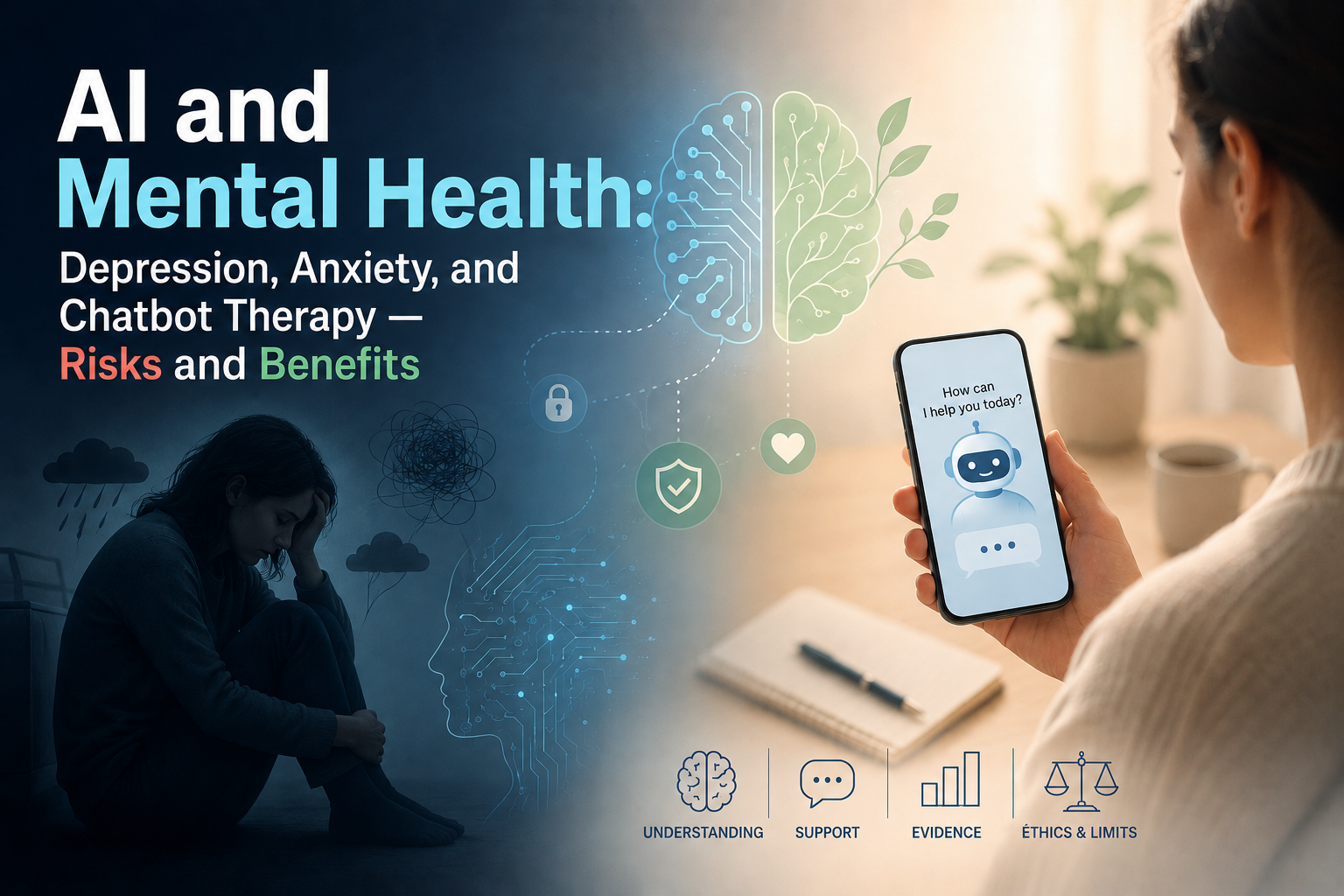
A Global Mental Health Crisis Nobody's Quite Solving
Before getting into the technology, it's worth understanding the scale of the problem it's trying to address. The world is in the middle of a mental health crisis that's growing faster than health systems can respond to it. That's not a dramatic exaggeration — it's a structural mismatch between demand and supply that's been building for decades, and the 2020 pandemic only sped it up.
Those numbers alone are alarming. The problem gets worse when you look at the gap between who needs help and who can actually get it. In nearly every country — including the wealthiest ones — a combination of factors pushes people away from the care system entirely:
- A shortage of providers: entire countries have fewer than one psychiatrist per 100,000 people, and even in major cities, the wait for a first appointment can stretch for months.
- High cost of treatment: a single private therapy session can cost the equivalent of a full day's wages, making ongoing care unaffordable for a huge share of the population.
- Long public-system waitlists: in public health systems, the gap between asking for help and getting a first psychological appointment often stretches into weeks or months — a dangerous window for someone in acute distress.
- Social stigma: in many cultures, admitting to psychological distress is still treated as weakness, which delays people from seeking help in the first place.
- Geographic inequality: rural areas and smaller towns often have almost no mental health providers nearby, forcing long travel or fully remote care as the only options.
It's exactly in that gap — between urgent need and insufficient supply — that artificial intelligence found room to step in. Not because anyone decided "AI is better than human therapy," but because, in practice, the alternative for millions of people isn't "chatbot versus therapist." It's "chatbot versus nothing at all."
Understanding this backdrop completely changes how you should evaluate AI in mental health. It's not competing with ideal clinical care — it's competing with a total absence of support that affects most of the world's population. That difference in baseline is the key to an honest assessment of the whole topic.
What "AI Therapy" Actually Means
Here's the first misconception worth clearing up: "AI therapy" doesn't just mean opening ChatGPT and venting. There's an entire ecosystem of platforms built specifically for emotional support, each with different architectures, clinical protocols, and therapeutic goals. Lumping these categories together is one of the most common mistakes — made both by people who defend the technology uncritically and by people who dismiss it outright.
The Main Categories of Platforms
Broadly speaking, the AI-for-mental-health market splits into three major product families, each with a different value proposition:
| Platform | What it offers | Technical foundation |
|---|---|---|
| Woebot | Structured chatbot with short daily sessions, focused on CBT techniques for mood and anxiety | Pre-defined clinical rules + natural language processing |
| Wysa | Emotional support assistant with guided exercises, mood journaling, and optional handoff to human coaches | Conversational AI + library of evidence-based protocols |
| Replika | Broader-purpose conversational companion, built for connection and venting rather than strict clinical use | Generative language model with personalized "personality" |
| ChatGPT and general-purpose assistants | Informal use for organizing thoughts, getting psychoeducation, and reflecting on situations | General-purpose language model, no dedicated clinical protocol |
The difference between these categories isn't just marketing. Platforms like Woebot and Wysa were designed with input from clinical psychologists, follow scripts based on validated therapeutic protocols, and have clear limits on what they can and can't do. A general-purpose assistant like ChatGPT, on the other hand, wasn't built with that specific purpose in mind — it can still be useful, but it doesn't carry the same built-in safeguards or clinical structure.
The Technology Running Behind the Scenes
Behind the friendly chat interface of any mental health chatbot, several technologies work together:
- Natural language processing (NLP): lets the system interpret what someone is saying, recognize speech patterns linked to certain emotional states, and generate responses that fit the context.
- Structured cognitive behavioral therapy (CBT): many platforms build CBT techniques — one of the most studied and scientifically validated therapeutic approaches — directly into the conversation, turning classic cognitive-restructuring exercises into guided chat flows.
- Sentiment analysis: algorithms that try to identify the emotional tone of a message (sadness, anger, anxiety, hope) to adapt the next response accordingly.
- Machine learning: over time, some systems adjust the type of exercise or content suggested based on a user's interaction history, though real personalization still falls well short of what a human therapist provides.
It's worth flagging a nuance that doesn't get discussed enough: most of these systems don't actually "understand" emotions the way a human does. They recognize statistical patterns in text and respond based on probabilities learned during training. That doesn't make them useless in practice, but it's essential for setting realistic expectations — especially during moments of more intense distress.
The Real Benefits of AI in Mental Health
Before getting into the risks — which are real and serious — it's worth being honest about where these tools actually add value. Ignoring the benefits would be just as intellectually dishonest as ignoring the dangers.
24/7 Availability, No Exceptions
This is, without question, the biggest practical edge AI has over traditional care. Emotional crises don't follow business hours. A panic spiral at 4 a.m., a wave of sadness on a holiday weekend, a moment of dread during a trip — in every one of these scenarios, traditional therapy simply isn't accessible. AI is.
- Available in the middle of the night, with no on-call requirement
- Works on holidays and weekends, when offices are closed
- No appointment needed, no waiting room
- Accessible from anywhere with an internet connection
Lowering the Financial Barrier
Most AI-based emotional support platforms offer free tiers or pricing that's a fraction of a traditional therapy session. That doesn't mean they replace professional treatment — it means they widen access to a first layer of support for people who otherwise wouldn't have any help at all.
Less Fear of Judgment
A pattern that shows up consistently in research on this topic: many people report feeling freer to open up about difficult things when they first talk to an AI rather than a human. That's especially true for:
- Anxious feelings someone considers "irrational" or "overblown"
- Episodes of deep sadness and a sense of hopelessness
- Chronic loneliness and trouble connecting with other people
- Recurring negative thoughts someone feels too embarrassed to say out loud to anyone they know
There's a known psychological explanation for this: the perceived absence of judgment — even if only partial — lowers the initial barrier to opening up. For a lot of people, "rehearsing" how to put a problem into words with an AI before bringing it to a human professional works as a bridge, not a replacement.
Scale Like Nothing Else
A single AI system can, in theory, support millions of people at the same time, with no waitlist and no "slots in the calendar." From a public health standpoint, that's powerful: even if the quality of support is lower than what a human psychologist provides in complex cases, the ability to reach a massive number of people with at least some baseline support has real value — particularly in regions with severe provider shortages.

How AI Specifically Helps With Anxiety
Anxiety, by nature, involves a lot of physical symptom monitoring and repetitive thought patterns — characteristics that lend themselves reasonably well to structured, routine-based tools. It's one of the areas where AI apps show the most consistent results in early research.
Practical Features on Offer
- Guided breathing exercises: protocols like 4-7-8 breathing or diaphragmatic breathing, with a built-in timer and step-by-step instructions inside the app.
- Progressive relaxation techniques: muscle relaxation scripts that help ease the physical tension that comes with anxiety spikes.
- Guided meditation and mindfulness: short sessions (usually 3 to 10 minutes) focused on grounding in the present moment, a technique widely used in mindfulness-based therapies.
- Trigger identification: by logging mood and context repeatedly, some systems can flag patterns — for example, "you reported high anxiety on 4 of the last 5 Sunday nights" — helping users notice their own recurring triggers.
- Structured mood journaling: instead of a blank journal, the app guides specific prompts that make self-reflection easier and generate useful data to track progress over time.
Built on Cognitive Behavioral Therapy
Most of the exercises these platforms offer are adapted directly from CBT protocols, the approach with the largest body of scientific evidence for treating anxiety. A concrete example: when an AI asks a user to "identify the automatic thought," "weigh the evidence for and against it," and then "reframe it in a more balanced way," it's reproducing, in chat format, a classic cognitive-restructuring exercise — a technique human therapists have used for decades.
Mild to moderate anxiety, without complex co-occurring conditions, tends to respond reasonably well to this kind of structured support — particularly as a complement to other forms of care, not as the sole source of treatment.
How AI Can Support People With Depression
Depression is harder to address through AI than anxiety, mainly because it involves symptoms like anhedonia (loss of pleasure), deep fatigue, and, in more severe cases, real risk to someone's life. Still, there are legitimate, useful applications — always as a complement, never as a replacement for professional care in moderate to severe cases.
Applications That Already Work in Practice
- Ongoing mood tracking: simple daily check-ins ("how are you feeling today, on a scale of 1 to 10") build a history that both the user and, eventually, a human professional can use to spot trends toward worsening or improvement.
- Self-care reminders: nudges to drink water, step outside, get sunlight, or keep a sleep schedule — things that sound trivial but are often the first to slip during a depressive episode.
- Encouragement toward small healthy habits: suggestions for low-effort activities (a short walk, reaching out to a friend, getting natural light) that have scientific backing as supportive measures alongside depression treatment.
- Early detection of worsening signs: in some more advanced systems, language pattern analysis over time can flag concerning shifts — like an increase in hopelessness-related words — so the person (or a professional monitoring the case) gets an alert.
- Support between therapy sessions: arguably the most promising and currently most underused application. AI can act as a bridge between appointments — logging what happened during the week, reinforcing exercises assigned by a therapist, and helping someone prepare for the next session.
AI can offer structural support and ongoing monitoring, but it doesn't replace a medical or psychological diagnosis. Depression is a clinical condition that can have biological causes, may require medical evaluation, and often needs medication — something entirely outside the scope of any chatbot available today.
ChatGPT's Specific Role in Mental Health
Unlike the specialized platforms mentioned above, ChatGPT and general-purpose AI assistants weren't built with a clinical mission — but in practice, millions of people already use them informally as a kind of "first place to vent." That spontaneous use deserves its own analysis, because it carries both real upside and specific risks.
What ChatGPT Does Well
- Listening without rushing or interrupting: someone can write as much as they want, at their own pace, without the social pressure of "taking up someone's time."
- Helping organize tangled thoughts: one of the most underrated uses — asking the AI to "help organize" a messy emotional situation into bullet points often brings real clarity, even without any therapeutic advice involved.
- Explaining psychological concepts: terms like "generalized anxiety," "rumination," "attachment style," or "burnout" can be broken down in accessible language, helping people better understand what they're feeling.
- Suggesting reflection prompts: simple Socratic questions ("what makes you think that?", "is that the only way to look at this situation?") that encourage self-reflection.
- Actively pointing toward professional help: well-tuned models tend to recommend therapy or medical evaluation in situations that go beyond what a text conversation can resolve.
What ChatGPT Can't (and Shouldn't) Do
- Diagnose mental health conditions: diagnosis requires structured clinical evaluation, a full medical history, and often additional testing — none of which can be safely done through a text exchange.
- Prescribe medication: adjusting psychiatric medication involves individual variables (weight, medical history, other medications, side effects) that only a doctor can responsibly assess.
- Replace the therapeutic relationship with a psychologist: a significant part of psychotherapy's effectiveness comes from the therapeutic relationship itself — something a language model, by definition, can't genuinely replicate.
- Handle serious crises on its own: high-risk situations — active suicidal ideation, psychotic episodes, intense panic crises — require specialized human intervention, not a conversation with a chatbot.
The safest and most productive way to use ChatGPT in this context is as a complementary tool for organizing thoughts and psychoeducation — never as the sole source of emotional support, and never as a substitute for treatment a professional has already recommended.
The Real Risks of AI in Mental Health
This is, without exaggeration, the most important section of this article. All the legitimate enthusiasm around AI's benefits needs to be balanced against an honest look at the risks — because, unlike most other AI use cases, what's at stake here is emotional well-being and, in extreme cases, someone's physical safety.
Misreadings and Incorrect Interpretations
Language models can misread the emotional context of a message, especially when there's irony, sarcasm, defensive minimizing ("I'm fine, just a bit tired" from someone genuinely struggling), or region-specific slang. A poorly calibrated response in that moment can leave someone feeling misunderstood — or worse, validate a flawed self-assessment that delays them from getting real help.
Emotional Dependency on the Chatbot
This is an increasingly documented phenomenon, especially on companionship-focused platforms like Replika. Some users develop intense emotional bonds with their AI assistants — to the point of treating them as close friends, romantic partners, or even a primary attachment figure. The issue isn't that the bond exists; it's what it might be replacing.
Creeping Social Isolation
There's a real risk — still being studied, but already observed clinically — that some people gradually swap real human relationships for artificial ones. Unlike real people, AI is always available, rarely pushes back in uncomfortable ways (unless specifically designed to), and never brings the natural friction of genuine human relationships. For someone already vulnerable to isolation — through depression, social anxiety, or chronic loneliness — that "ease" can end up reinforcing the exact pattern that needed to be broken.
The False Sense of Being "in Treatment"
This risk is subtle but extremely relevant: getting empathetic, well-written responses from an AI doesn't mean someone is receiving adequate clinical care. There's a huge gap between "I felt heard during that conversation" and "I'm receiving structured treatment for my condition." People with moderate to severe symptoms can, without realizing it, delay seeking professional help because they feel like they're "already getting treated" by chatting regularly with a chatbot.
Privacy and Protection of Sensitive Data
Conversations about mental health are, by definition, extremely sensitive data. Before using any platform like this, it's worth asking questions most users never actually stop to consider:
- Where is conversation data stored, and for how long?
- Who inside the company has technical access to those conversations?
- Is the data used to train future AI models?
- Could it be leaked, sold, or shared with third parties (advertisers, insurers, employers)?
- Does the platform comply with data protection laws like the GDPR (EU) or similar regulations in your country?
Before sharing deeply personal information with any AI platform, skim the privacy policy — even just the highlights. Stick to platforms that are transparent about data storage and use, and be wary of free apps with no clear business model: in those cases, the user's data is often the actual product.
Ethical Questions That Still Don't Have a Clear Answer
Beyond the practical risks, there's a set of ethical debates that remain open — without global consensus, still being worked out alongside the technology itself.
Who's Responsible When AI Gets It Wrong?
If a mental health chatbot gives bad guidance and that contributes to someone's condition worsening, who's accountable? The possibilities under debate include:
- The company that built it: for not implementing sufficient safeguards, or for marketing promises that go beyond what the product actually delivers.
- The professional who recommended the tool: if a therapist or doctor pointed a patient toward a specific app without properly evaluating its limits.
- The user themselves: the most controversial argument, since it places responsibility on someone who's often in a vulnerable state precisely because they're seeking help.
The emerging — and still early — regulatory trend leans toward holding the developing companies primarily accountable, requiring clear disclosure of limitations and mandatory referral protocols for high-risk situations.
The Risk of Emotional Manipulation
An uncomfortable but necessary question: could an AI optimized for "engagement" (time spent, daily return rate, product stickiness) end up reinforcing usage patterns that aren't actually healthy for the user, even unintentionally? That's a structural conflict of interest in any digital product built around a retention-based business model — and it gets especially delicate when the product in question deals with emotional vulnerability.
Psychological Data Demands Strict Protection
Information about trauma, depression history, anxiety patterns, and emotional crises is among the most sensitive data a person can share digitally — comparable, in sensitivity, to medical records. Unlike a traditional clinical chart, though, this data isn't always subject to the same strict confidentiality regulations, depending on jurisdiction and how the company classifies its own product (calling itself a "wellness app" instead of a "medical device," for instance, completely changes the level of regulatory oversight that applies).
Can AI Replace Psychologists? A Balanced Answer
This is probably the most-searched question on this whole topic — and it deserves an answer that avoids both extremes: the overly optimistic "AI will democratize therapy for everyone" and the reflexive pessimism of "this is all dangerous and should be banned." The honest answer is: it depends on what exactly is being compared, and for what purpose.
| Function | AI does this well | Human psychologists do this better |
|---|---|---|
| Initial screening and psychoeducation | ✓ Yes, fairly effective | ✓ Also effective, but at higher cost |
| Basic mood tracking | ✓ Yes, scalable and continuous | ✓ Yes, but limited by scheduling |
| Deep interpretation of complex emotions | ✗ Limited | ✓ A clear strength of human professionals |
| Historical and personal life context | ✗ Limited memory across sessions | ✓ Builds understanding over time |
| Genuine empathy and reading nonverbal cues | ✗ Doesn't exist | ✓ Central to the therapeutic process |
| Crisis intervention | ✗ Not recommended as the only resource | ✓ Essential and irreplaceable |
| 24/7 availability | ✓ Clear AI advantage | ✗ Limited by scheduling |
| Cost of access | ✓ Usually cheaper or free | ✗ Higher cost |
What AI Does Well
- Initial screening — helping someone better understand what they're feeling before seeing a professional
- Basic, ongoing support between appointments
- Mental health education, explaining concepts in accessible language
- Tracking patterns over time and generating useful data
What Psychologists Do Better
- Deep interpretation of complex, sometimes contradictory emotions
- Human context built over months or years of ongoing care
- Genuine empathy, reading tone of voice, facial expression, and body language
- Clinical intervention during a crisis or high-risk situation
- Building a therapeutic relationship — widely recognized as central to successful treatment outcomes
The most realistic outlook for the coming years isn't "AI replacing psychologists" — it's hybrid models: AI handling ongoing support, monitoring, and psychoeducation day-to-day, while human professionals focus their limited time on cases that need deeper clinical intervention. Done well, that combination has real potential to expand access without compromising quality where it matters most.
The Future of Mental Health With AI
The trends already in motion — some in clinical trials, others in early-stage rollout — point toward a deeper integration between technology and emotional care. It's worth understanding what's genuinely on the near horizon.
Hybrid Care Becoming the Norm
Digital health experts expect that, in the coming years, insurance plans and clinics will increasingly offer packages combining regular human sessions with continuous AI-based support between them — a model already being tested in pilot programs in several countries and likely to spread as it proves out consistent results.
Emotional Monitoring Through Wearables
Smartwatches and other wearables already collect data like heart rate variability, sleep patterns, and activity levels — metrics with known correlations to mood and stress states. The next frontier is integrating that biometric data with AI assistants, building systems capable of catching early signs of emotional decline before the person even consciously notices it themselves.
Early Depression Detection Through Digital Patterns
Ongoing research is exploring how typing patterns, phone usage frequency, sleep disruptions (tracked via smartphone), and even shifts in voice tone during calls could serve as early warning signs of depressive episodes — potentially weeks before someone seeks help on their own. This is a promising area, but one that also raises serious privacy and consent questions.
True Personalization
Today's systems are still mostly one-size-fits-all, applying the same protocols to very different user profiles. The next generation of tools needs to push toward real personalization: adjusting language, pacing, and intervention style based on individual history, culture, age group, and even someone's preferred communication style.
Integration With Telehealth
The line between "wellness app" and "clinical tool" should keep blurring, with AI platforms increasingly integrating directly with telehealth systems — letting data collected by the AI be shared (with explicit consent) directly with the psychiatrist or psychologist in charge, creating a more continuous care flow than today's fragmented setup.
Multimodal Emotional Assistants
The next generation of assistants should combine text, voice, and eventually video — analyzing not just what someone says, but how they say it: tone of voice, speech rhythm, facial microexpressions caught on camera. That multimodal approach promises a richer read on a user's emotional state, though it also significantly amplifies the privacy concerns already discussed above.
Speculation: The (Still Distant) Dream of an AI That "Feels" With You
There's an idea that circulates often in forums, on social media, and even in some optimistic future-tech predictions: an artificial intelligence that doesn't just process text, but truly understands and shares human emotional experience — a kind of "perfect therapist" that never gets tired, never judges, remembers every detail of a patient's life across decades, and picks up on emotional nuance no human ever could. It's a compelling idea. It's also, given where the technology actually stands, pure fiction.
Why This Isn't Possible Yet
Today's language models — including the most advanced ones available in 2026 — don't have consciousness, subjectivity, or genuine emotional experience. They're extremely sophisticated statistical systems, capable of recognizing patterns across billions of text examples and generating responses that sound empathetic because they were trained on enormous volumes of empathetic human language. But "sounding empathetic" and "feeling empathy" are categorically different things. There's currently no scientific evidence that AI systems have any form of subjective experience — and the scientific community itself is far from any consensus on whether that's even theoretically possible with today's underlying architecture.
Separating Rumor From Real Research
It's worth untangling two types of conversation that often get mixed together in public discourse:
- Real, documented research: there's serious, institutionally funded work exploring how to improve the accuracy of emotional detection in text and voice, how to reduce bias in AI-generated responses, and how to build safer crisis-referral protocols. That's applied science, with peer-reviewed publications behind it.
- Speculation and overheated marketing: claims that "AI will soon understand you better than any human" or "we'll soon have digital therapists indistinguishable from humans" belong, for now, to the realm of speculation — often used as a marketing strategy by companies chasing investment or media attention.
Could We Ever Actually Get There?
Honestly? Nobody really knows. There are three plausible scenarios discussed within the scientific and philosophical community:
- Scenario 1 — Increasingly convincing simulation, without real consciousness: AI keeps getting better at appearing empathetic and understanding, to the point where the practical difference for the user becomes nearly irrelevant day-to-day — even without any genuine subjective experience behind it. Most researchers consider this the most likely scenario over the next decade.
- Scenario 2 — Some form of emergent "proto-consciousness": a highly speculative and controversial scenario, with no current scientific evidence supporting it, but discussed theoretically by some philosophers of mind and AI researchers.
- Scenario 3 — A permanent technological ceiling: the possibility that current language-model architecture simply never reaches anything resembling genuine subjective experience, due to a structural limitation rather than just a matter of scale or computing power.
For now, any "deep emotional connection" someone feels with an AI is real for the person feeling it — but it isn't mutual in the way it's often described. Treating a chatbot as if it genuinely cares, in the human sense of the word, is psychologically understandable, but it doesn't match the technical reality of what's actually happening behind the screen.
* Amazon and Mercado Livre affiliate links. Buying through them supports TechTurbo at no extra cost to you. These products are wellness complements and don't replace medical or psychological care.
Frequently Asked Questions About AI and Mental Health
AI systems can identify patterns associated with depression — like shifts in language, drops in how often someone uses certain apps, changes in sleep patterns, or answers to screening questionnaires (like the PHQ-9, widely used in digital mental health). That's different from a clinical diagnosis, which requires a full professional evaluation. AI can flag "this looks concerning" — but it can't confirm a depression diagnosis with the same reliability as a psychiatrist or psychologist.
No. ChatGPT can be useful for organizing thoughts, getting mental health information, and reflecting on everyday situations, but it doesn't replace the therapeutic relationship, clinical evaluation, or crisis-intervention skills a psychologist or psychiatrist provides. For any moderate to severe anxiety or depression, human professional care remains essential.
Early studies on structured platforms like Woebot show positive results for reducing mild to moderate anxiety and depression symptoms, especially with consistent use over a few weeks. Results are generally more modest than what's achieved with traditional human therapy, but significantly better than no intervention at all. It tends to work best as a complement rather than a standalone treatment, especially for more serious cases.
It depends heavily on the platform. Before sharing sensitive information, check the privacy policy, understand where data is stored, and confirm there's proper encryption. Platforms built specifically for mental health, with a clear business model (subscription-based, for example, rather than "free with no explanation"), tend to have stronger data policies than free general-purpose assistants without a defined clinical purpose.
Serious digital mental health platforms are designed to recognize certain risk signals in text and, when that happens, immediately route the person to specialized crisis support and human care — rather than trying to handle the situation alone. This is one of the most important safeguards separating a responsible clinical platform from a generic assistant without that kind of protocol. Even so, no AI system should be the only line of support during a serious crisis — getting immediate human help should always come first.
Among the most studied platforms with the strongest evidence base are Woebot (built around structured CBT), Wysa (with guided exercises and an option to connect with human coaches), and Replika (more focused on companionship than clinical treatment). The right choice depends on the goal: for structured, evidence-based support, specialized clinical platforms tend to be a better fit than general-purpose assistants.
Most AI mental health platforms offer free tiers with basic features, and premium subscriptions that generally cost a fraction of a single private therapy session. That makes ongoing support financially accessible to a lot more people — but it's worth remembering that the lower cost also reflects a more limited level of care, especially for complex cases.
This article is informational and doesn't replace professional evaluation or treatment. If you or someone you know is going through a serious emotional crisis or having suicidal thoughts, please reach out for immediate help.
In the United States, you can call or text the 988 Suicide & Crisis Lifeline by dialing 988, available 24/7, free and confidential. If you're outside the U.S., search for your country's local crisis line — most nations have a free, 24-hour equivalent. In a medical emergency, call your local emergency number or go to the nearest emergency room.
Conclusion: A Powerful Tool, Not a Magic Fix
Artificial intelligence didn't arrive in mental health because it's perfect — it arrived because the traditional care system simply can't meet today's global demand on its own. That doesn't make AI harmless, and it doesn't make it dispensable either. It makes it exactly what it really is: a powerful tool, with real benefits and equally real risks, that works best when used with a clear sense of its own limits.
If you're thinking about using AI as emotional support, the most honest advice is simple: use it as a complement, not a replacement. Take advantage of the round-the-clock availability, the structured exercises, and the low-pressure space to organize your thoughts — but the moment you notice any sign that things are getting worse, reach out for human professional help without hesitation. Technology can open the door to care. It still can't walk all the way through it on its own.
Get analysis like this straight to your inbox
Technology, artificial intelligence, and the behind-the-scenes of the tools changing how we live — no spam, straight to the point.