1. The History of Electric Vehicles: Older Than You Think
Most people assume the electric car is a 21st-century invention. That's a fascinating historical misconception. The first electrically powered vehicle was built by Robert Anderson in Scotland around 1832 — decades before the internal combustion engine became dominant. The fundamental challenge was the same then as it is today: storing enough energy to make a useful journey.
By the late 19th century, electric vehicles were thriving on the streets of New York, London, and Paris. In 1900, approximately 38% of all vehicles in the United States were electric. The shift to gasoline happened for economic and infrastructural reasons: cheap Texas oil discoveries, the invention of the electric starter motor (which eliminated the dangerous hand crank on gas cars), and above all, Henry Ford's mass production of the Model T.
For nearly a century, EVs were relegated to low-speed applications — golf carts, forklifts, industrial vehicles. The modern revival began in the 1990s with the GM EV1, the first contemporary production EV. Never sold to the public (only leased), it nonetheless proved that a competitive electric car was feasible. In 2008, Tesla launched the Roadster and permanently changed the game.
AI's role in the electric renaissance
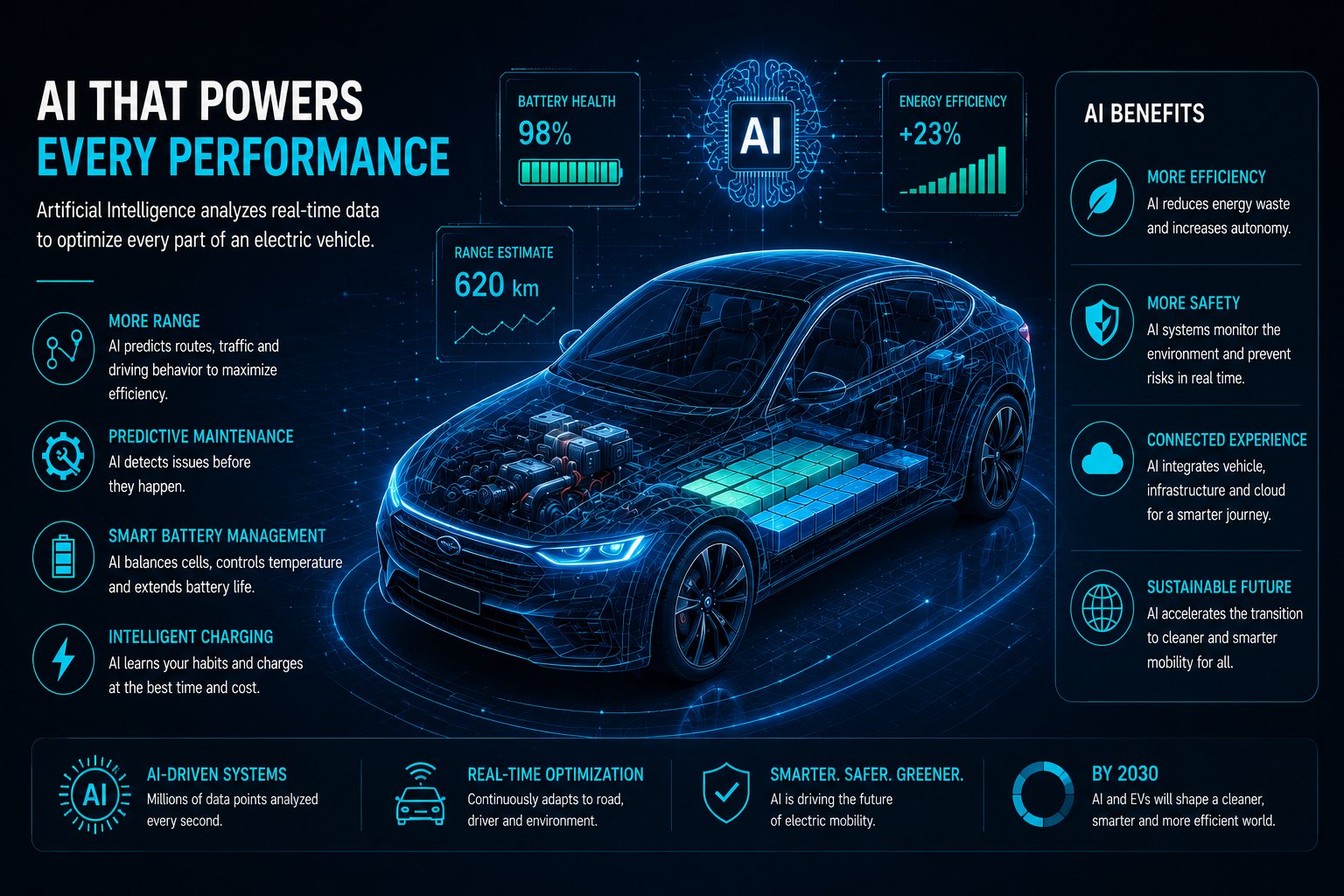
What separates a 2025 EV from a 2012 EV isn't just a bigger battery or a more powerful motor — it's the intelligence layer wrapped around every system. AI has transformed the electric vehicle from a simple combustion substitute into a computational platform on wheels. Every sensor, every charging cycle, every routing decision now involves machine learning models operating in real time.
2. The Evolution of Automotive AI: From Control Systems to Neural Networks
The history of AI in cars actually predates the modern EV era by decades. In the 1970s, the first Engine Control Units (ECUs) used algorithms to optimize fuel injection. They were simple lookup tables and conditional logic — but they were the embryo of automotive artificial intelligence.
The real evolution happened in waves:
- 1980–2000: More complex ECUs, adaptive ABS, traction control. Deterministic algorithms — predictable, but limited.
- 2000–2015: First Advanced Driver Assistance Systems (ADAS). Cameras, radar, and ultrasonic sensors feed basic computer vision algorithms. Tesla Autopilot arrives in 2014.
- 2015–2022: Deep learning transforms environmental perception. Convolutional neural networks identify pedestrians, signs, and obstacles with human-level precision — or beyond it — in controlled conditions.
- 2022–present: Language models and multimodal reasoning enter vehicles. The car doesn't just "see" — it interprets context, anticipates other drivers' behavior, and converses in natural language.
A current Tesla Model 3 processes data from 8 cameras, 12 ultrasonic sensors, and 1 long-range radar simultaneously. Tesla's FSD chip executes 36 trillion operations per second — performance that rivaled supercomputers only a few years ago.
Why EVs are the natural habitat of AI
There's a deep synergy between AI and electric vehicles that goes beyond the obvious. Electric motors are inherently digitally controlled: unlike a combustion engine with hundreds of moving mechanical parts, an electric motor responds to electronic commands with microsecond latency. This creates the perfect environment for AI algorithms requiring instant feedback. EVs also generate enormous data volumes on usage patterns — something ML models exploit voraciously.
3. Smart Batteries: The Heart AI Learned to Care For
If there is one bottleneck that has always limited electric vehicles, it has a name: the battery. Not because cell technology is poor — the problem is that batteries are extraordinarily complex systems, sensitive to temperature, charge cycles, depth of discharge, and chemical aging. Managing all of this optimally has always demanded a level of sophistication only AI can deliver.
AI-powered BMS: far beyond charge control
Traditional Battery Management Systems monitored voltage, current, and temperature reactively. If the battery overheated, it cut power. If a cell discharged below a threshold, it was protected. Simple, but inefficient. An AI-powered BMS operates predictively and adaptively. Rather than reacting to problems, it anticipates them. Machine learning models analyze:
- The complete charge cycle history of each individual cell
- Real-time temperature gradients across battery sectors
- Cell degradation patterns benchmarked against global fleet data
- External conditions: ambient temperature, altitude, humidity
- The owner's driving style
This allows the system to, for example, pre-condition the battery before a fast charging session — heating or cooling cells to their optimal temperature range before you arrive at the charger. This single optimization alone can cut DC charging time by up to 25% and extend battery life by years.
Degradation prediction: knowing your battery's future
One of the most valuable — and rarely discussed — AI applications in batteries is degradation forecasting. Models trained on millions of charge cycles can estimate with surprising accuracy how long a specific battery will take to reach 70% or 80% of its original capacity. For consumers, this means being able to assess the true health of a used EV's battery — not just current capacity, but a projected degradation curve over the next five years. Volkswagen and BMW already offer AI-based battery health certificates for certified pre-owned vehicles.
The solid-state battery frontier
The next frontier is solid-state batteries, promising higher energy density, faster charging, and elimination of fire risk. Companies like QuantumScape, Solid Power, and Toyota are racing to commercialize this technology. AI plays a dual role: accelerating the discovery of new materials through generative models and molecular simulations, and developing new BMS algorithms to manage completely different electrochemical characteristics.
| Battery Type | Density (Wh/kg) | Cycle Life | Fast Charging | Status |
|---|---|---|---|---|
| NMC Liquid | 250–300 | 1,000–2,000 | Good | Current (most EVs) |
| LFP | 150–200 | 3,000–6,000 | Moderate | Current (China/Tesla) |
| Solid-State | 400–500 | 5,000+ | Excellent | 2027–2030 |
| Sodium-ion | 120–160 | 4,000+ | Good | Emerging (CATL) |
4. Autonomous Driving: AI Behind the Wheel
Autonomous driving is the most visible — and most misunderstood — topic in automotive AI. When Elon Musk promised fully autonomous cars in 2016, the public and press interpreted it as a nearby finish line. In practice, we were only at the starting gun of an extraordinarily complex marathon.
The 6 levels of autonomy, clearly explained
| SAE Level | Name | Real Description | Examples |
|---|---|---|---|
| 0 | No Automation | Human controls everything | Pre-2010 vehicles |
| 1 | Driver Assistance | Assist with either steering or pedals | Cruise Control, AEB |
| 2 | Partial Automation | Accelerates + steers in limited conditions | Tesla Autopilot, GM Super Cruise |
| 3 | Conditional Automation | AI drives; human must remain available | Mercedes Drive Pilot (certified) |
| 4 | High Automation | AI drives without intervention in defined areas | Waymo One (Phoenix, SF) |
| 5 | Full Automation | AI drives in all conditions, no pedals needed | Does not exist commercially yet |
Tesla approach: pure cameras + neural networks
Tesla bets on cameras as the sole visual perception source, arguing that since humans drive with eyes, a system trained on sufficient camera data can replicate this. FSD v12 made a qualitative leap by migrating to an end-to-end neural network architecture: camera input goes in, actuator control comes out — no coded rules in between. Results are impressive in normal conditions, but the absence of direct depth perception (no LiDAR) still creates critical blind spots.
Waymo/Cruise approach: sensor fusion
Waymo — Google's autonomous vehicle arm — uses a combination of cameras, multiple LiDARs, radars, and ultra-detailed HD maps. More expensive and complex, but offering redundant depth perception. Waymo One already operates commercially in Phoenix and San Francisco without a safety driver — the only public Level 4 service in the world.
No autonomous system today is truly safe in all conditions. Heavy rain, snow, unmarked construction zones, unpredictable pedestrian behavior, and the "long tail" of rare situations still challenge every system. We are at Level 3–4 in specific niches, not universal autonomy.
Reinforcement Learning in driving decisions
A rarely discussed but crucial technique is reinforcement learning applied to traffic decision-making. Instead of programming explicit rules, the system learns by trial and error in simulation — receiving rewards for safe, efficient behaviors and penalties for collisions or abrupt maneuvers. Billions of simulated miles completed in hours.
5. Predictive Maintenance: The AI That Knows What Will Break Before You Do
An experienced mechanic can "feel" when an engine is about to fail — a different sound, a subtle vibration, a slightly elevated temperature. Automotive AI is doing something similar, but with mathematical precision and scale impossible for any human.
How it works in practice
Modern EVs carry hundreds of sensors continuously transmitting data — component temperatures, vibration patterns, anomalous power consumption, subcomponent behavior. ML models, trained on real fleet failure data, learn to recognize the "digital signatures" of deteriorating components. A concrete example: a coolant pump motor starts consuming 3% more energy than standard to maintain the same flow. No alarm fires. The driver notices nothing. But the algorithm detects the anomaly, correlates it with historical failure patterns, and notifies the maintenance system: "High probability of coolant pump failure in 2–4 weeks."
Over-the-Air Updates: the car that improves while you sleep
A direct consequence of AI integration with connectivity is the ability for over-the-air (OTA) updates. Tesla normalized this: a car purchased in 2022 may have significantly different autonomous driving functionality by 2025, without the owner visiting a dealership. More than a convenience, this represents a fundamental shift in the automotive business model — manufacturers now sell cars as improving platforms and charge subscriptions for software-unlocked features.
6. Charging Infrastructure: The Biggest Bottleneck and How AI Is Solving It
The best EV in the world is useless without somewhere to charge it. This is, honestly, the greatest challenge of the entire electric transition. But AI is attacking this problem on multiple fronts simultaneously.
Intelligent grid management
Imagine a residential neighborhood where 40% of residents own EVs and all arrive home at 6:30 PM. If everyone plugs in simultaneously, demand can collapse local transformers. This phenomenon — the "duck curve" — is a nightmare for utilities. AI-powered smart charging algorithms solve this: the vehicle automatically negotiates with the grid on timing and charging speed based on dynamic tariffs, available grid capacity, and the user's actual need. The car you plugged in at 6 PM may only begin charging at 10 PM — when the tariff is 60% cheaper and the grid has slack — and finish precisely at 7 AM when you need to leave.
V2G: your car as a grid battery
The Vehicle-to-Grid (V2G) concept inverts the logic: instead of only consuming energy from the grid, the EV can return it during peak demand. A car parked 22 hours a day with a 60 kWh battery represents a valuable energy reserve. With AI-managed V2G, this energy can be sold back to utilities during demand spikes, generating revenue for the owner. Nissan and Japanese utilities have operated V2G programs for years. Ford implemented V2G in the F-150 Lightning. The main constraint remains additional battery degradation from extra cycles — which AI BMS algorithms are learning to minimize.
Charger availability forecasting
A practical and frustrating problem: arriving at a charging station to find all points occupied. AI-based systems solve this with availability prediction. The Waze for EVs, in effect: the system considers not only which chargers are currently free, but predicts which will be available at the vehicle's estimated arrival time, based on historical patterns and active reservations.
7. Market Impact: U.S., China, and Europe — Three Realities
China: the market that outpaced every forecast
China didn't just adopt EVs — it became the global technology epicenter. In 2024, more than 60% of all electric vehicles sold globally were in China. Brands like BYD, NIO, XPENG, and Li Auto have developed automotive AI capabilities that rival — and in some areas surpass — what Silicon Valley has produced. The NIO ET7's NOMI AI system goes beyond a voice assistant: it learns driver preferences, suggests routes based on mood and context, and acts as an intelligent co-pilot. The Chinese government was instrumental: aggressive subsidies, EV production mandates, massive charging infrastructure investment, and data collection policies that created competitive advantages at scale.
United States: the market that invented it, then was outpaced
The U.S. created Tesla, Waymo, Cruise, and the modern concept of the autonomous car. But adoption has been slower due to structural factors: infrastructure dominated by gasoline car culture, still-elevated average EV prices, fragmented charging infrastructure, and legitimate range anxiety for long-distance travel. The Inflation Reduction Act of 2022 changed key equations: tax credits of up to $7,500 per North American-manufactured EV. The result was a massive acceleration of investment — Ford, GM, Stellantis, and even Toyota announced battery factories in the U.S.
Europe: regulation as the accelerator
Europe chose a different playbook: mandate the transition and let industry adapt. The 2035 ban on new combustion car sales in the EU created a hard deadline that concentrated billions of euros of investment in EV and battery technology. Germany's automotive heritage is both an asset (engineering excellence at BMW, Mercedes, Volkswagen) and a liability (enormous sunk cost in combustion technology). The region's charging infrastructure is significantly more developed than the U.S. market, particularly in Scandinavia, where Norway leads with over 90% EV market share for new cars.
| Region | EV Market Share 2024 | 2030 Target | Infrastructure | Automotive AI |
|---|---|---|---|---|
| China | ~45% | 70%+ | Extensive | Global leader |
| United States | ~8% | 50% (Biden target) | Growing | Pioneer (Tesla/Waymo) |
| Europe | ~22% | 100% new cars | Good | BMW, Mercedes, VW |
| Rest of World | <5% | Varied | Early stage | Import market |
8. Trends Through 2030: What to Expect in the Next Four Years
Lithium-free batteries: the next leap
Dependence on lithium — primarily extracted in Australia, Argentina, Chile, and China — is a recognized geopolitical vulnerability. Sodium-ion batteries, which CATL is already commercializing, use far more abundant materials. AI models are accelerating the discovery of new electrolytes and anode structures that could double energy density without lithium.
Level 4 autonomy at commercial scale
Waymo and Baidu's Apollo Go are expected to expand robotaxi operations to more than 20 cities globally by 2028. The Mobility-as-a-Service (MaaS) business model is beginning to substitute individual vehicle ownership in megacities — especially in China, where congestion and parking costs make the model economically compelling.
Generative AI inside the vehicle
ChatGPT entered cars — literally. Mercedes integrated ChatGPT into the MBUX Voice Assistant. BMW and Volkswagen have similar projects. By 2030, most premium vehicles will feature assistants with contextual reasoning capacity, long-term memory, and deep personalization. The car will know you go to the same restaurant on Fridays, prefer scenic routes on weekends, and have an important meeting Monday — and will adjust charging to ensure sufficient range.
Cybersecurity: the dark side of automotive AI
The more connected and intelligent a vehicle, the larger its cyberattack surface. Researchers have already demonstrated remote hacking of steering, braking, and locking systems on popular models. As vehicles gain autonomy, the consequences of a successful attack become potentially fatal. AI enters here as defense: anomaly detection models monitor internal vehicle data traffic for suspicious patterns. UNECE WP.29 (international automotive cybersecurity regulation) already requires manufacturers selling in Europe to implement attack detection and response systems. This will globalize by 2030.
Convergence with smart cities
The intelligent EV doesn't exist in isolation. The most transformative vision is integration with smart urban infrastructure: traffic lights communicating with cars about phase duration, parking spaces automatically reserving upon detecting approach, bridges and overpasses reporting road conditions in real time. By 2030, we'll likely see the first functional V2X (Vehicle-to-Everything) urban corridors in Chinese cities, parts of Europe, and potentially major U.S. metropolitan areas.
9. Beyond the Possible: What Sounds Like Science Fiction — But May Be the Final Destination
This section deliberately steps outside the boundaries of what exists today or what is in confirmed development. What follows is a mix of credible technical rumors, early-stage research findings, declared visions of engineers and scientists, and well-grounded speculation. This isn't gratuitous fiction — every concept has real roots. But none has a delivery date. The difference between a dream and the future, in technology, is usually just a matter of decades and billions of dollars.
9.1 Roads That Charge Moving Cars — and Cars That Charge Roads
Imagine never needing to stop to recharge. The vehicle simply circulates and continuously replenishes itself through the road. This isn't fiction — it's the premise of Dynamic Wireless Charging (DWC), which Israel, Sweden, Germany, and South Korea are already testing on real road segments. The idea: electromagnetic coils embedded in the asphalt transfer energy to receivers on the vehicle chassis via induction. Electreon — an Israeli company — deployed a 1-mile stretch in Tel Aviv where electric buses recharge in motion. Efficiency is still 80–85%, below cable charging (92–96%), and infrastructure cost per kilometer remains prohibitive for scale today. The futuristic vision goes further: what if vehicles could return energy to the road on downhill segments? A convoy of trucks descending a mountain pass generating enough electricity to power vehicles climbing the same route simultaneously, AI coordinating this energy ballet in real time.
Multiple countries have functional pilot projects. The most optimistic forecast is commercial segments between 2030–2035 on high-density routes such as urban bus corridors. For complete highways, we're talking post-2040.
9.2 Self-Healing Batteries — That May Not Age
Battery degradation is today inevitable — each charge-discharge cycle slowly erodes electrode structure. But researchers at Stanford, MIT, and Chinese laboratories are investigating something that sounds absurd: self-regenerating electrode materials. In 2023, researchers published results on silicon anode electrodes with up to 90% microcrack self-recovery after expansion-contraction cycles. Still in the lab, still far from commercial efficiency — but proof of concept exists. The radical vision: a battery lasting the vehicle's entire service life — 30, 40 years — without significant degradation. AI monitoring every nanometer of electrochemical material and triggering self-repair processes during low-demand cycles (overnight charging, for example).
9.3 Swarm Intelligence: When Cars Think Together
Current autonomous driving is fundamentally individualistic — each vehicle perceives its environment and makes decisions alone. The next frontier is radically different: vehicles sharing perception and decision-making in real time, forming a computational superorganism of mobility. Imagine 10,000 autonomous vehicles in a metropolis, each sharing what their cameras see with all others. The vehicle 2 miles away already knows about the accident you're about to encounter — not via GPS or map, but because a nearby vehicle transmitted raw perception data via 6G. Swarm AI recalculates routes for all 10,000 simultaneously, redistributing traffic before congestion even forms.
9.4 Brain-Vehicle Interface: Driving with Thought
This is closer than it appears — and more unsettling than anything else on this list. Neuralink has already implanted brain chips in humans. In 2024, the first Neuralink patient controlled a computer cursor using thought alone. The obvious question is: when does that signal reach vehicle controls? Ford patented a non-invasive EEG brainwave monitoring system for detecting driver fatigue. BMW Group Research published studies on detecting lane-change intention via EEG — the car perceives you're about to change lanes before you move the wheel, because your brain has already made the decision. The radical future: a vehicle with no steering wheel, no pedals, no touchscreen. You think "turn left" and it turns. You feel drowsy and the system detects it, assumes control and safely pulls over. AI doesn't just drive — it reads intent before action.
9.5 The Car That Generates More Energy Than It Consumes
This seems to violate thermodynamics. It doesn't. High-efficiency photovoltaic panels (perovskite, efficiency >30%) integrated across the entire vehicle surface — roof, hood, doors, transparent window cells — could generate on a sunny day 1.5–2 kWh per hour. For a vehicle consuming 15–18 kWh/100km, that represents 8–12 km of range per hour of stationary sun exposure. The Lightyear 0, launched in 2022, had solar panels generating up to 70km/day of additional range. The company went bankrupt in 2023 due to unsustainable cost (approximately $1.3 million per car), but the concept survived. The vision: solid-state batteries + perovskite panels + AI-maximized regenerative braking + heat recovery from the environment. In sun-rich regions, operating costs could approach zero for urban use.
9.6 Living Materials: The Car That Fixes Itself
A dent that disappears in 24 hours. A scratch in the paint that closes like healing skin. Self-repairing windows after microcracking. Nissan commercialized Scratch Shield paint with polyrotaxane that self-repairs minor scratches in hours. In the lab, researchers at ETH Zurich developed polymeric structures that reconstitute up to 80% of original strength after severe ruptures. The next level: structural chassis materials with self-repair capability monitored by an integrated sensor network managed by AI. The system would detect microfractures before they become visible, trigger polymeric restoration, and alert when damage is too severe for self-repair. A car that resists time not as an aging machine, but as an adapting organism.
9.7 Digital Twins and Vehicle Personality
BMW, Mercedes, and NVIDIA are working on the digital twin concept: a complete virtual replica of the vehicle existing on cloud servers, updated in real time with all sensor data. While you drive, your vehicle's digital version runs in parallel in the cloud — and algorithms test scenarios, predict failures, and optimize configurations before applying them to the real vehicle. The more audacious vision isn't about maintenance — it's about personality. The digital twin accumulates 10 years of data about you: your preferred routes, your curve tolerance, your emotional state via biometric data, your music at different times, your reactions to different weather. Over time, the vehicle doesn't just learn your habits — it develops a predictive model so refined it anticipates needs you haven't consciously articulated yet. When you buy a new car, your digital twin — your "mobility identity" — migrates to it.
9.8 Urban Air Mobility: eVTOL and the Third Dimension
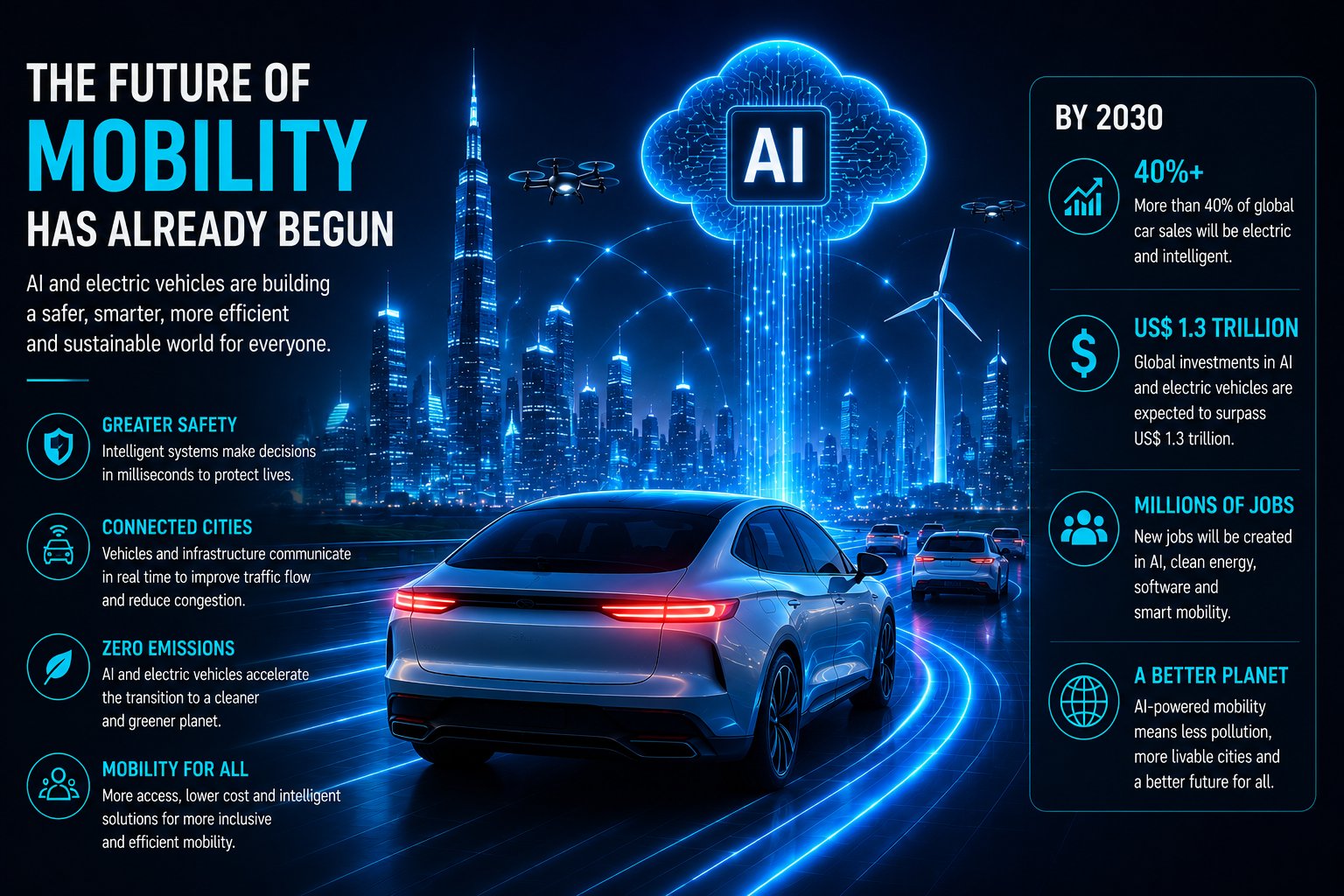
The flying car stopped being a joke. Joby Aviation (backed by Toyota and Delta Air Lines), Archer, Lilium, and EHang are already testing eVTOL aircraft (electric vertical takeoff and landing) with certifications underway at the FAA and EASA. Joby received FAA type certification in 2024 — a historic milestone. The vision isn't replacing cars with aircraft — it's creating an additional mobility layer for 12–125 mile trips in congested urban areas, operated with the same autonomy level as driverless taxis on the ground. AI would coordinate not just the individual aircraft, but the entire low-altitude urban airspace — thousands of eVTOLs sharing air corridors without collision, like swarm intelligence applied to the third axis.
9.9 Mobility Without Ownership: The Most Radical Concept
Perhaps the greatest conceptual leap isn't technological — it's philosophical. The question engineers, urban planners, and economists ask quietly is this: if an autonomous vehicle can be available in 3 minutes at any hour, why would anyone own a car? A private car is used, on average, only 4% of the time. The rest sits in garages and parking lots consuming precious urban space. If fleets of autonomous electric vehicles can serve on demand with superior quality at a fraction of individual ownership cost — the economic logic of car ownership dissolves. The implications: cities redesigned without parking structures (today 30–40% of central urban area in many cities). Residential garages converted to living space. Widened sidewalks. Transport carbon emissions approaching zero. AI as the central nervous system of the entire grid.
Toyota calls this "Woven City" — a city built from scratch at the base of Mount Fuji where autonomous electric and underground vehicles move people and goods without intersecting with pedestrians. Surface streets are exclusive to people on foot. AI manages all invisible logistics below. Construction began in 2021. It's real. It's small. But it's a prototype of what urban planners believe is achievable at metropolitan scale by 2050.
9.10 Zero Traffic Deaths: A Declared Goal, Not a Dream
Every year, approximately 1.35 million people die in road accidents worldwide. In the U.S. alone, over 40,000 deaths annually. 94% of these accidents have human error as the primary cause. The Vision Zero goal — officially adopted by Sweden, Norway, the Netherlands, and dozens of global cities — is literal: zero traffic deaths. Not reduction. Zero. This sounds utopian until you realize that a well-implemented autonomous vehicle system won't get distracted, won't drink and drive, won't fall asleep at the wheel, won't pass in a prohibited zone, and will have millisecond reaction time. RAND Corporation research estimates that with 90% autonomous vehicles on the road, traffic deaths could fall more than 90%. This generation may be the last to accept traffic deaths as normal. And that, perhaps, is the most powerful argument of all for not just dreaming about this technology — but demanding it arrives.
Conclusion: The Electric Revolution Is an Intelligence Revolution
It's tempting to reduce the transition to electric vehicles to a simple fuel swap — gasoline for electricity. But what's happening is far deeper: the radical computerization of transportation, with AI as the central protagonist.
Batteries that predict their own failure. Driving systems that learn from every mile of global fleet data. Chargers that negotiate tariffs in real time. Assistants that know you better than some friends. And beyond that, a more radical horizon: roads that charge moving cars, batteries that self-heal, vehicles that think in swarms, interfaces that read intention before any physical gesture. Some of these concepts arrive in 10 years. Others in 30. But all have roots in real laboratories today.
For consumers and investors globally, the practical message is: follow closely, prepare thoughtfully, but don't rush blindly. Infrastructure is still maturing, prices are still elevated in many markets, and technology evolves too quickly for impulsive decisions. But by 2028–2030, the question may no longer be "should I buy an EV?" — but rather "why haven't I already?"
The future of mobility is electric, connected, and intelligent. And it's arriving faster than most people imagine.
Frequently Asked Questions (FAQ)
It depends on your usage profile. For urban drivers with home or workplace charging and daily trips under 100 miles, the equation is already favorable — the per-mile cost of electricity is 70–80% lower than gasoline. For those who frequently make long interstate trips through areas without charging infrastructure, real limitations still exist. Prices are expected to fall 20–30% by 2028 as battery production scales and government incentives mature.
Fleet data shows modern batteries (especially LFP and latest-generation NMC) retain 80–85% capacity after 125,000 miles. AI-powered BMS is fundamental here: frequent charging above 80% or below 20%, combined with high temperatures, accelerates degradation. Tesla Model 3 vehicles with 200,000+ miles typically show 85–90% original capacity — largely thanks to intelligent BMS management.
Level 5 — full autonomy in any condition, without pedals or steering wheel — likely won't reach the general consumer before 2035. Level 4 in specific niches (robotaxis in mapped cities, low-traffic roads) is arriving between 2026–2030. The difficulty isn't technical in common conditions — it's the "long tail" of rare situations that systems still handle poorly.
In regions with clean electricity grids (like most of Europe, parts of the U.S., and countries with high renewables), the answer is a clear yes. The "carbon breakeven point" — where the EV has emitted less total CO₂ than its gasoline equivalent (accounting for manufacturing) — is typically reached between 15,000–30,000 miles depending on the grid mix. In countries with coal-heavy grids, the benefit is smaller, though still positive over the vehicle's lifetime.
Hybrid (HEV): Has an auxiliary electric motor that recovers energy during braking, but cannot be plugged in. Never drives solely on electricity for useful distances. Plug-in Hybrid (PHEV): Has a larger battery that can be charged from an outlet and can drive 25–50 miles on electricity alone. Ideal for short daily commutes with occasional longer trips. Pure Electric (BEV): No combustion engine. Range of 200–450 miles depending on model. Lowest maintenance and operating costs.
Across multiple dimensions. In the battery, it prevents overheating and reduces fire risk. In driving, ADAS systems with AI (autonomous emergency braking, lane keeping, driver fatigue detection) already demonstrably reduce accidents. The NHTSA estimates well-implemented ADAS could prevent up to 1.3 million crashes annually in the U.S. The flip side is cybersecurity — more connected vehicles are more vulnerable to remote attacks, requiring AI also on the defense side.
Get the news before everyone else
AI, electric vehicles, gadgets and world-changing technology — every week, straight to your inbox. No spam.
* Amazon affiliate links. Purchasing through them supports TechTurbo at no extra cost to you.