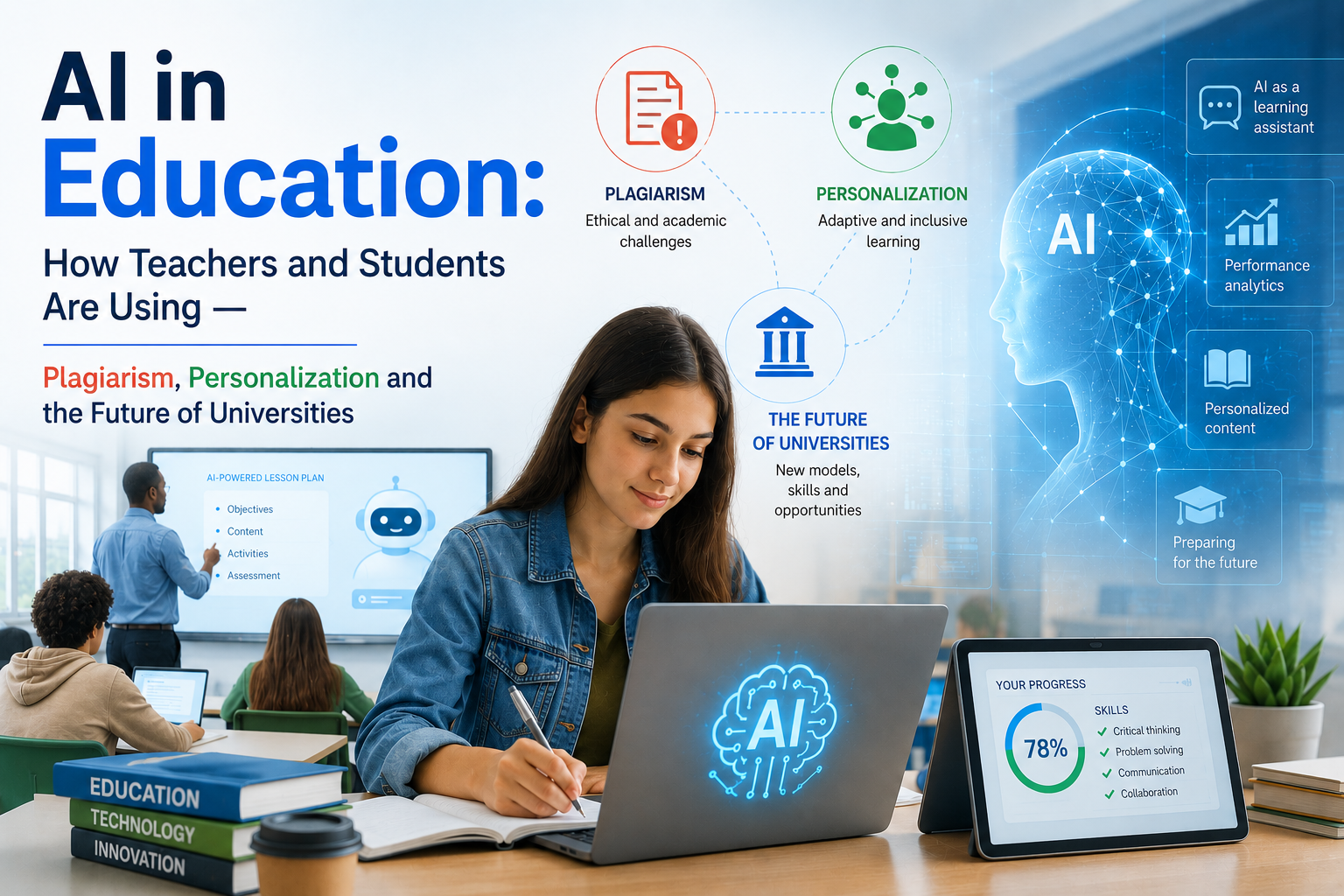
Why Education Is One of the Sectors Most Transformed by AI
Education has always had a structural problem no reform could solve: one teacher, thirty students, a single pace. Fast learners get bored. Those who need more time fall behind. This model — inherited from the industrial revolution and essentially unchanged for 150 years — was designed to standardize, not to personalize. And it's precisely in that crack that artificial intelligence found its most transformative role.
Unlike other educational technologies that came and went (interactive whiteboards, tablets distributed en masse, platforms nobody used), AI attacks the core of the problem: it can adapt to each student individually, at scale, at low cost. It's not one more tool in the classroom — it's a structural change in how knowledge is transmitted, practiced, and assessed.
The Changes Already Underway
- Personalized learning: systems that adjust pace, difficulty, and content format based on each student's real-time performance
- Virtual tutors: assistants available 24/7 that explain concepts, answer questions, and suggest exercises — without judgment and without impatience
- Automated grading: from objective questions to full essays, with detailed feedback in seconds
- Educational content creation: lesson plans, exercises, presentations, and adapted materials generated in minutes
- Real-time translation: breaking down language barriers for international students and content
- Accessibility: text-to-speech, automatic captions, language adaptation for different needs
- Performance tracking: dashboards showing exactly where each student is advancing and where they're stuck
- Administrative automation: attendance, reports, communications, and paperwork that consumed hours of a teacher's time
The right question isn't "will AI enter education?" — it already has, with or without schools' permission. The real question is: who will guide that use? Institutions that ignore the topic aren't protecting their students from AI; they're simply letting them use it without criteria, without ethics, and without supervision.
How Teachers Are Using AI in Practice
Far from the theoretical debate, teachers worldwide have already woven AI into their work routines — and the accounts converge on a single point: the technology gives back time. Time that was consumed by repetitive tasks and can now be invested in what no machine does: looking a student in the eye and noticing something is wrong.
Lesson Planning
Planning is historically one of the most time-consuming teaching tasks. With AI, a teacher can:
- Generate structured lesson plans from the topic, grade level, and learning objectives — in minutes, not hours
- Create varied activities on the same content: quiz, case study, debate, hands-on project
- Generate exercises at progressive difficulty levels, from basic to challenging
- Adapt the same content for different levels — the same fractions lesson explained for 4th graders and for remedial support
Grading Tests and Assignments
Grading is where AI delivers the most immediate time savings:
- Instant objective grading of multiple choice, true/false, and fill-in-the-blank
- Class performance analysis: which questions had the most errors, which content needs review
- Individualized feedback generation — instead of just "wrong," the student gets an explanation of why and a review suggestion
Material Production
- Slide presentations structured from the lesson plan
- Exercise sets with annotated answer keys
- Chapter summaries for review
- Case studies contextualized to students' local reality
- Practice tests in standardized exam format (SAT, AP, state assessments)
A Day in the Life of a Teacher With AI
To move from abstract to concrete, follow the routine of an 8th-grade English teacher who wove AI into her work — a composite portrait of real practices reported by educators:
6:50 AM — Prep. On the bus, she asks the AI assistant for three activity ideas about narrative writing, one tailored to each of her differently-leveled classes. She refines her favorite in five minutes. Before, this would have eaten the previous evening.
10:30 AM — Break. She uploads the 32 essays from her morning class to the assisted-grading platform. The AI does the first pass: spelling, cohesion, structure. In the afternoon she'll review only the discursive aspects — argumentation, evidence, voice — which are what truly demand a human eye.
1:15 PM — Diagnosis. The dashboard shows 60% of the class missed questions on subject-verb agreement with compound subjects. She asks the AI for five new exercises focused on exactly that point and schedules a 15-minute review for the next class.
5 PM — What AI doesn't do. She notices a student who always participated has been withdrawn and underperforming for two weeks. No algorithm will initiate that conversation. She pulls the student aside, talks, loops in the counselor. This is the work that became more visible — and more possible — once the paperwork got out of the way.
How Students Are Using AI (For Better and For Worse)
If teachers adopted AI cautiously, students embraced it voraciously. Surveys across countries indicate that most high school and college students already use AI tools regularly — often without the school knowing or offering any guidance. The legitimate uses are powerful:
- Smart summaries: turning long chapters into study-ready syntheses — useful for review, dangerous as a substitute for reading
- Explaining difficult content: asking for a physics or chemistry concept to be re-explained with different words, examples, and analogies — as many times as needed
- Worked solutions: understanding the step-by-step of a math problem, not just the final answer
- Language practice: text and voice conversation with real-time correction, without the embarrassment of making mistakes in front of the class
- Programming: debugging code, understanding error messages, and learning logic with a tireless tutor
- Writing: getting feedback on structure and argumentation before submitting — when used to improve your own text, not to replace it
- Exam prep: personalized practice tests, review schedules, and identification of weak points
- Study organization: realistic weekly study plans that account for the student's other commitments
AI works better as support for learning than as a substitute for intellectual effort. The difference is easy to state and hard to police: using AI to understand better is learning; using AI to avoid having to understand is self-deception with an expiration date — the bill comes due at the exam, the entrance test, or the job market.
A Day in the Life of a Student With AI
7:30 AM — Pre-class review. On the way to school, Ethan, 16, asks the assistant for a summary of the three main points from yesterday's biology class. He arrives with the material fresh.
2 PM — Math homework. He gets stuck on a quadratic function problem. Instead of asking for the answer, he asks: "explain the first step without solving the problem." He works out the rest himself. He makes a sign error at the end, the AI points out where, he redoes it. This is using AI to learn.
4 PM — Spanish. Twenty minutes of voice conversation with the AI about the movie he watched over the weekend. The assistant corrects his pronunciation of "desarrollo" for the fourth time, without impatience.
7 PM — History paper. Here lies the day's ethical test. He asks the AI for an overview of the Civil Rights Movement, uses the references as a starting point, verifies the information against his textbook (he's already learned that AI invents sources), and writes the text in his own words. In a footnote, he declares: "I used AI for initial research and grammar review" — as his school's policy requires.
Personalized Learning: the End of One-Size-Fits-All
Of all AI's benefits in education, personalization has the greatest transformative potential — because it attacks that structural problem of the industrial teaching model head-on. Adaptive systems can adjust, for each student:
| Dimension | How AI adapts | Impact on the student |
|---|---|---|
| Pace | Advances when there's mastery, revisits when there are gaps | Nobody falls behind or gets bored waiting |
| Difficulty | Calibrates exercises in the "zone of development": neither too easy nor impossible | Constant challenge without paralyzing frustration |
| Exercises | Generates infinite variations focused on each student's recurring errors | Practice directed exactly where it's needed |
| Examples | Uses contexts that connect with the student's interests (sports, games, music) | Abstract content gains concrete relevance |
| Language | Simplifies or sophisticates the explanation based on demonstrated understanding | The explanation meets the student where they are |
The result is that each student walks a unique path toward the same learning objectives. In practice, it's what an excellent private tutor always did — but now available to any student with access to a device, and not only to those who can afford one-on-one lessons.
AI and Inclusion: the Silent Revolution
While the spotlight stays on plagiarism and ChatGPT, AI's most transformative application in education happens away from the headlines: the inclusion of students with disabilities and learning differences. For these students, AI isn't convenience — it's the difference between participating in class or watching from the outside.
- Visual impairment: text-to-speech for any material, automatic description of images and charts, voice-command navigation
- Hearing impairment: real-time automatic captions during class, transcription of educational videos, translation into simplified written language
- Dyslexia: text-to-audio conversion, adapted fonts and spacing, summaries with clear visual structure, guided reading
- ADHD: breaking long tasks into short steps with progress milestones, smart reminders, more dynamic and interactive content formats
- Autism: language adaptation (reducing ambiguity and idioms), predictable study routines, communication support through symbols and text
Accessibility tools always existed, but they were expensive, scarce, and dependent on specialists who weren't always available. AI democratized accessibility: functions that once cost thousands of dollars in dedicated equipment are now built into any smartphone. For millions of families, this is the most concrete face of AI's educational revolution.
AI in Early Childhood Education: Potential and Caution in Equal Measure
Applying AI with young children is the territory that demands the most balance. The potential is real: educational games that adapt to each child's development, literacy support with read-aloud recognition, interactive cognitive-development activities, and playful introduction to other languages during life's most fertile window for language learning.
But no stage of education depends so heavily on what AI doesn't offer: rich human interaction. Child development is deeply social — children learn language, empathy, and emotional regulation face-to-face, in play with other children, in a caregiver's arms. That's why child-development specialists converge on three principles:
- Always human supervision: AI as a tool mediated by adults, never as a "digital babysitter"
- Limited screen time: technology complements — never replaces — physical play, social contact, and shared reading
- Curated content: age-specific platforms with pedagogical oversight, not generic adult assistants

The Risks: What's at Stake When AI Enters the School
It would be irresponsible to treat educational AI by its benefits alone. The risks are real, some already materialized at scale, and ignoring them is the fastest way to turn a powerful tool into a structural problem. This is, deliberately, one of the longest sections of this article.
Plagiarism and Academic Dishonesty: the Elephant in the Classroom
No topic related to AI in education is more searched — and more misunderstood — than plagiarism. The problem has layers that deserve careful separation:
- Copying ready-made answers: the crudest use — pasting the test question into a chatbot and transcribing the answer. Clear cheating, the digital equivalent of copying off a classmate
- Work entirely generated by AI: essays, reviews, and dissertations produced by the machine and signed by the student. Beyond the dishonesty, the student leaves the experience having learned absolutely nothing
- Absence of critical thinking: the subtlest risk — even without formal fraud, the student who outsources all intellectual elaboration atrophies exactly the capacities school exists to develop
The central challenge for institutions is drawing the line between legitimate collaboration and fraud. Is using AI to check grammar acceptable? What about suggesting the text's structure? What about writing the introduction? There's no universal consensus — and that's precisely why every institution needs an explicit policy (more on that below). What consensus does exist: the fraud isn't in using the tool, it's in presenting as your own an intellectual work that isn't.
Excessive Dependence: the Silent Atrophy
More worrying than occasional plagiarism is the pattern of dependence that sets in gradually:
- Ceasing to research: the chatbot's ready answer replaces investigation across multiple sources — and with it dies the ability to research, compare, and synthesize
- Losing critical capacity: those who never compare sources don't develop the muscle to question information
- Reduced creativity: if every production starts with "what does the AI suggest," the student's own voice never matures
- Not developing independent reasoning: real learning happens in the effort — in the productive difficulty of wrestling with a problem. Eliminating all friction eliminates the learning too
AI in education is like the calculator in math: nobody questions an engineer using one — but everyone understands why a child must first learn to compute by hand. The tool amplifies those who already master the fundamentals and atrophies those who skip that step. The difference is that a calculator only computes; AI writes, argues, and thinks for you, which makes the temptation — and the risk — incomparably greater.
Incorrect Information: When the Tutor Errs With Confidence
Language models have a dangerous characteristic in the educational context: they err with the same fluency and confidence with which they get things right. Documented problems include:
- Factual errors: dates, formulas, names, and concepts presented incorrectly with complete naturalness
- Invented references: AI can cite books, articles, and authors that simply don't exist — a serious risk for academic work
- Outdated data: models trained up to a certain date may ignore discoveries, curriculum revisions, and recent events
The defense is pedagogical, not technological: teaching information verification as a basic curricular skill. The student who learns to check what the AI says has developed something more valuable than any correct answer — they've developed methodological skepticism.
Student Privacy: the Most Sensitive Data
AI-powered educational platforms collect an extraordinary volume of data on minors — and this dimension gets far less attention than it should:
- Performance data: every error, every success, every hesitation recorded — building detailed cognitive profiles of children
- Class recordings: voice and image of minors processed by third-party systems
- Complete academic records: information that can follow a person for decades if leaked or commercialized
- Platform security: schools rarely have the technical staff to audit the security of the vendors they contract
In the US, laws like FERPA and COPPA give special treatment to children's educational and online data, requiring parental consent and limiting data use. Schools that adopt AI platforms without evaluating legal compliance are taking on real legal risk — beyond the ethical risk.
How to Detect AI-Generated Work (and Why Detectors Fail)
Institutions' instinctive reaction to AI plagiarism was to seek automatic detection tools. The reality, however, is uncomfortable and needs to be said clearly: there is no 100% reliable AI detector — and there probably never will be.
Detectors analyze statistical patterns in the text (word predictability, sentence uniformity), but these patterns are increasingly indistinguishable from human writing, especially after editing. Worse: detectors generate false positives — accusing genuinely human texts of being AI-generated. Students who write more formally and in a structured way, and non-native speakers of the language, are disproportionately flagged. An unfair accusation of fraud can mark an innocent student's academic life.
The Approach That Actually Works
Experienced educators converge on a combined strategy, where technology is just one element — and never the decisive one:
- Analyzing the process, not just the product: tracking drafts, versions, and the work's evolution over time. A text that appears finished, with no history, raises questions
- Knowing the student's writing: teachers who regularly read a class's output notice abrupt changes in style and vocabulary
- Oral interviews: asking the student to explain and defend their own work. Those who genuinely wrote it can sustain the conversation; those who outsourced it can't
- Tools as support, never as verdict: detectors can flag texts that deserve attention — but should never be the sole basis for a disciplinary decision
- Redesigning assessments: the smartest response to the problem — in-person assessments, hands-on projects, presentations, and work requiring connection to personal experiences are naturally resistant to AI fraud
Will AI Replace Teachers? The Honest Answer
It's the most-searched question on the topic — and it deserves more than the standard reassuring answer. Yes, part of what teachers do today will be automated. No, that doesn't eliminate the profession. Understanding the difference requires separating the tasks from the essence.
| What AI does well (and will take over) | What remains irreplaceably human |
|---|---|
| Automating repetitive and bureaucratic tasks | Empathy: sensing a student is struggling before they say anything |
| Grading assignments and objective tests | Motivation: inspiring, holding accountable with warmth, believing in a student who gave up on themselves |
| Organizing content and schedules | Mediation: managing conflict, building community, teaching coexistence |
| Personalizing exercises and paths | Critical judgment: weighing contextual nuances no algorithm captures |
| Immediate feedback on technical errors | Social-emotional development: forming people, not just transmitting content |
| Continuous availability for questions | Ethics and example: values are learned through relationship, not through a prompt |
The conclusion the evidence supports: AI tends to transform the teacher's role, not eliminate it. The teacher of the near future spends less time grading stacks of tests and more time doing what only humans do — guiding, inspiring, and forming. The real risk isn't AI replacing teachers; it's the teacher who masters AI replacing the one who doesn't. The medical analogy is precise: automated exams didn't eliminate doctors, but doctors who use technology well have a decisive advantage over those who ignore it.
The Future of Universities: Reinvention or Irrelevance
No educational level is under more pressure than higher education. If information is freely available and an AI tutor explains any content, what exactly justifies four years and tens of thousands of dollars in tuition? The universities that survive will be those with an answer to that question — and it runs through these trends already in motion:
- More flexible curricula: modular, customizable tracks replacing rigid grids of identical courses for everyone
- Mature hybrid learning: lecture content migrates to adaptive platforms; the campus specializes in what requires presence — labs, debates, projects, community
- Competency-based assessment: demonstrating what you can do, instead of accumulating class hours and memorization tests
- Discipline-specific intelligent tutors: specialized AI agents accompanying each student in calculus, anatomy, or constitutional law — with the human professor supervising the whole
- Virtual laboratories: chemistry, physics, and engineering simulations without material cost and without physical risk
- Augmented and virtual reality: medical students practicing procedures on virtual patients; future engineers walking through full-scale structures before building
Professions Are Changing Too — and the Curriculum Must Catch Up
The university that prepares students for the 2030 job market needs to teach what the 2030 market will demand. And the list is already reasonably clear:
- AI fundamentals: not just for technical roles — every professional will need to understand these tools' capabilities and limits
- Data analysis: statistical literacy as a cross-cutting requirement, from marketing to healthcare
- Critical thinking: paradoxically, the more ready answers AI offers, the more valuable the ability to question them becomes
- Applied ethics: decisions about technology use will have human consequences in every field
- Creativity and complex problem-solving: exactly the territories where humans maintain an advantage
- Human-AI collaboration: the defining professional skill of the decade — knowing what to delegate to the machine and what to keep
The 10 Human Skills AI Cannot Replace
If AI takes over routine cognitive tasks, human value migrates to what it can't reach. These are the competencies schools and universities should put at the center of the curriculum — because they're the ones that will keep distinguishing people in the workplace and in life:
- Critical thinking — evaluating information, identifying biases, and questioning premises, including AI's own
- Genuine creativity — AI recombines the existing; humans create what doesn't yet exist from lived experience
- Emotional intelligence — reading emotions, regulating your own, and responding sensitively to another's state
- Authentic communication — adapting tone, timing, and message to complex human contexts, from family conflict to professional negotiation
- Leadership — inspiring trust and mobilizing people around a purpose, something no algorithm does for you
- Collaboration — building together, compromising, negotiating, and combining differences in real teams
- Ethics in practice — deciding what's right in ambiguous situations where there's no answer in the manual
- Curiosity — the impulse to ask "why?" and "what if?" that drives all discovery
- Adaptability — reinventing yourself amid change, a skill that AI's own speed makes more essential every year
- Complex problem-solving — integrating technical knowledge, human context, and judgment in unprecedented situations
Myths and Facts About AI in Education
| Claim | Verdict | The reality |
|---|---|---|
| "AI will eliminate teachers" | ✗ Myth | AI automates tasks, not relationships. The profession transforms — the teacher becomes a guide and mediator, roles that only gain value |
| "Using AI is always plagiarism" | ✗ Myth | It depends on use and transparency. Using AI to review or study is legitimate; presenting generated text as your own is not. Context and institutional policy define the line |
| "AI always provides correct answers" | ✗ Myth | Models err with confidence, invent references, and carry biases. Verification remains indispensable |
| "AI makes learning more superficial" | ⚠ It depends | Used as a shortcut, yes — it atrophies reasoning. Used as a tutor that deepens and challenges, it produces the opposite effect. The decisive variable is how you use it, not whether you use it |
| "Students with AI learn faster" | ⚠ Partially | Studies show real gains with well-structured adaptive tutoring — but the effect disappears when AI becomes a ready-answer machine |
| "Only wealthy schools will have access" | ✗ Myth (with a caveat) | Free tools are already accessible on any smartphone. The real inequality risk lies in the quality of usage guidance — and there, yes, well-structured schools pull ahead |
How to Create a School Policy for Responsible AI Use
The worst AI policy is having none. In the absence of clear rules, each teacher decides alone, students navigate a vacuum, and conflicts get resolved on improvisation — usually badly. Institutions that have been through this process converge on five fundamental guidelines:
- 1. Define when AI can be used: specify by activity type — allowed for research and study, conditional on assignments (with declaration), prohibited in in-person assessments. Clarity eliminates the gray zone where fraud lives
- 2. Require transparency about use: normalize the declaration ("I used AI for X") as standard academic practice, analogous to citing sources. Those who declare don't cheat
- 3. Teach source verification: include checking AI-generated information in the curriculum — turning the tool's biggest risk into a pedagogical opportunity
- 4. Protect student data: evaluate compliance with FERPA, COPPA, and applicable privacy laws before adopting any platform, require clear contracts on data use, and favor tools with local processing when possible
- 5. Promote AI literacy for everyone: ongoing training for teachers and structured guidance for students and families. A policy that only prohibits, without educating, merely pushes usage underground
The best school AI policy isn't the most restrictive — it's the most educational. The goal isn't to prevent students from using a technology they'll use for the rest of their lives; it's to form them to use it with judgment, ethics, and intellectual autonomy. A school that only blocks outsources the education to the algorithm.
The Future of the Classroom: Welcome to 2035
Projecting technologies that already exist in early stages, the 2035 classroom is reasonably predictable — and less futuristic than it seems:
- AI tracking each student in real time: the system knows each student's complete learning history and anticipates difficulties before the test reveals the problem
- Automated grading with immediate feedback: the student errs, understands the error, and redoes it — in the same minute, not the following week
- Simultaneous translation: international students follow any class in their own language; language exchange stops being a barrier
- Virtual reality simulations: the history class visits ancient Rome; the biology class travels through the circulatory system from the inside
- Adaptive assessments: tests that adjust to the student's level in real time, precisely measuring what they know — not their resistance to trick questions
- AI assistants for teachers: every educator with a copilot handling logistics while they handle people
- Content personalized by performance: next week's material generated from what the class — and each student — demonstrated in the previous one
Speculation: the Dream of the "Neural Teacher" — Where Science Ends and Fiction Begins
Every debate about the future of education eventually bumps into visions that sound straight out of science fiction. It's worth rigorously separating what's in real research, what's plausible speculation, and what remains fantasy — because mixing those planes is the raw material of irresponsible hype.
What's in Real Research (but Far From Scale)
- Educational brain-computer interfaces: companies like Neuralink and academic labs are developing interfaces that read neural signals. Current applications focus on accessibility (people with paralysis controlling devices). Educational use — measuring attention and cognitive load in real time — exists only in lab experiments with expensive equipment that's either invasive or imprecise
- Cognitive-state detection through sensors: eye tracking and attention sensors already work in research. The promise is the system noticing a student is lost before they raise their hand. The obstacle isn't technical — it's ethical: monitoring children's attention creates privacy and autonomy dilemmas still without answers
What's Plausible Speculation (Decades, Not Years)
- The complete "neural teacher": an AI that perceives, from the student's brain state, exactly which explanation would work best at that moment — and delivers it precisely tailored. Technically conceivable as an extrapolation; practically far from any reliable horizon
- Accelerated learning through neural stimulation: research with transcranial stimulation shows modest and controversial effects on memory and learning. The cinematic version — "learning kung fu by download" — has no known technical path
What's Pure Fiction (and Probably Will Remain)
Direct transfer of knowledge into the brain — the "knowledge download" dream à la The Matrix — hits an obstacle that isn't engineering, but nature: knowledge isn't a file. It forms in unique neural networks, shaped by each individual's experience, inseparable from emotion, context, and body. There's no "file format" for human knowledge to be transferred. Current neuroscience doesn't see even a theoretical path to this — and it's honest to say it may never.
The good news hidden in that limitation: the effort of learning isn't a flaw to be eliminated — it's the very mechanism of learning. The brain builds knowledge through friction, repetition, and corrected error. Any technology that promises to completely eliminate that effort is promising, in practice, to eliminate the learning. AI can make the path more efficient and personalized; it can't — and perhaps never will — walk it for you.
Frequently Asked Questions About AI in Education
No — but it will profoundly transform the profession. AI takes over repetitive tasks (grading, planning, organization), freeing the teacher for what's irreplaceable: empathy, motivation, conflict mediation, social-emotional development, and ethical formation. The most realistic scenario is the teacher shifting from content-transmitter to learning-guide — a role AI amplifies rather than threatens.
It depends on the institution's policy and the type of use. In general, using AI to study, understand concepts, and check grammar is considered legitimate. Presenting AI-generated text as your own production is academic fraud at most institutions. The safest practice: ask the teacher what the course rule is, and transparently declare any AI use in your work.
For students: use AI as a tutor (to understand), not as a ghostwriter (to produce for you); always write in your own words; verify the information; and declare use when it happens. For teachers: track the writing process (drafts and versions), know your students' style, do oral defenses of assignments, and redesign assessments toward formats requiring personal elaboration — more effective than any detector.
Yes — and it's increasingly common and recommended. Planning lessons, creating exercises, adapting materials for different levels, and generating feedback are legitimate uses that save hours of work. Two essential precautions: review all generated content (AI makes factual errors) and never enter students' personal data into tools without privacy guarantees adequate to FERPA and applicable laws.
Evidence indicates it does — when well used. Studies on adaptive tutoring systems show real performance gains, especially for struggling students, because AI personalizes pace and reinforces exactly each student's weak points. But the effect reverses when the tool is used as a shortcut to ready answers: in that case, apparent performance rises and real learning plummets. The decisive variable isn't the technology — it's how it's used.
The four biggest: plagiarism and academic fraud (AI-generated work); excessive dependence (atrophy of independent reasoning, research, and creativity); incorrect information (AI errs with confidence and invents references); and student data privacy (platforms collecting sensitive information on minors). All are manageable with clear institutional policy, AI literacy, and pedagogical supervision — none is solved by outright prohibition.
It's one of the most transformative applications. For dyslexia: text-to-audio conversion and adapted formatting. For ADHD: breaking tasks into short steps and more interactive content. For visual impairment: text-to-speech and image description. For hearing impairment: real-time automatic captions. For autism: adapted language and predictable routines. Resources that once cost a fortune and depended on scarce specialists are now accessible on any device.
On several fronts: discipline-specific virtual tutors, adaptive systems that personalize learning paths, virtual labs and simulations (especially in medicine and engineering), administrative automation (enrollment, FAQs, document issuance), predictive analytics to identify students at risk of dropping out, and support for scientific research. The structural trend is the hybrid model: lecture content on intelligent platforms and the campus focused on hands-on experiences and academic community.
Conclusion: the Question Isn't "If," It's "How"
Artificial intelligence is already in education — on students' phones, in the routines of the most switched-on teachers, and in the platforms schools contract. Pretending it doesn't exist protects no one; it only guarantees that its use happens without criteria, without ethics, and without pedagogical benefit. The question separating prepared institutions from unprepared ones isn't whether AI will be used, but how.
For teachers: start small — use AI to plan one lesson this week and measure the time you got back for your students. For students: adopt the golden rule — AI to understand, never to avoid understanding. For administrators and families: demand a clear responsible-use policy at your institution. Education is going through its biggest transformation since the invention of the modern school — and the difference between harnessing it or suffering through it is being defined right now, in the choices of those who teach and those who learn.
Analysis like this, before everyone else
Technology, AI, education and the future of knowledge — no spam, straight to the point, every week.