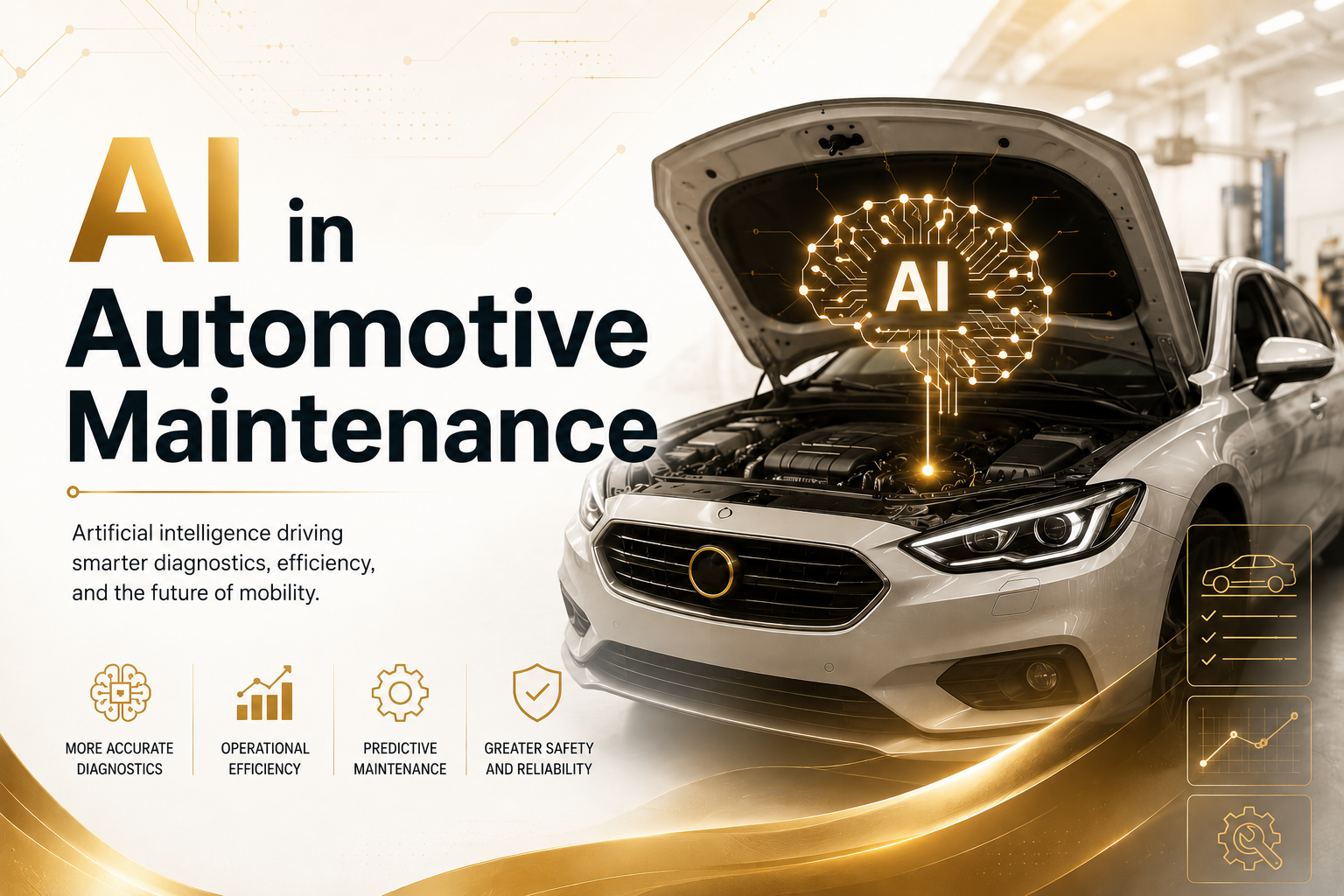
What Is Artificial Intelligence in Automotive Maintenance
In practice, AI applied to automotive maintenance is a set of machine learning techniques that analyze data collected by the vehicle itself — vibration, temperature, fuel consumption, noise, error codes — to identify patterns that precede a mechanical failure. Instead of waiting for a part to break, the system recognizes subtle degradation signals and alerts in advance, often weeks before the problem becomes critical.
The workflow, broken into steps, follows a logic that's relatively easy to grasp even for non-technical readers: sensors scattered across the vehicle collect data continuously, electronic control units (ECUs) process and transmit that information, telemetry systems send the data for analysis (locally or in the cloud), and machine learning algorithms compare the current pattern against thousands of historical cases to spot anomalies. When the detected pattern resembles a known failure signature, the system generates an alert.
Efficiency percentages for predictive maintenance vary depending on the study, industry, and fleet analyzed. For current, context-specific data, consult technical publications from SAE International, automaker reports, and specialized academic studies — full references in the final section of this article.
How Modern Cars Generate Data
A modern mid-to-high-end vehicle carries dozens — in some cases, over a hundred — sensors working simultaneously. Understanding where this data comes from helps explain why AI became so relevant to maintenance:
- ECU (Electronic Control Unit): the engine's "brain," processing combustion, injection, and ignition data in real time
- Engine sensors: temperature, RPM, oil pressure, airflow — the foundation of any modern mechanical diagnosis
- ABS sensors: monitor each wheel's rotation speed individually, essential both for safety and for diagnosing brake wear
- Tire pressure sensors (TPMS): alert to incorrect inflation, which directly impacts fuel consumption, wear, and safety
- Temperature sensors: monitor the engine, transmission, cooling system and, in EVs, the battery
- Battery monitoring system: especially critical in hybrids and EVs, but also relevant for conventional 12V batteries
- GPS and telemetry: location, route, driving pattern, and mileage, used for both navigation and behavior analysis
- Cameras and radar: feed driver-assistance systems and, increasingly, automated visual diagnostic systems
This data, in isolation, is just numbers. What AI does is precisely connect those dots — recognizing that a specific vibration, combined with a subtle temperature variation and a slightly irregular rotation pattern, corresponds to the early onset of bearing wear, for example, long before the driver notices any perceptible noise.
Corrective, Preventive, and Predictive Maintenance: Understanding the Differences
These three terms often appear together but represent completely different philosophies of car care — and understanding the difference is essential for smarter financial and safety decisions.
- Corrective maintenance: fixes the problem after it has already happened. Reactive by definition — the car breaks, you take it to the shop
- Preventive maintenance: follows a fixed schedule based on time or mileage, regardless of the part's actual condition (oil change every X miles, for example)
- Predictive maintenance: uses real condition data, continuously monitored, to predict when replacement will be necessary — neither too early (wasting a still-good part) nor too late (risking failure)
| Criterion | Corrective | Preventive | Predictive |
|---|---|---|---|
| When it occurs | After failure | At fixed scheduled intervals | When data indicates real need |
| Cost | High (collateral damage, towing, unplanned downtime) | Medium (may replace parts still in good condition) | Optimized (replacement at the right time) |
| Risk | High — failure may occur at a dangerous moment | Low to medium | Low — anticipation reduces surprises |
| Advantages | No monitoring investment needed | Simplicity, predictable scheduling | Maximum efficiency, less waste, greater safety |
| Disadvantages | Unpredictable, can cause accidents or greater damage | May replace parts unnecessarily or too late | Requires sensors, AI systems, and upfront investment |
Traditional preventive maintenance assumes all parts wear at the same rate — which is rarely true in practice. A car used predominantly on highways wears components very differently from one used in stop-and-go city traffic. Predictive maintenance individualizes that analysis, using the actual behavior of that specific vehicle instead of a generic manufacturer average.
Smart Diagnostics: How AI Sees What the Human Eye Doesn't
Traditional automotive diagnosis relied heavily on the mechanic's experience — listening to the engine, feeling vibrations, visual testing. AI doesn't replace that experience, but complements it by processing volumes of data no human could analyze in real time.
- OBD-II codes: AI doesn't just read the error code, it cross-references vehicle history and patterns from thousands of similar cases to suggest the most probable cause
- Vibration analysis: sensors capture vibration frequencies imperceptible to the human body, identifying early bearing wear, imbalance, and looseness
- Temperature: subtle variations and heating/cooling patterns reveal cooling system problems before overheating occurs
- Pressure: oil, tire, fuel system — gradual drops often go unnoticed without continuous monitoring
- Fuel consumption: unusual increases signal anything from injection problems to engine component wear
- Noise: acoustic analysis technologies can already identify specific sound signatures of particular mechanical failures
- Maintenance history: AI cross-references previous repairs with the current pattern, identifying recurrences and related issues
The most concrete gain from all this is time: a diagnosis that would take hours of manual testing can be reduced to minutes when AI already points to the most likely causes, leaving the mechanic the task of confirming and executing the repair — not investigating from scratch.
AI in Auto Repair Shops: Beyond Diagnostics
Transformation in repair shops goes far beyond identifying defects. AI is already integrated into several operational aspects that directly impact customer experience and business profitability:
- Assisted diagnostics: modern scanners suggest probable causes based on databases of millions of cases
- Automated estimates: systems generate cost estimates based on diagnostics, part price history, and average repair time
- Predictive inventory management: algorithms forecast which parts will see higher demand, avoiding both excess dead stock and shortages of critical parts
- Automated parts ordering: integration with suppliers allows automatic restocking when inventory hits a certain threshold
- Repair time forecasting: more accurate estimates of when the car will be ready, improving customer communication
- Shop organization: optimized scheduling and mechanic allocation based on service complexity and team availability
- Customer service: chatbots and automated assistants for scheduling, common questions, and status updates
- Administrative automation: invoicing, financial control, and management reports without constant manual intervention
AI at Automakers: From the Production Line to Aftersales
In factories, AI application is even broader and more mature than in maintenance retail — automakers have invested heavily in these technologies for longer:
- Quality control: computer vision cameras identify paint, assembly, and finish defects at speeds impossible for manual inspection
- Automated visual inspection: trained algorithms detect microscopic imperfections in parts and welds
- Production optimization: AI adjusts line pace, resource allocation, and bottleneck prediction in real time
- Intelligent industrial robots: not just executing programmed tasks, but adapting movements based on force and vision sensors
- Vehicle testing: crash test and durability simulations increasingly supported by predictive models, reducing (without eliminating) the need for exhaustive physical testing
- Field failure analysis: data from already-sold vehicles feeds systems that identify defect patterns before they become large-scale recalls
- OTA (Over-The-Air) updates: embedded software is remotely updated, fixing bugs and even improving performance without a dealership visit
- Remote monitoring of sold fleets: automakers track aggregate performance across thousands of vehicles to identify wear trends by model
AI in Fleet Management: Where Financial Return Is Most Evident
Transportation, logistics, and rental companies find in AI monitoring one of the most direct and measurable financial returns in all of automotive maintenance:
- Reduced fuel consumption: driving pattern analysis identifies inefficient behaviors (harsh acceleration, excessive idling) for correction through training
- Predictive maintenance at scale: instead of managing each vehicle individually, algorithms prioritize the entire fleet by maintenance urgency
- Driver behavior monitoring: hard braking, speeding, and fatigue are identified to reduce accident risk
- Accident prevention: real-time alerts on risky conditions, including driver fatigue detected by internal cameras
- Reduced operational costs: fewer emergency stops, fewer fines, less premature component wear
- Higher vehicle availability: less downtime means more vehicles available for operation, directly impacting revenue
Electric Vehicles and Artificial Intelligence: An Even Greater Dependence
If AI is already relevant for combustion cars, in electric vehicles it becomes practically indispensable — the electrochemical complexity of batteries requires far more sophisticated monitoring than any traditional mechanical system.
- Battery monitoring (BMS — Battery Management System): tracks hundreds of individual cells, preventing accelerated degradation and safety risks
- Temperature control: lithium-ion batteries are extremely temperature-sensitive — AI manages the cooling system to maximize lifespan and safety
- Range prediction: algorithms calculate real range considering not just battery charge, but weather, route elevation, driving style, and air conditioning use
- Smart charging: systems adjust charging speed and pattern to preserve long-term battery health, avoiding accelerated degradation
- Optimized regenerative braking: AI calibrates regeneration intensity based on road conditions and driver behavior
- Remote software updates: EVs depend even more on OTA, since a large part of vehicle performance is defined by software, not just hardware
A poorly managed electric vehicle battery doesn't just lose range prematurely — it can represent a real safety risk in extreme overheating scenarios. AI in this context isn't a convenience, it's a core part of the vehicle's safety system, continuously monitoring parameters that would be impossible to track manually.
Benefits of AI in Automotive Maintenance
Bringing together everything covered so far, the concrete and measurable gains from this technology are substantial:
- Cost reduction: maintenance at the right time avoids both premature replacements and expensive emergency repairs
- Fewer breakdowns: anticipating failures drastically reduces unexpected roadside stops
- Faster diagnostics: hours of manual investigation reduced to minutes of assisted analysis
- Longer component lifespan: intervention at the ideal moment, neither too early nor too late
- More safety: early detection of failures in critical systems like brakes and suspension
- Fuel savings: monitoring driving patterns and mechanical condition that affect consumption
- Lower emissions: well-regulated, monitored engines pollute less
- Higher shop productivity: less time in exploratory diagnosis, more time in effective repair
Challenges and Risks Few Articles Mention
No technology is free of limitations, and AI in automotive maintenance has real challenges deserving honest attention:
- Sensor failures: a faulty sensor can generate completely wrong diagnoses — AI is only as good as the data it receives
- Incorrect diagnostics: especially in vehicles with non-original modifications or aftermarket parts not cataloged by the system
- Technological dependence: shops that rely too heavily on scanners can lose traditional manual diagnostic ability
- Need for qualified professionals: correctly interpreting AI-generated data requires specific training, not just traditional mechanical experience
- Cyberattacks: increasingly connected vehicles represent an attack surface for hackers, a risk that grows alongside connectivity
- Vehicle data privacy: detailed telemetry reveals travel patterns, habits, and driver behavior — sensitive data requiring adequate protection
- Implementation costs: equipping shops with advanced diagnostic technology requires upfront investment not always accessible to smaller businesses
Will AI Replace Mechanics?
It's the most recurring question on the topic, and the answer follows the same pattern seen in other professions: automation of specific tasks, not elimination of the profession as a whole.
| What AI does well | What still requires a human mechanic |
|---|---|
| Analyzing large volumes of sensor data | Physical inspection: assessing actual wear, play, and visual conditions sensors don't fully capture |
| Suggesting probable causes of failure | Manual repair: physically executing the fix remains specialized human work |
| Statistical prediction of maintenance need | Technical interpretation of atypical cases: modified vehicles, unusual problems, and out-of-pattern situations |
| Automating estimates and inventory | Customer service: explaining the problem, negotiating priorities, and building trust |
| Continuous real-time monitoring | Decision-making in ambiguous situations: judging when to repair versus replace a component |
The conclusion supported by available evidence is clear: the mechanic profession is evolving, not disappearing. Professionals who specialize in interpreting AI data, understanding complex electronic systems, and working alongside these tools gain significant competitive advantage over those who ignore this transformation. New skills in automotive electronics, data analysis, and software-assisted diagnostics are becoming as important as traditional mechanical knowledge.
What the Auto Shop of the Future Looks Like
Projecting trends already in development, the shop of coming years should incorporate technologies still emerging today:
- Predictive maintenance as standard: no longer a differentiator, but a basic customer expectation
- Augmented reality for repairs: smart glasses overlaying visual instructions directly on the component being repaired
- Auxiliary robots: assisting with repetitive or physically demanding tasks, freeing the mechanic for higher-value work
- AI natively integrated into scanners: diagnosis and repair suggestions in a single fluid interface, without manual consultation of separate databases
- 3D printing of parts: discontinued or low-demand components manufactured on demand right at the shop
- Connected vehicles by default: continuous telemetry sent directly to the owner's trusted shop, anticipating maintenance needs
- Real-time diagnostics: the car "notifies" the driver and the shop simultaneously when a concerning pattern is detected
- Remote updates: a growing share of repairs resolved via software, without a physical visit
How It Works in Practice: a Case Study
To make all this concrete, follow a realistic scenario of how predictive maintenance works in real life:
Week 1 — An almost imperceptible signal. A vehicle starts showing small vibrations in the front right wheel, so subtle the driver notices nothing different while driving. The vibration sensors and ABS data, however, pick up a frequency variation slightly outside that specific vehicle's historical pattern.
Week 1, same afternoon — Pattern recognition. The AI system compares this vibration signature against its database of thousands of similar cases and identifies a match with the typical pattern of early wheel bearing wear — a failure that, if ignored, evolves from noticeable noise to real wheel-lockup risk within a few weeks.
Week 1, that evening — Alert to the driver. The vehicle's app (or the connected dealership's system) sends a notification: "We've detected a vibration pattern that may indicate wear on the front right wheel bearing. We recommend scheduling an inspection within the next two weeks." No urgent alarm, no panic — just a data-based recommendation.
Week 2 — Calm scheduling. The owner books maintenance in advance, choosing a convenient time, without the pressure of an emergency problem. The shop already receives the alert and data history, allowing them to prepare the correct part before the vehicle even arrives.
Result: the repair is simple, fast, and planned — replacing the bearing before it damages other components or, worst case, fails while driving. Comparison to the scenario without predictive maintenance: the same wear, undetected in time, would likely progress to noticeable noise in 4-6 weeks, and eventual complete failure in 2-3 months — potentially damaging the wheel hub, requiring a more expensive repair, and creating real accident risk if the failure occurred at speed.
Myths and Facts About AI in Automotive Maintenance
| Claim | Verdict | The reality |
|---|---|---|
| "AI fixes cars on its own" | ✗ Myth | AI diagnoses and predicts — the physical repair remains specialized human work |
| "AI eliminates mechanics" | ✗ Myth | Transforms the profession, requiring new skills, but doesn't eliminate the need for specialized human work |
| "Software updates can fix some problems" | ✓ True | Many electronic and calibration issues are already resolved via OTA update, without physical intervention |
| "Connected cars send data for analysis" | ✓ True | Continuous telemetry is the foundation of every modern predictive maintenance system |
| "Every OBD-II scanner uses artificial intelligence" | ✗ Myth | Basic scanners only read error codes; real AI is in more advanced systems that analyze patterns and make predictions |
| "AI never gets the diagnosis wrong" | ✗ Myth | Faulty sensors or incomplete data can generate incorrect diagnoses — human oversight remains essential |
| "Only luxury cars have predictive maintenance" | ⚠ Increasingly untrue | The technology is rapidly trickling down to mainstream models, though still more common in premium segments |
| "Electric vehicles depend more on AI than combustion cars" | ✓ True | Battery management complexity requires far more sophisticated AI monitoring |
| "Predictive maintenance always reduces costs" | ⚠ Usually, but not always | The upfront investment in sensors and systems may not pay off in low-value or infrequently used vehicles |
| "Cheap Bluetooth scanners offer full diagnostics" | ✗ Myth | Entry-level scanners read basic codes; deep diagnostics require more robust professional equipment |
Speculation: the Dream of the "Autonomous Repair Shop" — Where Science Ends and Fiction Begins
Every debate about the future of automotive maintenance eventually bumps into visions that sound like science fiction. It's worth rigorously separating what's real research in progress, what's plausible speculation, and what will probably remain impossible or, at minimum, extremely distant.
What's in Real Development
- Increasingly precise self-diagnosis: systems already identifying dozens of failure types with high confidence before noticeable symptoms, mature and constantly expanding technology
- Assisted repair robots in controlled environments: robotic arms already assist with specific, repetitive tasks in large-scale shops, under constant human supervision
What's Plausible Speculation (Years, Not Decades)
- Partial self-repair of electronic components: vehicles capable of automatically reconfiguring software parameters to compensate for sensor wear, delaying (not eliminating) the need for physical repair
- Full 3D printing of complex mechanical parts right at the shop: today limited to plastics and simple parts; high-precision structural metal parts still require industrial infrastructure
What's Pure Fiction (and Will Probably Remain Distant)
A vehicle fully autonomous in its own maintenance — capable of identifying, ordering, and physically installing its own parts without any human intervention — hits limitations that go beyond software. Mechanical repairs involve physical force, manual precision, and situational judgment that generalist robots still don't replicate reliably outside highly controlled industrial environments. Replacing a wheel bearing requires specific torque, precise alignment, and often manual adjustments that vary from vehicle to vehicle — tasks that remain human territory for physical reasons, not just regulatory ones.
Current and developing technology points in a clear direction: increasingly autonomous diagnostics, increasingly assisted repair — but rarely fully autonomous. The automotive maintenance of the near future doesn't eliminate specialized manual work; it makes it more precise, more predictable, and safer. The "fully robotic shop with no human presence" remains, for now, closer to science fiction than to a real technology roadmap.
Frequently Asked Questions About AI in Automotive Maintenance
It's the approach that uses real sensor data — vibration, temperature, pressure, consumption — continuously monitored to predict when a component will need maintenance, instead of following a fixed schedule or waiting for failure to happen. It individualizes maintenance to that specific vehicle's real usage conditions.
It connects to the vehicle's OBD-II port (mandatory in cars manufactured after certain dates per each country's regulations) and reads error codes stored by the electronic control unit. More advanced scanners also show real-time sensor data and, in some cases, use AI to suggest probable causes for the detected problem.
No. Basic scanners only read and clear error codes, without any intelligent analysis. Real AI is present in more advanced systems that cross-reference data with databases of millions of historical cases to suggest diagnoses, predict future failures, and identify patterns a simple error code doesn't reveal on its own.
For most drivers, yes — entry-level Bluetooth models cost relatively little and let you understand what the "check engine" light means before deciding if it's urgent to visit a shop. It doesn't replace professional diagnosis for complex problems, but it avoids surprises and gives useful information to discuss with your mechanic.
Not with absolute certainty — AI works with probabilities based on historical patterns, not guaranteed predictions. It can indicate that a data pattern closely resembles cases that evolved into a certain failure, but unpredictable factors (atypical use, uncataloged parts, sensor failures) can create exceptions to the prediction.
Beyond diagnostics, AI assists with parts inventory management, automatic estimate generation, repair time forecasting, schedule organization, and even initial customer service via chatbots. The practical result is less time on administrative tasks and more time available for specialized technical work.
Yes, much more intensely. An EV's Battery Management System (BMS) monitors hundreds of individual cells, managing temperature, charging speed, and range prediction in real time — a complexity with no direct equivalent in traditional combustion engines.
In most cases, yes, by avoiding both premature replacement of still-good parts and more expensive emergency repairs caused by failures not caught in time. The upfront investment in monitoring technology tends to pay off over time, especially in heavily used vehicles or commercial fleets, where the return is faster and more measurable.
Conclusion: Automotive Maintenance Has Entered the Data Era
Automotive maintenance is going through its most significant transformation since the introduction of embedded electronics in vehicles. Sensors, telemetry, and machine learning algorithms are replacing the reactive "wait for it to break, then fix it" model with a data-driven, intelligently predictive approach. But this guide's throughline deserves repeating: artificial intelligence doesn't replace the mechanic — it transforms what they do, automating exploratory diagnosis and freeing up human time for what genuinely requires technical judgment, hands-on experience, and specialized manual skill.
If you're an everyday driver, start small: a basic OBD-II scanner already offers useful visibility into your vehicle's health. If you work in mechanics, the time to invest in data-assisted diagnostic training is now — professionals who master this intersection of traditional mechanics and technology will have a real competitive edge in the coming years. The data era has arrived at the shop, and it rewards those who adapt early.
Analysis like this, before everyone else
Technology, AI, automotive mechanics and the future of mobility — no spam, straight to the point, every week.