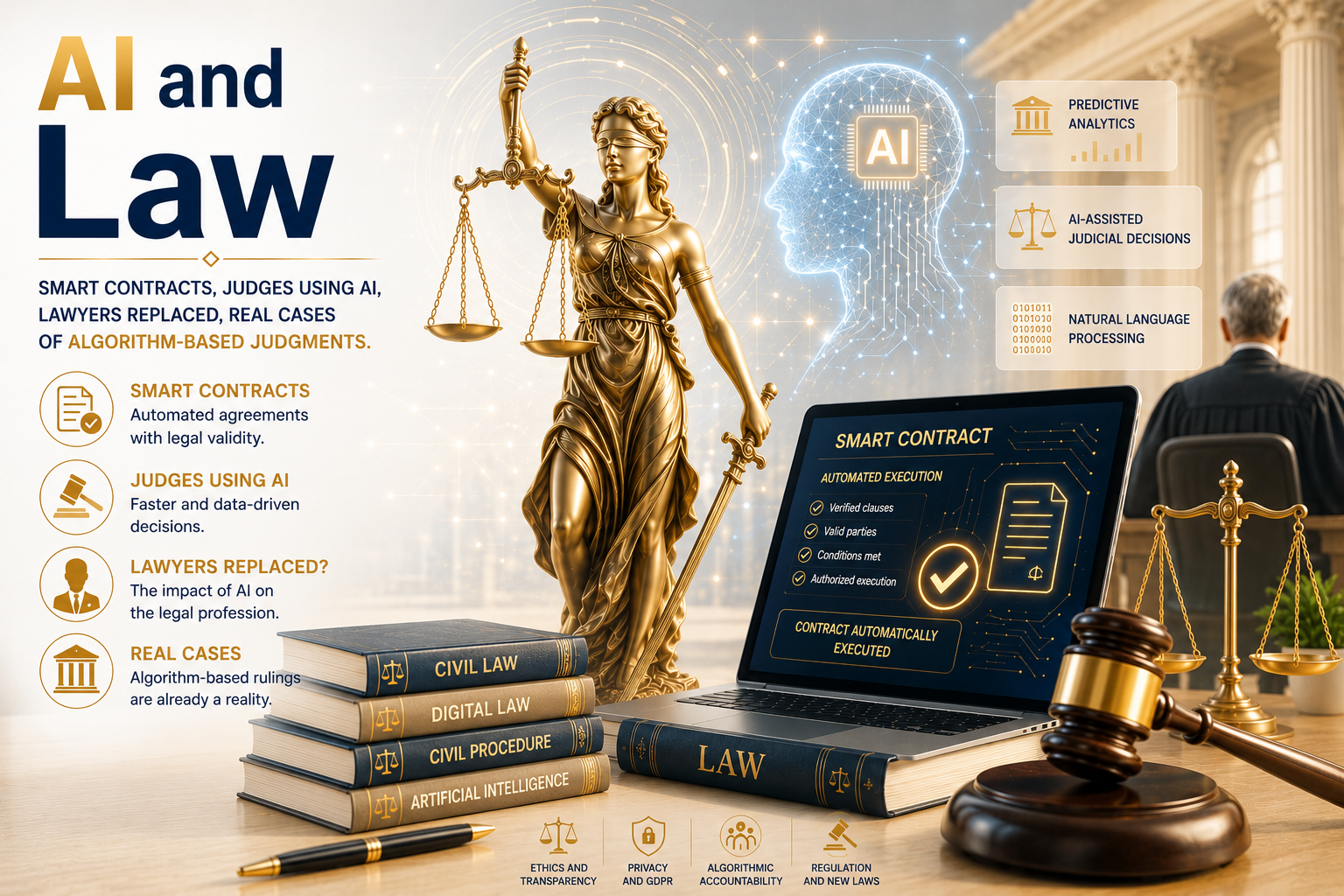
What Is AI Applied to Law?
Legal AI isn't a single technology, but a set of tools performing specific tasks across the legal universe. It can analyze millions of documents in minutes, locate relevant case law across decades of decisions, review contracts identifying problematic clauses, summarize lengthy filings into easy-to-read pages, organize evidence systematically, and automate repetitive tasks that once consumed hours of manual work.
The most obvious gain is a drastic reduction in time and operational cost — a case law search that would take a paralegal a full day can be done by AI in seconds. But it's essential to understand from the outset a principle that will run through this entire article: reducing time doesn't mean eliminating human oversight. Legal AI functions as an extremely fast, methodical assistant, not a substitute for the professional judgment that guides strategic, ethical, and interpretive decisions.
How Law Firms Are Using AI in Practice
Far from being a futuristic promise, AI is already integrated into the daily routines of law firms of every size — from solo practices to large corporate firms. The most established applications include:
Legal Research
Fast searching across statutes, case law, and legal scholarship is where AI shows the most immediate and measurable gain. Semantic search systems can find relevant decisions even when the terminology used differs from the search terms — something traditional keyword search simply cannot do.
Contract Review
AI tools specialized in contracts can automatically identify:
- Inconsistent clauses: passages that contradict each other within the same document
- Legal risks: provisions exposing one party to disproportionate liability
- Missing obligations: essential points typically found in similar contracts but omitted here
- Repeating patterns: comparison against hundreds of prior contracts to identify deviations from company standards
Legal Drafting
AI assists in drafting contracts, motions, legal opinions, cease-and-desist letters, and administrative responses — always as a starting point to be reviewed, never as a final product to be filed without human review.
Document Organization
In due diligence and complex litigation involving thousands of documents, automatic AI classification identifies and categorizes relevant files in a fraction of the time a team of lawyers would take working manually.
A merger and acquisition contract can have hundreds of pages of exhibits and related documents. Where a junior team would take days reviewing manually item by item, AI tools do a first pass in hours — flagging points that deserve priority human attention. The work doesn't disappear; it concentrates where it actually matters.
Smart Contracts: Myth and Reality
Few topics generate as much confusion as smart contracts. A smart contract is, by technical definition, computer code that automatically executes pre-programmed actions when specific conditions are met — without manual intervention from either party.
Real Applications
- Insurance: automatic payout when a verifiable event occurs (a confirmed flight delay via public data, for example)
- Logistics: releasing payment to suppliers when sensors confirm delivery of goods to a specific location
- Real estate: automated property transfer upon confirmation of full payment, reducing title-transfer steps
- E-commerce: releasing digital products immediately after payment confirmation, without customer service intervention
- Automatic payments: execution of recurring installments tied to specific contractual conditions
Smart contracts are usually associated with blockchain technology — which ensures the code can't be altered after deployment — but that doesn't make them complete substitutes for traditional contracts. They depend on legal rules for full legal validity, and issues like defects in consent, unfair terms, and interpreting party intent still require human legal analysis. Code that automatically executes an illegal clause doesn't make that clause valid — it just automates its execution, which can even worsen the legal problem.
AI in the Courts: Where Automation Has Already Arrived
Institutional use of AI by courts has grown steadily, consistently concentrated on administrative and organizational support functions — not on replacing the judge's decision-making role. Real applications include:
- Case triage: automatic classification of new filings by subject matter, urgency, and complexity
- Case classification: identifying filings with identical or very similar issues for joint handling
- Case distribution: more efficient allocation of workload among judges and court divisions
- Precedent identification: automatically locating relevant prior decisions for the case under review
- Statistical analysis: generating reports on average case duration, appeal rates, and decision patterns by division
- Case management support: alerts on deadlines, pending motions, and administrative bottlenecks
In virtually all Western legal systems, the decision remains, as a rule, the exclusive responsibility of the judge. AI tools speed up administrative processes and provide organized information — but interpreting the law, weighing evidence, and rendering the final decision remain a human act, carrying the judge's personal signature and responsibility.
Real Cases of AI in Justice Around the World
This is, without question, the section that sparks the most curiosity — because it moves from theory to what's actually happening, with all its achievements and controversies.
Brazil: Large-Scale Administrative Support
Several Brazilian courts already use AI systems to automatically classify cases, identify recurring issues among millions of lawsuits, locate relevant case law for analogous cases, and speed up administrative routines that once consumed weeks of manual work. Brazil's judiciary has invested significantly in these tools precisely to handle the massive volume of cases proceeding simultaneously in the country — one of the highest per-capita litigation rates in the world.
It's important to stress: these tools support human work without replacing judicial decision-making. They identify patterns and organize information; legal interpretation of the specific case remains a judge's prerogative.
United States: the Algorithmic Bias Debate
In the United States, some risk-assessment systems have been used to aid decisions related to pretrial release and sentencing — calculating a "recidivism risk" score based on the defendant's historical data. These systems sparked intense public and academic debate for two central reasons: potential discriminatory bias (since historical data can reflect pre-existing structural inequalities in the justice system) and lack of transparency about the exact criteria used in the calculation, making it harder for defense attorneys to challenge.
China: Digital Courts at National Scale
China has invested heavily in digital courts and intelligent judicial support systems, achieving high automation in certain types of proceedings — especially lower-complexity, high-volume disputes like e-commerce litigation. The Chinese model is often cited as an example of scale, but it also raises questions about procedural transparency and due-process guarantees in a legal context distinct from Western systems.
Estonia: Controlled Experimentation
Estonia, known for its advanced digital infrastructure in public services, developed projects to study AI use in lower-complexity disputes — always with human oversight and well-defined limits on the scope of automated action. The Estonian case illustrates a more cautious approach: testing limited applications before any expansion, with continuous evaluation of results.
| Country | Main use | Controversy level |
|---|---|---|
| Brazil | Large-scale administrative and organizational support | Low — focus on efficiency, no automated decisions |
| United States | Risk assessment for pretrial release and sentencing | High — debate over bias and transparency |
| China | Digital courts with high procedural automation | Moderate to high — due-process questions |
| Estonia | Controlled experimentation in simple disputes | Low — limited, supervised scope |

A Day in the Life of a Lawyer With AI
To make this concrete, follow the routine of Michael, a corporate lawyer at a mid-sized firm who has woven legal AI into his daily work:
8 AM — Inbox triage. AI has already classified the previous night's 40 emails by urgency and subject, summarizing the three most critical ones in two lines each. Michael prioritizes in five minutes what would take half an hour to review manually.
9:30 AM — Contract review. A 45-page service agreement arrives for analysis. AI has already flagged two disproportionate penalty clauses and a missing provision on early termination. Michael focuses his analysis exactly on those three points, instead of rereading the entire document from scratch.
11 AM — Case law research. To support an opinion on a non-compete clause, he asks the AI for a survey of recent decisions on the topic. In seconds, he receives eight relevant precedents with a summary of each — work that used to require an entire afternoon of manual database research.
3 PM — The tool's limit. A client calls, worried about a delicate ownership dispute between business partners who are also brothers-in-law. No AI will advise on how to navigate that tense family conversation, pick up on the client's shaken tone of voice, or decide the negotiation strategy considering the personal history between the parties. This is work that only exists because AI freed up time from the mechanical part — and that no current technology can replace.
Will AI Replace Lawyers?
It's one of the most-searched questions on the topic, and the honest answer follows the same pattern seen in other professions: task automation, not elimination of the profession.
| What AI does very well | What still requires a human lawyer |
|---|---|
| Case law and statutory research | Legal strategy: defining the best approach for a case considering multiple non-legal variables |
| Contract review and risk identification | Negotiation: reading the other side of the table, conceding at the right moment, bluffing when necessary |
| Summarizing lengthy filings | Oral advocacy: persuading a court with presence, tone of voice, and reading reactions in real time |
| Document organization and classification | Constitutional interpretation: weighing competing principles in hard cases with no obvious answer |
| Automating repetitive tasks | Mediation: building bridges between parties emotionally invested in a conflict |
| Generating drafts and templates | Empathy and trust: the human relationship that makes a client entrust important decisions to a professional |
The conclusion supported by available evidence is clear: AI tends to transform legal practice, not eliminate it. Lawyers who master these tools can handle more cases with more depth, delegating the mechanical part and investing human time exactly where it generates real value — in strategy, negotiation, and the relationship of trust with the client.
The Risks: What Can Go Wrong
No honest article about legal AI can limit itself to the benefits. The risks are real, documented, and in some cases have already produced concrete legal consequences for those who ignored them.
Algorithmic Bias
AI systems learn from historical data — and if that data carries structural biases (racial, socioeconomic, gender-based), the algorithm can reproduce and even amplify those distortions, even without explicit intent to discriminate. The American recidivism-risk assessment case, mentioned earlier, is the most globally cited example of this specific risk.
Lack of Transparency
Many AI systems function as "black boxes": they produce a recommendation or score without it being easy to understand exactly which criteria were used and how they were weighted. This is particularly problematic in a legal context, where the right to challenge a decision requires understanding its reasoning.
Hallucinations: the Most Publicly Documented Risk
Generative AI models can invent case law that doesn't exist, cite repealed or never-enacted statutes, and create completely fake court decisions — presenting all of it with the same confidence as accurate information. Cases of lawyers who filed briefs citing AI-invented case law have already resulted in disciplinary sanctions in multiple countries, becoming one of the most-cited examples of the risks of careless use of this technology in legal practice.
Every citation to case law, statute, or legal scholarship generated by AI must be checked against the original source before being used in any filed document. This isn't a best-practice suggestion — it's a basic ethical and professional requirement, given the already-documented history of legal hallucinations generated by these systems.
Privacy and Confidentiality
Court cases frequently contain extremely sensitive data: personal documents, evidence involving third parties, medical information, and companies' trade and strategic secrets. Using AI tools that process this data on external servers raises serious questions about professional confidentiality and data protection — especially when the client is a company competing with others that also use the same tool.
Ethics: Who's Responsible When AI Gets It Wrong?
This is one of the most fundamental questions, and still lacks a fully settled legal answer across every possible scenario:
- Who's responsible for AI error? — generally, the professional or institution that used the tool remains responsible for the final outcome, since AI is legally treated as an instrument, not a subject of rights and obligations
- Who's responsible for damage caused? — depends on context: there can be joint liability between the tool's developer, the institution that implemented it, and the professional who used it without proper verification
- Who's responsible for algorithmic discrimination? — courts worldwide have been deciding case by case, generally holding responsible the institution that implemented the system without adequate bias auditing
- Who's responsible for an incorrect automated decision? — the dominant principle is that human oversight is mandatory precisely so there's an identifiable party responsible for the final decision
Accountability and human oversight remain central principles in virtually every legal system that has regulated or is regulating AI use. Technology can automate tasks, but legal responsibility for decisions affecting third-party rights remains attributed to identifiable people or institutions — never to the algorithm itself.
Regulation: What Already Exists and What's Being Built
Brazil
- Brazilian Internet Civil Rights Framework (Marco Civil): though preceding the specific AI debate, it establishes neutrality and accountability principles that influence the automation discussion
- General Data Protection Law (LGPD): imposes strict rules on processing personal data handled by AI systems, including data present in court records
- AI legislation in progress: Brazil's Congress is discussing specific regulatory frameworks for AI, including provisions specifically targeting use in the justice system
- Judiciary rules: higher courts have been publishing internal resolutions and guidelines on responsible AI use in case management, generally requiring transparency and human oversight as mandatory conditions
Europe and the US
- The EU AI Act: the world's first comprehensive AI legislation classifies systems used in the administration of justice as high-risk, requiring audits, detailed documentation, and mandatory human oversight
- Protection of fundamental rights: European regulation treats the right to a fair trial and due process as explicit limits on automating judicial decisions
- Transparency: high-risk systems must be auditable, with clear documentation of criteria and functioning
- Risk classification: the same risk framework used for other AI applications (covered in earlier articles on this site about privacy and education) applies to the legal context, with the justice system among the most sensitive uses
- United States: regulation is more fragmented, with individual states and specific agencies addressing algorithmic bias in criminal justice through separate initiatives, without a single comprehensive federal framework comparable to the EU's
AI as a Support Tool vs. AI as a Decision-Maker
This distinction is the key to precisely understanding where we stand today — and why so much confusion exists in public discussions on the topic.
| Dimension | AI as support tool | AI as decision-maker |
|---|---|---|
| Current adoption | Widely spread and established | Virtually nonexistent in final judicial decisions |
| Examples | Case law research, case triage, contract review | Automated sentencing without human review |
| Legal status | Accepted and encouraged in most legal systems | Highly controversial, limited by due-process principles |
| Accountability | Clear — falls on the professional using the tool | Ambiguous and subject to intense legal debate |
What exists today, in an established and widely accepted form, is AI as support for research, organization, and analysis. Fully automated judicial decisions — without any human intervention at the final stage — remain highly controversial and, in most Western legal contexts, are limited or prohibited by constitutional principles like due process, the right to reasoned decisions, and the right to adversarial proceedings.
10 Legal Tasks AI Already Does Today
To make all this concrete and immediately applicable, here's a list of applications already mature and widely available:
- Reviewing contracts — identifying problematic clauses in minutes
- Summarizing lengthy filings — condensing hundreds of pages into precise executive summaries
- Locating case law — semantic search that understands context, not just keywords
- Comparing clauses — against databases of thousands of prior contracts
- Organizing documents — automatic classification by topic, relevance, and urgency
- Drafting motions — first drafts of filings and opinions for human review
- Researching legislation — including recent amendments and provisions' effective dates
- Identifying inconsistencies — internal contradictions in lengthy documents
- Translating legal documents — with attention to field-specific technical terminology
- Assisting with due diligence — initial triage of thousands of documents in mergers and acquisitions
What AI Still Cannot Do
As important as celebrating what AI already does well is being honest about its current limitations — which continue to depend heavily on human judgment:
- Negotiating complex settlements — which require reading body language, emotional timing, and knowledge of relationships between parties
- Assessing witness credibility — judgment involving nuances of human behavior impossible to quantify algorithmically
- Interpreting cultural and social nuance — context that changes the legal meaning of the same factual situation across different communities
- Weighing constitutional principles in hard cases — where there's no obvious answer and the decision requires genuine ethical judgment
- Exercising empathy and building client trust — the foundation of the professional relationship no interface can replicate
The Future of Courts
Projecting trends already in motion, the justice system of coming years should include developments already in early-stage implementation across several countries:
- Fully digital proceedings: complete elimination of paper throughout case processing, already reality in much of Brazil's judiciary
- Hybrid hearings: combining physical and remote presence as the default, not the exception
- Real-time automatic translation: eliminating language barriers in proceedings involving foreign parties
- Instant legal research: AI natively integrated into court case-management systems, available to judges and staff
- AI summarizing lengthy filings: automatic summaries generated at case assignment, saving initial reading time
- Intelligent judicial assistants: tools dedicated to helping judges organize reasoning and research precedents
- Predictive litigation analysis: estimates on likely case duration and probability of success, used to guide strategic decisions by parties and attorneys
The Future of Legal Practice: New Skills Needed
Just as happened in other professions analyzed on this site, legal practice in the near future will demand skills that today remain niche but should become essential:
- Legal prompt engineering: knowing how to formulate precise requests to AI tools to get useful, reliable results
- Legal data analysis: interpreting statistical reports generated by AI systems on decision trends and litigation risk
- AI auditing: assessing whether systems used by courts or companies show bias or transparency failures
- Data protection: growing specialization in privacy law applied specifically to the legal context
- Digital law: an area moving from niche to cross-cutting across nearly all legal practice
- AI governance: advising companies and public institutions on responsible AI implementation
- Technology compliance: ensuring the firm's or company's own AI tool use meets regulatory requirements
Speculation: the Dream (or Nightmare) of the "Algorithm-Judge" — Where Science Ends and Fiction Begins
Every debate about the future of AI in Law eventually bumps into visions that sound like science fiction. It's worth rigorously separating what's real research in progress, what's plausible speculation, and what will probably remain impossible — or, in Law's case, undesirable even if technically feasible.
What's in Real Development
- Increasingly sophisticated decision-support systems: tools that don't decide, but present the judge with a complete picture of precedents, statistics from similar cases, and possible legal reasoning — mature and constantly expanding technology
- Automated algorithmic bias auditing: systems that analyze other AI systems for discriminatory patterns, a growing research field especially after the American risk-assessment cases
What's Plausible Speculation (Decades, Not Years)
- AI assistants with advanced counter-argument simulation: systems that test the strength of a legal argument by simulating multiple angles of challenge before it reaches court. Technically feasible as an extrapolation; still far from widespread adoption
- Truly self-executing, self-interpreting contracts: smart contracts capable of "understanding" context and party intent beyond simple binary conditions, reducing interpretation disputes
What's Pure Fiction (and Probably Will Remain)
A fully autonomous "algorithm-judge," issuing rulings without any human oversight in complex cases — hits an obstacle that isn't just technical, but legal and philosophical in nature. The judicial function in democratic systems isn't just processing information and applying rules — it involves political legitimacy, public accountability, and the capacity to weigh competing values in ways that reflect a community's evolving social and moral fabric. An algorithm can process volumes of data impossible for humans, but it has no legal status to be held accountable, cannot answer to society the way an appointed or elected judge does, and embodies no democratic legitimacy whatsoever.
Resistance to fully replacing the judicial function with AI isn't merely a temporary technical limitation to be overcome with "more data" or "better models" — it's a structural feature of how democratic societies organize legitimacy for their most impactful decisions. Human oversight in the judiciary isn't an obstacle to efficiency to be removed by technology — it's the mechanism that ensures decisions about liberty, property, and fundamental rights have identifiable accountability and democratic answerability. AI can (and should) make the system faster, more organized, and more accessible; it should not — and in most legal systems legally cannot — replace the final responsibility of a human being invested with legitimate judicial authority.
* Amazon affiliate links. Buying through them supports TechTurbo at no extra cost to you.
Frequently Asked Questions About AI and Law
Not entirely. AI automates tasks like research, contract review, and document organization, freeing up lawyer time for activities requiring human judgment: legal strategy, negotiation, oral advocacy, and building client trust. The trend is transformation of the profession, not elimination — lawyers who master these tools gain a competitive edge over those who ignore them.
Judges can (and increasingly do) use AI as a support tool — to research precedents, organize information, and generate statistics. What remains controversial and, in most legal systems, isn't permitted is a fully automated judicial decision without human oversight, since principles like due process and the right to reasoned decisions require identifiable human accountability for the final ruling.
They're computer code that automatically executes pre-programmed actions when specific conditions are met — like releasing payment when a delivery is confirmed. They're usually associated with blockchain, but don't completely replace traditional contracts: they depend on legal rules for full legal validity, and issues of interpretation and defects in consent still require human analysis.
Yes, and it's an increasingly common use — but always as an initial draft to be reviewed, never as a final product to be filed without verification. Generative AI models have already been at the center of documented "legal hallucination" cases, citing nonexistent case law, which has already resulted in disciplinary sanctions for lawyers who didn't check the content before filing.
Yes, and its use has been encouraged by courts and bar associations in several countries as a way to gain efficiency. What isn't permitted in most jurisdictions is using AI without proper professional verification of the generated content, especially in documents filed with courts — responsibility for the content remains with the professional who signs the filing.
The fundamental rule is checking every citation to case law, statute, or scholarship generated by AI directly against the original source before using it in any document. Treat AI-generated content like the draft of a talented but inexperienced paralegal: useful as a starting point, but requiring careful review before any professional use.
It depends on the context, but the general principle is that AI is legally treated as an instrument, not a liable party. The professional or institution that used the tool remains responsible for the final outcome, and there may be joint liability with the technology developer in cases of documented technical failure or lack of proper oversight.
Conclusion: Powerful Tool, Responsibility Remains Human
Artificial intelligence has already profoundly transformed the daily routine of courts and law firms around the world — speeding up research, automating contract review, and organizing volumes of information that would be impractical to process manually. But this guide's throughline deserves repeating: in virtually every legal system that has regulated the topic, final decisions about rights, liberty, and property still require identifiable human accountability.
If you work in the legal field, start small: identify one repetitive task in your daily routine — research, document triage, first-pass contract review — and test a specialized AI tool. Treat every generated result as a suggestion from a fast assistant that still requires your final professional verification. The right technology, used with judgment, can be the difference between a legal practice bogged down in mechanical tasks and one that dedicates human time exactly where it matters most: strategy, negotiation, and trust.
Analysis like this, before everyone else
Technology, AI, law and the future of professions — no spam, straight to the point, every week.